Democratic Labor Union Cargo Solidarity General Strike Enters Week 1
Liquor Industry Shipping Disruptions Persist "Struggling for Normalization"
Companies Closely Monitoring Situation... Self-Employed Suffer Losses Too
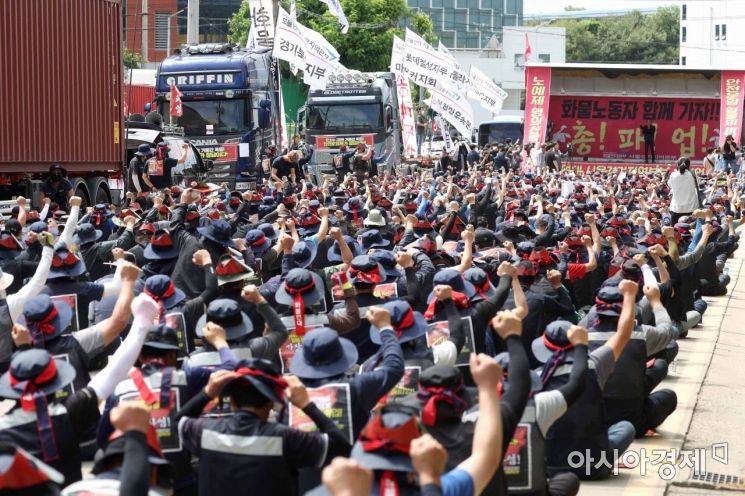 On the 7th, a kickoff rally for the general strike was held near the Inland Container Depot (ICD) in Uiwang-si, Gyeonggi Province, as the Cargo Solidarity Union launched a full strike demanding the abolition of the safety freight sunset system and an increase in transportation fees due to high oil prices. Photo by Moon Honam munonam@
[Asia Economy Reporter Song Seung-yoon] The ripple effects of the strike by cargo truck owners affiliated with the Korean Confederation of Trade Unions (KCTU) Cargo Solidarity continue to impact the food and beverage industry.
The liquor industry, where the strike first began, is still facing difficulties in product transportation. As of the 13th, HiteJinro's product shipment rate had dropped to 38% of normal levels before slightly recovering but still remains below 50%. The company plans to maximize shipment rates by contracting with other logistics providers, but the situation is not improving easily. Earlier, about 130 cargo truck owners belonging to Suyang Logistics, a subcontracted carrier for HiteJinro, joined the KCTU Cargo Solidarity at the end of March and went on strike. Since then, there have been disruptions in the shipment of soju products from the Icheon and Cheongju plants, which handle 70% of HiteJinro's total soju production.
OB Beer has also faced shipment halts of beer produced at its three plants in Icheon, Cheongju, and Gwangju since the 7th due to the union's general strike. Currently, OB Beer's beer shipment volume has fallen to about 20% of usual levels. The company plans to mobilize substitute vehicles to recover shipments to about half the normal level, but it is expected to take some time to return to normal. An OB Beer official stated, "We plan to use all available means today to raise the shipment rate to about 50% of normal."
Jeju Samdasoo also experienced a temporary blockade of Samdasoo water shipments from Jeju Port to the mainland. Although the blockade has been lifted and transportation from Jeju Port to inland areas is now proceeding normally, the strike by the Cargo Solidarity in the Mokpo region has significantly reduced the volume of Samdasoo water heading to the Seoul metropolitan area. As of this day, the supply volume of Samdasoo is about 40% of usual levels. Jeju Development Corporation has been actively seeking alternative transportation methods since the incident began.
Other bottled water manufacturers such as Nongshim, Lotte Chilsung Beverage, and Dongwon F&B currently state that there are no disruptions in product supply, but they are closely monitoring the situation in case the strike prolongs. Previously, Samyang Foods proactively prepared for the strike by shipping contracted volumes in advance.
If this situation continues long-term, convenience stores, large supermarkets, wholesalers, and regular restaurants are also expected to face difficulties securing supplies. Just last weekend, many restaurants and bars in busy districts frequently ran out of stock due to insufficient liquor supplies. Some even switched beverage types or resorted to early stockpiling.
The Cargo Solidarity's general strike has now entered its seventh day. The government has been holding practical negotiations with the Cargo Solidarity throughout the weekend to find a compromise, but no significant progress has been made yet. During the weekend, various logistical disruptions and minor clashes occurred across the country. The Cargo Solidarity is demanding the abolition of the sunset clause on the "Safe Freight Rate System," expansion to all vehicle types and product categories, and measures to address fuel costs. There are concerns that if the strike continues for another two weeks, industries such as construction and steel could suffer greater damage due to shipment disruptions.
© The Asia Business Daily(www.asiae.co.kr). All rights reserved.

















