Gasoline Price Nears 3,000 KRW per Liter at Yongsan Gas Station in Seoul
Ukraine War, US-Saudi Negotiations, and Other Areas Where Korea's Diplomatic Skills Are Challenged
Efforts Including 100% Expansion of Fuel Tax Reduction and Legislative Proposals Submitted to the National Assembly
International Oil Price Increase Expected to Continue for the Time Being
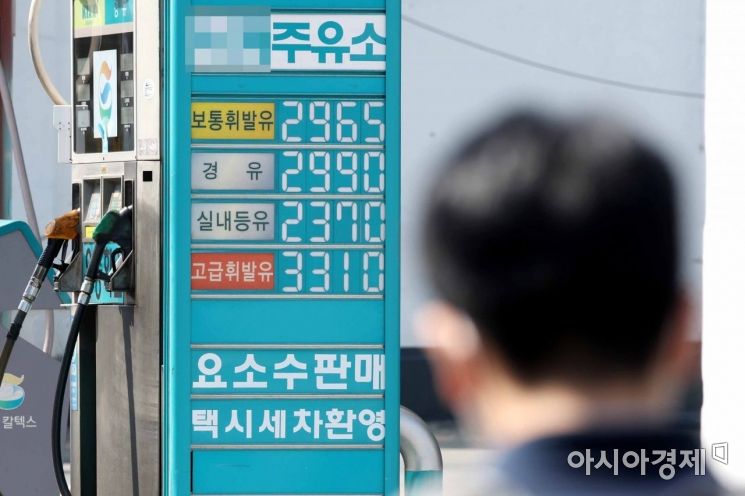 On the 12th, at a gas station in downtown Seoul where oil prices are continuously rising, gasoline is being sold at 2,965 won per liter and diesel at 2,990 won per liter. Photo by Mun Ho-nam munonam@
[Asia Economy Reporter Moon Chaeseok] As gasoline prices at domestic gas stations hit record highs, consumers are facing increased inflationary pressure. Prices of other goods such as food and beverages are also rising, making it difficult to implement policies that only cut fuel prices. Moreover, global factors such as the prolonged Russia-Ukraine war have caused oil prices to soar and inflation to continue, raising concerns that fuel prices may rise further in the near future.
According to the Korea National Oil Corporation's oil price information site Opinet, as of 9 a.m. on the 13th, the nationwide average retail price of gasoline was 2,071.41 KRW per liter, up 2.81 KRW from the previous day. On the 11th at noon, the price was 2,063.45 KRW, breaking the 10-year and 2-month record set on April 18, 2012, at 2,062.55 KRW, and it surged about 8 KRW in two days. After surpassing the 2,000 KRW mark for the first time in about 9 years and 5 months on March 15, prices fluctuated briefly but broke through 2,000 KRW again on the 26th of last month and have been skyrocketing since. Diesel prices are also on a sharp rise. At the same time, the average diesel retail price increased by 3.55 KRW to 2,071.54 KRW per liter compared to the previous day. On the 12th of last month, diesel broke the 13-year and 10-month record set on July 16, 2008, at 1,947.75 KRW, reaching 1,953.29 KRW, and has been hitting new highs daily. Both gasoline and diesel prices at the GS Caltex Seogye gas station in Yongsan-gu, Seoul, recorded the highest prices at 2,965 KRW and 2,990 KRW per liter, respectively. The era of "3,000 KRW per liter fuel prices" is approaching rapidly.
The price increase is so exorbitant that domestic policies alone seem insufficient, fueling pessimism. Even the most reliable policy tool, the fuel tax cut, is not having the desired effect. The government has been cautious in adjusting the fuel tax cut rate to avoid disrupting the tax system, but the impact remains limited. Last November, the fuel tax cut was expanded from 15% to 20%, and from the 1st of last month, it was further increased from 20% to 30%, lowering gasoline prices by 247 KRW per liter and diesel by 174 KRW per liter. However, over six months, nationwide gasoline and diesel prices have risen by 383 KRW and 586 KRW per liter, respectively, with the price increases exceeding the tax cut effects by 55% and 237%.
The problem is that there are few effective policy measures to drastically reduce oil prices. Proposals to adjust the fuel tax's flexible rate to expand the cut to 37% have been discussed, but their effects are expected to be limited. This would reduce gasoline prices by only 57 KRW per liter, insufficient to offset the price surge. For this reason, a bill has even been proposed in the National Assembly to raise the upper limit of the fuel tax cut from 30% to 100%.
There is also the option of fuel price rebates, but securing additional funding is challenging, and it could further fuel inflation, making implementation difficult. Since this system refunds transportation fuel costs paid by citizens in cash after a sharp rise in oil prices, it requires funding through taxes. Diplomatic scenarios such as resolving the Russia-Ukraine war or additional negotiations between the U.S. and Saudi Arabia are increasingly unrealistic. Market factors such as the European Union's sanctions on Russian crude oil imports, declining U.S. crude oil inventories, and increased demand during the summer vacation season also contribute to pushing oil prices higher. Although OPEC+ (Organization of the Petroleum Exporting Countries Plus) plans to increase production by about 50% from next month through August, it is currently failing to meet existing production targets. For these reasons, there are forecasts that international oil prices, currently in the 120-dollar-per-barrel range, could exceed 150 dollars.
International investment banks (IBs) are raising their forecasts for global oil prices, and with the global economic recovery not gaining momentum, refiners judge that it is difficult to guarantee increased demand for petroleum products from consumers. This could lead to a vicious cycle where refineries reduce operating rates (decreasing supply), causing petroleum product prices to rise further. A representative from the Korea Petroleum Association stated, "Due to supply shortages relative to demand, high oil prices are expected to continue for the time being."
© The Asia Business Daily(www.asiae.co.kr). All rights reserved.

















