FKI Announces Results of 'Minimum Wage and Labor Conditions Survey'
Although social distancing measures have been fully lifted, the hardships faced by self-employed individuals remain an ongoing issue. One out of every two self-employed people cited the ‘minimum wage’ as their biggest management difficulty. Over the past five years, the minimum wage has increased by a staggering 44.6%. There are calls for a reasonable level of minimum wage determination to ease the burden on self-employed individuals who are facing the triple risks of high inflation, high exchange rates, and high interest rates.
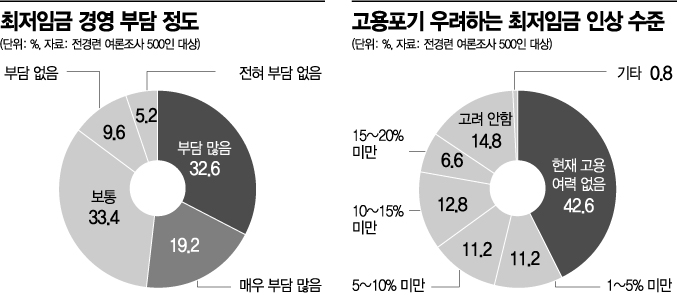
According to a ‘Minimum Wage and Labor Conditions Survey’ conducted on the 13th by the Federation of Korean Industries through the polling agency Monoresearch targeting self-employed individuals nationwide, more than half (51.8%) of self-employed respondents said that the current minimum wage (9,160 KRW per hour) places a significant burden on their business operations. Only 14.8% of self-employed respondents said they do not feel burdened by the minimum wage.
In particular, half (53.2%) of self-employed individuals predicted that this year’s business performance would be difficult to recover to the level of 2019, before the COVID-19 pandemic. Although dining-out demand and leisure and cultural activities are increasing amid the endemic phase of COVID-19, the burden of rapidly rising prices and the minimum wage is considered too great.
In fact, over the past five years (2016?2021), South Korea’s minimum wage increase rate was 44.6%, four times the G5 average of 11.1%. The UK (23.8%), Japan (13.0%), Germany (12.9%), France (6.0%), and the United States (0.0%) followed.
When asked how much of a minimum wage increase would lead them to give up hiring employees or consider laying off existing staff, 42.6% of self-employed respondents said they currently have no capacity to hire. Following that, 11.2% said they would consider giving up hiring or layoffs if the increase was between 1% and less than 5%, and another 11.2% said the same for an increase between 5% and less than 10%.
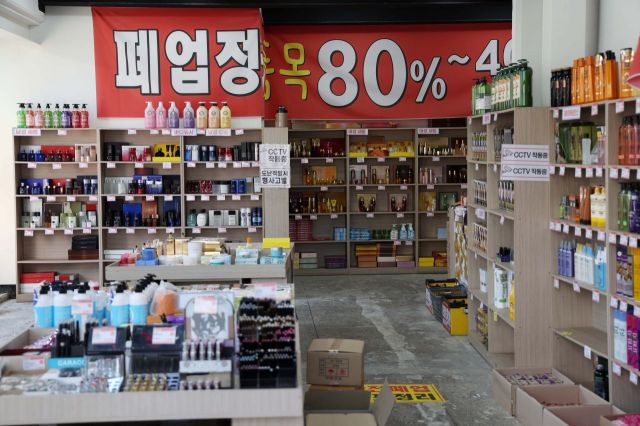 On the 8th, as the spread of COVID-19 continues, a store near Dongdaemun Design Plaza in Seoul is holding a clearance sale due to closure. Photo by Mun Ho-nam munonam@
When asked how much of a minimum wage increase would make them consider closing their business, 24.0% responded that they are already at a breaking point. By industry, the arts, sports, and leisure services sector (40.0%) was found to be in the most critical situation. The accommodation and food service industry (28.4%) ranked next highest.
Regarding the appropriate minimum wage level for next year, 42.8% favored freezing the wage. Those who said it should be lowered accounted for 13.4%. The labor sector is reportedly advocating for a minimum wage of 11,860 KRW next year, while the business sector is pushing for a freeze or a minimum increase of less than 3%.
Regarding the current minimum wage system, the most urgent improvement task was ‘differentiated application by industry and region,’ which accounted for 24.8%. This was followed by ‘restraining rapid minimum wage increases’ at 23.2%, and ‘supplementing the criteria for minimum wage determination’ at 19.8%.
Choo Kwang-ho, head of the economic division at the Federation of Korean Industries, pointed out, “The minimum wage increase rate over the past five years has been so rapid that it is six times the inflation rate. In a situation where inflation continues, excessive minimum wage increases will further worsen inflation and push small self-employed businesses to the brink, so the minimum wage must be determined at a reasonable level.”
© The Asia Business Daily(www.asiae.co.kr). All rights reserved.


















