Unconstitutional Risk in Obsolete Provision
Differences Remain on Safety Freight Rate System
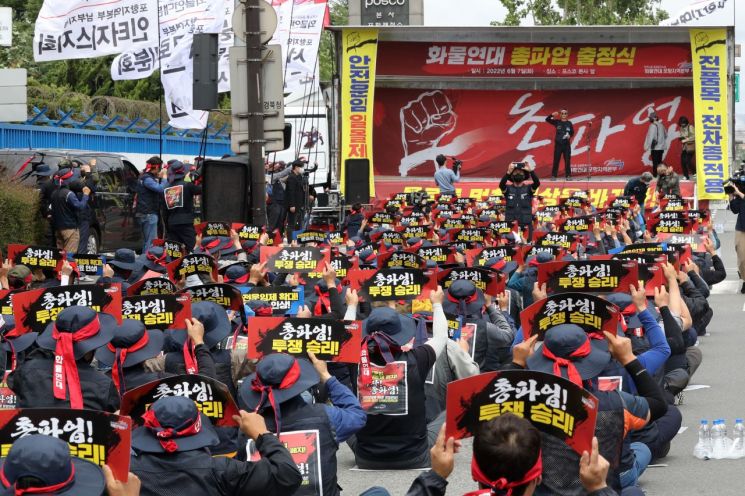
[Asia Economy Reporter Kim Min-young] The government’s position is that the ‘work commencement order’ demanded by the business community is practically a difficult card to execute. The work commencement order is a provision that has been obsolete for nearly 20 years and carries a risk of being unconstitutional, so if this card is used recklessly, it could deepen the conflict between the government and the Cargo Solidarity. The government’s stance is to resolve the collective transport refusal situation through dialogue first, but concerns are growing that the strike could be prolonged as differences between the government and Cargo Solidarity over the safety freight rate system remain unresolved.
On the 13th, the Ministry of Land, Infrastructure and Transport (MOLIT) stated in a press release, "We discussed measures to normalize logistics with Cargo Solidarity from 2:00 PM to 10:30 PM on the 12th but failed to reach an agreement," adding, "Cargo Solidarity proposed alternatives regarding the abolition of the sunset clause of the safety freight rate system and expansion of items, but MOLIT found it difficult to accept after review, leading to a halt in dialogue."
According to MOLIT and Cargo Solidarity, both sides held the 3rd and 4th rounds of negotiations consecutively over two days on the 11th and 12th, but despite more than ten hours of talks, no agreement was reached. A Cargo Solidarity official claimed, "Negotiations broke down because the People Power Party suddenly revoked the tentative agreement just before the final settlement," and added, "Internally, there is considerable anger over MOLIT pretending to negotiate but bringing an uncoordinated proposal."
In response, MOLIT rebutted, "The claim by the Cargo Solidarity headquarters that ‘negotiations broke down because the People Power Party revoked the agreement’ is not true," and said, "There were some disagreements during consultations with related agencies on matters discussed with Cargo Solidarity, which ultimately led to the suspension of talks."
As both sides show a sharp difference in positions over the safety freight rate system, which sparked this strike, signs of a prolonged strike are emerging. Cargo Solidarity intends to continue the indefinite strike, while MOLIT has publicly stated it will continue dialogue with Cargo Solidarity, but the schedule for the 5th round of negotiations has not yet been set.
As the strike enters its seventh day, the business community is urging the government to consider issuing a work commencement order, citing increasing damage to the industrial sector the longer the Cargo Solidarity strike continues. The work commencement order can be issued by the government after deliberation by the State Council when transport workers collectively refuse freight transport without just cause, causing or potentially causing a serious crisis to the national economy.
However, MOLIT’s position is that the work commencement order is a provision requiring legal review, and they intend to resolve the current situation through dialogue first. A MOLIT official said, "The work commencement order is a coercive provision and is not a fundamental solution to this situation," adding, "Legal review is a prerequisite, and it has not yet been conducted."
A Cargo Solidarity official strongly criticized, "It is an obsolete provision that has never been enforced since 2003, a form of forced labor intervention by the government," and said, "Considering cargo workers as individual business owners, if they are running at a loss and cannot continue their business, the government forcibly ordering them to open is itself an unreasonable act."
© The Asia Business Daily(www.asiae.co.kr). All rights reserved.

















