GIST Research Team
[Asia Economy Reporter Kim Bong-su] Domestic researchers have proposed a new mechanism that promotes ‘cancer metastasis,’ which accounts for over 90% of cancer-related deaths, and successfully discovered a peptide anticancer agent to inhibit it.
The Gwangju Institute of Science and Technology (GIST) announced on the 13th that Professor Nam Jeong-seok’s research team from the Department of Life Sciences identified that the cancer metastasis protein ‘Discadherin’ promotes cancer malignancy and metastasis through a cell signal transduction mechanism.
This research achievement is expected to contribute to establishing new anticancer treatment strategies with fewer side effects. Cancer is a disease difficult to treat due to recurrence and metastasis, and most cancer deaths result from dysfunction of essential organs caused by metastasis rather than the ‘primary’ site (where the cancer first occurs). To overcome cancer metastasis, it is necessary to elucidate the specific mechanisms of metastasis and develop therapeutic strategies to control it.
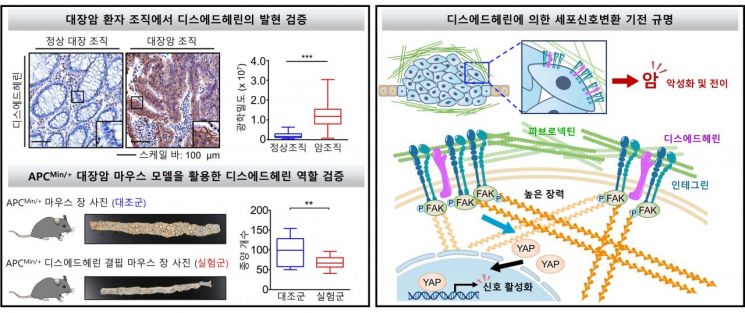
The research team verified through tissue analysis of colorectal cancer patients that the expression of Discadherin was specifically higher in cancer tissues than in normal tissues from the same patients. Based on this, colorectal cancer mouse experiments confirmed tumor formation and invasion suppression in Discadherin knockout mice (mice genetically engineered to lack the function of a specific gene).
They confirmed that Discadherin binds to fibronectin, a structural component of the extracellular matrix (ECM), increasing the physical forces applied to cancer cells. This activates proteins related to cell signal transduction mechanisms, inducing cancer malignancy and metastasis.
Furthermore, the team identified the amino acid sequence of the region where Discadherin binds to fibronectin and discovered a peptide that interferes with the Discadherin-fibronectin binding.
Professor Nam stated, “This study is significant in elucidating the mechanism by which Discadherin, specifically expressed in cancer cells, promotes cancer malignancy and metastasis, and in discovering a peptide that inhibits this process. We expect it to be a potential new treatment strategy with fewer side effects in the future.”
The research results were published online on the 21st of last month in ‘Theranostics,’ an international journal ranked in the top 6.07% in the medical field. The research team has also filed a patent for the new peptide and anticancer compositions containing it.
© The Asia Business Daily(www.asiae.co.kr). All rights reserved.
!["The Woman Who Threw Herself into the Water Clutching a Stolen Dior Bag"...A Grotesque Success Story That Shakes the Korean Psyche [Slate]](https://cwcontent.asiae.co.kr/asiaresize/183/2026021902243444107_1771435474.jpg)
















