Shutdowns, Shipment Reductions, Delivery Delays, Increased Logistics Costs
Government Negotiations Stalled... Concerns Over Widespread Labor Conflicts Including 'Hatu'
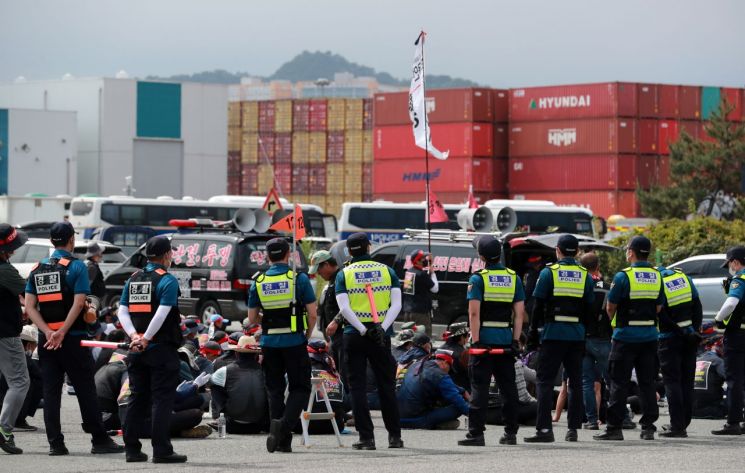 On the afternoon of the 8th, the second day of the Cargo Solidarity strike, Cargo Solidarity union members held a rally at the Busan New Port Samgeori in Gangseo-gu, Busan. (Image source=Yonhap News)
[Asia Economy Reporter Moon Chae-seok] The nationwide general strike by the Cargo Solidarity Headquarters of the Public Transport Workers' Union under the Korean Confederation of Trade Unions (Cargo Solidarity) has entered its sixth day, dealing a direct blow to the steel and petrochemical industries with decreased shipments. There are concerns that if the strike prolongs, the damage will spread across the manufacturing sector, including the shipbuilding industry, which is already struggling with rising raw material prices and other management risks.
According to the industry on the 12th, although negotiations with the government have entered their third day amid the sixth day of the Cargo Solidarity general strike, no clear signs of a strike suspension have yet been detected. The declaration of transport stoppage has caused primary damages such as shipment reductions, as well as increased risks of shutdowns and safety accidents.
In the steel industry, including POSCO, about 20,000 tons of land-transported cargo could not be shipped due to a rally held the previous day in Pohang. Approximately 500 union members from the Cargo Solidarity Pohang Headquarters held rallies at more than ten locations including POSCO Gate 3 and in front of transport companies in Pohang and Gyeongju. Comprehensive strikes have occurred at various manufacturing sites such as Hankook Tire and Hanon Systems in Daejeon, Hyundai Motor plants in Asan, Chungcheongnam-do, Hanil Cement, Sungshin Cement, Hanil Hyundai Cement in Danyang, Chungcheongbuk-do, Hanil Cement in Yeongwol, Gangwon-do, Ssangyong C&E in Donghae, and Halla Cement in Gangneung.
At the Pohang Steelworks, product shipments have been disrupted, leading to a shortage of warehouse space, and the company is taking necessary measures such as emergency transport. There are concerns about serious management disruptions, including the potential loss of transactions with client companies beyond immediate inconveniences. The situation is similar in the automotive industry, including Hankook Tire.
The situation is similar in the Ulsan industrial complex, where about 1,400 people reportedly participated in the strike as of the previous day. Major manufacturing production sites in petrochemicals and automobiles are facing difficulties in material and parts supply due to the strike.
In the Ulsan petrochemical complex, Cargo Solidarity union members have blocked key routes, preventing products from being shipped and causing them to pile up in front of factories. Companies are worried about halting deliveries to clients. Other industries such as shipbuilding and construction are closely monitoring the situation, warning that if the strike prolongs and inventories run out, secondary and tertiary damages such as parts supply disruptions may occur. Hyundai Motor is reported to have about 1,000 people blocking delivery vehicles' entry, which is causing production disruptions. If parts and inventory run out, other industries like shipbuilding and non-ferrous metals are also expected to suffer real damages such as reduced factory operating rates.
There are also concerns that the strike could escalate into a full-scale confrontation between labor and industry. The risks of factory shutdowns and safety accidents due to the strike, contract cancellations due to delivery delays, and increased logistics costs are considered 'short-term risks,' but in the worst case, they could lead to 'political struggles' such as demands for wage and collective bargaining agreements (Wage and Collective Bargaining) or institutional reforms.
In fact, Cargo Solidarity is demanding the government abolish the sunset clause of the 'Safe Freight Rate System' and expand it to all vehicle types and items, as well as prepare measures for fuel prices. The Safe Freight Rate System was introduced to guarantee appropriate wages for cargo drivers to prevent overwork, overloading, and speeding, and it is a system implemented for only three years from 2020 to this year. Cargo Solidarity demands that the system not be abolished at the end of the year but continue. They are requesting not only the abolition of the sunset clause but also the expansion of the Safe Freight Rate System to all vehicle types and all items beyond containers and cement.
There are signs that labor unions may engage in high-intensity summer struggles with companies, citing inflation and the COVID-19 endemic as justifications. Since the Cargo Solidarity general strike originated as a 'power struggle' between the government and companies early in the Yoon Suk-yeol administration, the consensus is that this year's wage and collective bargaining negotiations are likely to face significant conflicts across industries.
© The Asia Business Daily(www.asiae.co.kr). All rights reserved.

![Clutching a Stolen Dior Bag, Saying "I Hate Being Poor but Real"... The Grotesque Con of a "Human Knockoff" [Slate]](https://cwcontent.asiae.co.kr/asiaresize/183/2026021902243444107_1771435474.jpg)















