Deterioration of Fiscal Deficit in Soundness Indicators
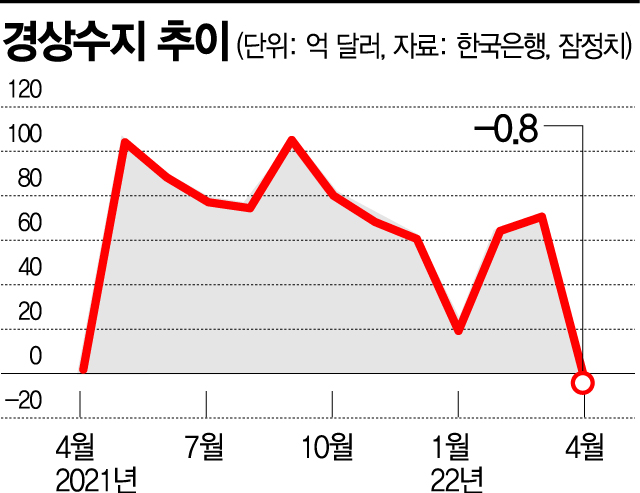
[Asia Economy Reporter Seo So-jung] Due to the sharp rise in raw material import prices, the surplus in the goods balance has decreased, and concentrated dividend payments to foreign investors have caused South Korea's current account to turn into a deficit in April. With the fiscal balance, an indicator of the soundness of national finances, also unable to escape a deficit, concerns are growing that a 'twin deficit' could materialize for the first time in 25 years since the 1997 foreign exchange crisis.
According to the preliminary balance of payments statistics announced by the Bank of Korea on the 10th, the current account recorded a deficit of 80 million dollars (about 100.5 billion won) in April, marking a deficit for the first time in two years since the 4.02 billion dollar deficit in April 2020. The current account had maintained a surplus for 23 consecutive months from May 2020 through March this year, but the surplus gradually shrank, and in April, the overseas dividend payments of December fiscal year-end companies such as Samsung Electronics overlapped, resulting in a deficit.
In particular, although exports performed well, the increase in imports, centered on raw materials, was larger, influencing the shift to a deficit. The goods balance surplus was limited to 2.95 billion dollars, shrinking by 2 billion dollars compared to the same month last year. Exports recorded 58.93 billion dollars, up 11.2%, supported by steady flows in major items such as semiconductors and petroleum products, but imports rose 16.5% to 55.98 billion dollars.
Especially, based on customs clearance in April, raw material imports surged 37.8% compared to the same month last year. Due to dividend payments by foreign-invested companies, the primary income balance recorded a deficit of 3.25 billion dollars.
Kim Young-hwan, head of the Financial Statistics Department at the Bank of Korea, explained, "Although goods exports showed a steady trend, the sharp rise in raw material prices caused a rapid increase in imports, significantly reducing the goods balance surplus. In April, seasonal dividend factors were added, resulting in the current account showing a deficit for the first time in 24 months."
© The Asia Business Daily(www.asiae.co.kr). All rights reserved.

















