"Regional Extinction Crisis... The Biggest Cause of National Land Imbalance Is Quality Jobs"
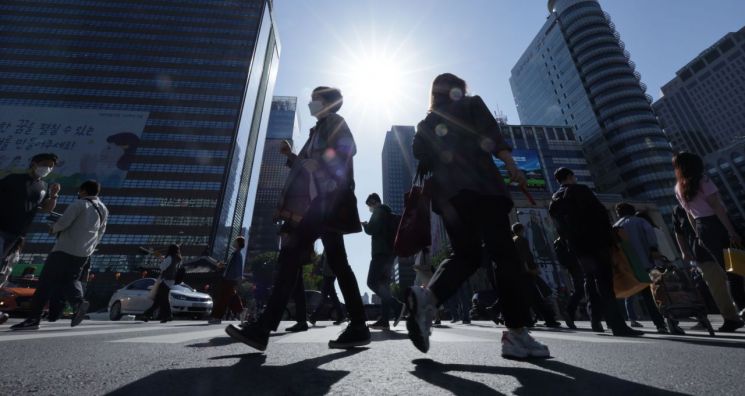 Citizens heading to work are crossing the crosswalk at Gwanghwamun Intersection in Seoul. [Image source=Yonhap News]
[Asia Economy Reporter Park Hyun-joo] It has been found that the average total salary per worker (the annual earned income minus non-taxable income) varies by more than 10 million KRW depending on the region. Except for Sejong, Seoul, and Ulsan, the average total salary per person in the remaining 14 metropolitan cities and provinces was found to be below 40 million KRW.
According to the 'Year-end Tax Adjustment Report on Earned Income by Metropolitan Autonomous District' (based on residence) received by Kim Hoe-jae, a member of the Democratic Party of Korea, from the National Tax Service on the 9th, the region with the highest average total salary per person among the 17 metropolitan cities and provinces in 2020 was Sejong, an administrative city with many public officials and public institution workers, at 45.2 million KRW.
The second highest was Seoul at 43.8 million KRW, which is 5.5 million KRW higher than the national average (38.3 million KRW). Ulsan, a manufacturing city, ranked third with 43.4 million KRW.
The region with the lowest average total salary per person was Jeju at 32.7 million KRW. Following Jeju were Jeonbuk (34 million KRW), Incheon (34.1 million KRW), Gangwon (34.4 million KRW), Daegu (35 million KRW), Busan (35.2 million KRW), Gyeongbuk (35.6 million KRW), Gyeongnam and Chungbuk (each 35.8 million KRW), Jeonnam and Gwangju (each 35.9 million KRW), Daejeon (37.1 million KRW), Chungnam (37.3 million KRW), and Gyeonggi (38.9 million KRW).
Out of the 746.3168 trillion KRW in taxable earned income in 2020, 423.4516 trillion KRW was generated in Seoul, Gyeonggi, and Incheon. The concentration of earned income in the Seoul metropolitan area (56.7%) increased by 0.3 percentage points compared to the previous year (56.4%). The total salary of Seoul residents (169.5768 trillion KRW) is about 9.5 times that of Gangwon (17.8269 trillion KRW).
Rep. Kim said, "With companies, infrastructure, job seekers, and population all concentrated in the Seoul metropolitan area, other regions face the risk of extinction, while fierce competition is taking place in the metropolitan area. The biggest cause of national land imbalance is quality jobs. To create quality jobs, we must promote regional headquarters systems and strengthen support for local small and medium-sized enterprises."
© The Asia Business Daily(www.asiae.co.kr). All rights reserved.
![Clutching a Stolen Dior Bag, Saying "I Hate Being Poor but Real"... The Grotesque Con of a "Human Knockoff" [Slate]](https://cwcontent.asiae.co.kr/asiaresize/183/2026021902243444107_1771435474.jpg)
















