Government-Academia-Industry Resolution on the 9th Afternoon
Standard Research Institute to Focus Investment Support on Developing 50-Qubit Quantum Computer by 2026
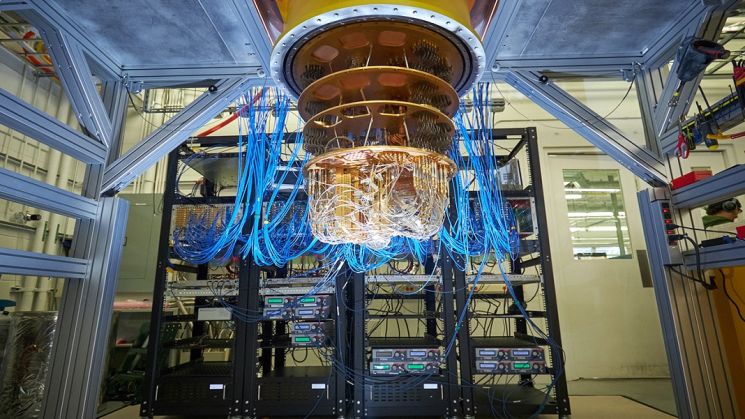
[Asia Economy Reporter Kim Bong-su] In the JTBC drama "Sisyphus" aired last year, the protagonist invents a time machine using a quantum computer. Although it is still at the level of "science fiction," scientists predict that within the next 10 years, practical quantum computers will be realized, becoming a catalyst for tremendous changes and advancements in science and technology. Accordingly, countries such as the United States and China are making national efforts to foster quantum science and develop quantum computing technology. South Korea, currently more than 10 years behind major countries, has also pledged to develop a 50-qubit quantum computer within 5 years and establish a quantum internet within 15 years to catch up with the U.S. and China.
The government, academia, and research institutes held the "Kickoff Meeting for the Construction of a 50-Qubit Quantum Computer and Development of Quantum Internet" on the afternoon of the 9th at the Korea Research Institute of Standards and Science in Daejeon, where they made this resolution.
A quantum computer is a technology expected to realize computing and communication that are much faster and perfectly secure than current supercomputers by utilizing the properties of the smallest unit of matter (quantum or Quantum), specifically quantum entanglement and superposition phenomena. Conventional computers have limitations in that no matter how much the speed of semiconductors or central processing units (CPUs) is increased or how densely they are designed, they become slower with more complex calculations involving many variables. This is because, like a maze with few entry points, they can only perform sequential calculations. However, a quantum computer can function like the human brain, which instantly processes and stores an enormous amount of diverse information collected through sensory organs such as eyes, ears, nose, and skin.
Currently, in the early development stage, American big tech companies like IBM and Google, as well as China, are leading the way. However, maintaining the unique properties of quantum requires superconducting states at absolute zero temperature (minus 273 degrees Celsius) and zero gravity, posing development challenges. South Korea has currently developed a 5-qubit quantum computer.
The government aims to become one of the "Top 4 Quantum Technology Powers by 2030" and is making large-scale investments in quantum computing and quantum communication fields. Over the next five years, a total of 49 billion KRW will be invested to build quantum computing research infrastructure. Additionally, 45.6 billion KRW will be supported during the same period for the development of core source technologies for the quantum internet.
Lee Jong-ho, Minister of Science and ICT, emphasized, "There is a growing expectation that quantum computers will be used to solve practical problems within five years. The next five years will be a very important turning point for the quantum ecosystem, and if we do not swiftly pursue technological catch-up now, there may be no second chance to secure competitiveness in quantum technology in the future." He added, "The construction of a 50-qubit quantum computer and the development of the quantum internet, which will be fully launched through today's event, are undoubtedly challenging given our current technological level and workforce size. However, since this is the path we must take for a quantum technology leap, I urge academia, industry, and research institutes to cooperate and do their best."
On this day, the Korea Research Institute of Standards and Science announced its vision to complete the construction of a 50-qubit superconducting quantum computer by 2026, becoming the third country in the world after the U.S. and China to independently build a 50-qubit quantum computer. The institute explained, "Although there are challenges such as a shortage of experts and difficulties in procuring key equipment and parts, we will closely collaborate with the top domestic research teams participating in the project from Sungkyunkwan University, UNIST, KISTI, and cooperating companies in quantum computing construction and operation." They added, "We will overcome these challenges through strategic cooperation with leading overseas institutions and active participation and support from the domestic industry." The Electronics and Telecommunications Research Institute (ETRI) and the Korea Institute of Science and Technology (KIST) also announced plans to develop initial wired and wireless quantum information relay devices, which are impossible with existing networks, by 2026, aiming to start a quantum internet pilot service by 2036. They pledged to do their best to secure core quantum memory technologies essential for quantum information storage.
To this end, ETRI (project lead) and KIST will serve as hubs, bringing together the capabilities of over 20 academia-industry-research organizations including KT, SKT, Woorinet, PPI, Chemoptics, Kyungpook National University, Institute for Basic Science, Korea University, Pusan National University, Sungkyunkwan University, Seoul National University, Yonsei University, POSTECH, Hallym University, GIST, KAIST, KRISS, TTA, and NIA.
On the same day, quantum computing construction and utilization partner companies such as KT and SKT held a signing ceremony and pledged to work on hardware development, discover application fields, develop solutions (software), and secure users to foster a utilization ecosystem. This agreement involves 34 companies including quantum computing demand companies, algorithm/software development and consulting firms, cloud service providers, and investors, and is scheduled to officially launch by the end of June after additional recruitment and establishment of an operational system.
The government also plans to actively utilize the Future Quantum Convergence Forum (with 83 institutions and 316 members), launched last year as a platform for exchange and cooperation among academia, industry, and research institutes related to quantum technology, to vitalize the quantum ecosystem and establish a virtuous cycle structure where technology development and industrialization mutually reinforce each other. The '2022 Quantum Week' will be held from the 27th of this month to the 1st of next month. Additionally, the opening of quantum-specialized graduate schools such as the Quantum Convergence Talent Training Center and ITRC is scheduled for August, and follow-up events to the Korea-U.S. summit including bilateral quantum workshops (in June, etc.) and the establishment of a Korea-U.S. Quantum Technology Cooperation Center will proceed smoothly as planned.
© The Asia Business Daily(www.asiae.co.kr). All rights reserved.
![Clutching a Stolen Dior Bag, Saying "I Hate Being Poor but Real"... The Grotesque Con of a "Human Knockoff" [Slate]](https://cwcontent.asiae.co.kr/asiaresize/183/2026021902243444107_1771435474.jpg)
















