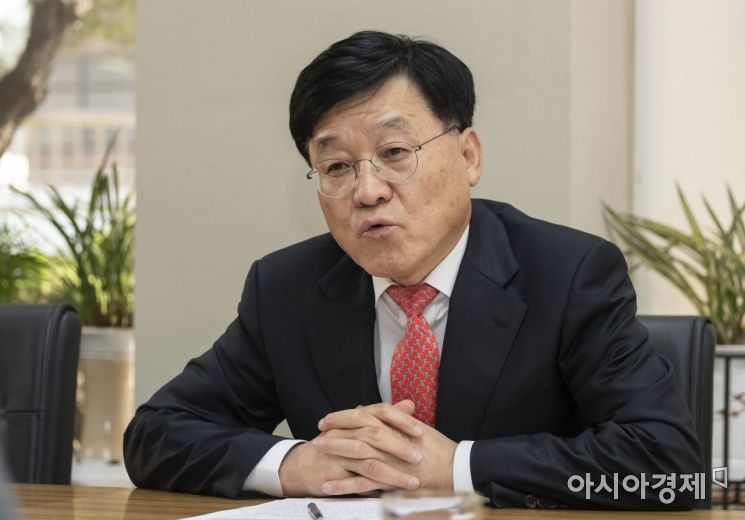
 Jung Manki, President of the Korea Automobile Manufacturers Association. / Photo by Dongju Yoon doso7@
[Asia Economy Reporter Hyunseok Yoo] There are claims that the preliminary feasibility study (PFS) for research and development (R&D) is hindering progress toward carbon neutrality and thus needs to be abolished or improved. Delays in starting R&D projects could cause Korea to fall behind competing countries, risking not only carbon neutrality but also the opportunity to secure future markets.
The Korea Industrial Alliance Forum (KIAF) announced on the 9th that it held the 22nd Industrial Development Forum and discussed the topic of "Current Status and Challenges of Carbon Reduction Technology R&D."
Jeong Eun-mi, Head of the Growth Engine Industry Research Division at the Korea Institute for Industrial Economics and Trade, emphasized, "In the short term, achieving 'energy efficiency' through the introduction of ultra-high-efficiency equipment and machinery and replacement of aging facilities is essential for carbon neutrality." She added, "It is also necessary to transition from high-carbon, fossil energy-based processes to low-carbon, eco-friendly 'innovative processes.'" Furthermore, she stated, "In the mid to long term, 'industrial restructuring' is required, including expanding the proportion of eco-friendly fuels and raw materials, activating 'resource circulation' through recycling and reuse of waste such as plastic waste, and shifting main products toward low-carbon products."
Jeong stressed that R&D policy is essential to achieve these goals. She explained, "It is necessary to enact special laws for carbon-neutral industrial transformation, establish a roadmap for greenhouse gas reduction industries, and strongly promote green-digital New Deal policies." She added, "Through national-level resource allocation, R&D and commercialization of disruptive technologies, processes, and products for a 'great transition' must be accelerated."
However, she argued that despite the widening technology gap compared to advanced countries, Korea’s R&D preliminary feasibility study system is holding back progress. According to the International Energy Agency (IEA), R&D plays a crucial role in commercializing climate technologies that can reduce 70% of greenhouse gases to achieve the 2050 carbon neutrality goal. Yet, despite a climate technology gap of 3.0 years with the U.S. and 2.5 years with the EU, Korea’s carbon neutrality R&D investment is only 7.4% of the U.S. and 23% of the EU.
Jeong Gwang-ha, Director of the Future Industry Research Institute affiliated with KIAF, pointed out, "From 2023 to 2030, Korea’s climate technology R&D project scale amounts to 6.729 trillion won, but delays in the preliminary feasibility study have prevented its inclusion in the 2023 budget." He warned, "There is a risk that the climate technology gap will widen further."
Jeong Manki, Chairman of KIAF, said, "Although Korea declared carbon neutrality by 2050 under the previous government, it was done based on idealistic justification, raising concerns that it may be a goal difficult to reach without economic regression." He explained, "For Ministry of Industry projects, it takes 2.8 years from R&D planning to final approval, and in the technology development competition where speed is key, the preliminary feasibility study system is an obstacle."
He added, "This system also produces various side effects such as project miniaturization and fragmentation, delays in review and evaluation periods due to increased project numbers, and reduced validity and reliability of evaluations due to uniform evaluation criteria." He argued, "It is urgent to either abolish the system entirely or creatively improve it so that the process from planning to final approval is completed within three months."
In the designated discussion, voices called for swift decisions on R&D support for industries with high carbon emissions such as steel, cement, and petrochemicals. Kim Young-joo, Executive Director of the Korea Metal Materials Research Association, said, "A high-quality R&D plan has been derived through more than a year of intensive expert discussions, but if results are not produced by the end of July, there will be setbacks in technology development." He explained, "Currently, core technologies for steel carbon neutrality such as hydrogen reduction steelmaking are at an early stage worldwide, but as the speed competition has begun, the actual start of R&D is already behind schedule, making this year the golden time for technology development."
Also, Kim Ui-cheol, Senior Researcher at the Korea Cement New Materials Research Association, emphasized, "Korea has set a higher reduction target than the European cement industry’s carbon neutrality goal." He added, "Cement companies have been responding quickly since last year by investing in greenhouse gas reduction facilities, discovering R&D projects, and building R&D consortia centered on associations to transition to a low-carbon industrial structure. However, if R&D, demonstration, and institutional improvements for key reduction means such as fuel and raw materials are not timely carried out due to government preliminary feasibility studies, there are limits to what companies can achieve alone."
Kim Pyeong-jung, Head of the Korea Petrochemical Industry Association, also stated, "Competitors such as the U.S., EU, and Japan support large-scale carbon neutrality R&D and demonstration research regardless of company size." He insisted, "The preliminary feasibility study for the carbon neutrality core industrial technology development project, which is currently delayed, must be swiftly approved so that companies can start technology development."
© The Asia Business Daily(www.asiae.co.kr). All rights reserved.
!["The Woman Who Threw Herself into the Water Clutching a Stolen Dior Bag"...A Grotesque Success Story That Shakes the Korean Psyche [Slate]](https://cwcontent.asiae.co.kr/asiaresize/183/2026021902243444107_1771435474.jpg)
















