The Upward Revision of Inflation Forecast Is Smaller Than the OECD Average
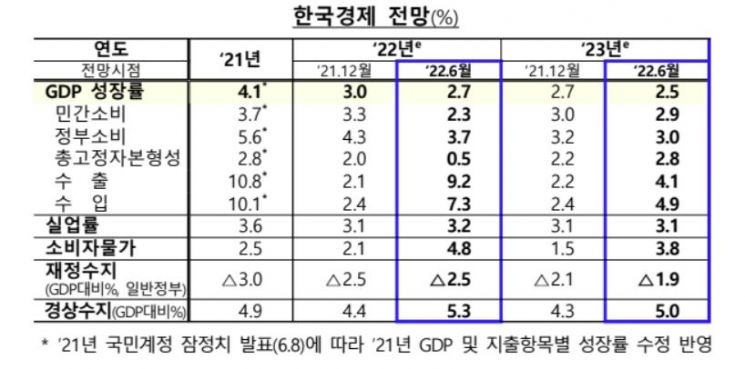
[Asia Economy Reporter Kim Young-won] The Organisation for Economic Co-operation and Development (OECD) has lowered South Korea's economic growth forecast for this year to 2.7% and raised the inflation rate forecast to 4.8%, an increase of 2.7 percentage points.
According to the Ministry of Economy and Finance on the 8th, the OECD lowered South Korea's economic growth forecast for this year by 0.3 percentage points from 3.0% to 2.7% in its economic outlook released that day. Most major domestic and international institutions have also lowered their growth forecasts for South Korea this year to below 3%. The Bank of Korea forecasted 2.7%, the International Monetary Fund (IMF) 2.5%, and the Korea Development Institute (KDI) 2.8% as revised projections.
The OECD also revised down South Korea's economic growth forecast for next year by 0.2 percentage points from 2.7% to 2.5%. Regarding the recent Korean economy, the OECD stated, "Exports have maintained a solid trend, but the recovery has slowed due to delayed consumption recovery," and "especially, inflation has significantly increased due to rising raw material prices triggered by the Ukraine crisis."
Regarding future prospects, it evaluated, "Private consumption is expected to continue its recovery due to the lifting of social distancing measures and the effects of supplementary budgets, but inflationary pressures and supply chain disruptions are affecting consumers, so the pace of consumption recovery is expected to be somewhat moderate."
The OECD particularly noted that household debt, rising housing prices, and a stronger-than-expected interest rate hike trend could act as downside risks to domestic demand. It also forecasted that if the Ukraine crisis prolongs, the depletion of rare gas stocks essential for semiconductor production could negatively impact production.
Regarding future policy directions, the OECD recommended, "Fiscal policy should reduce universal fiscal support and focus on supporting vulnerable groups to help manage inflation, and monetary policy should be operated to ensure that inflation expectations are stably formed."
The OECD also lowered the global economic growth forecast from 4.5% to 3.0%, a 1.5 percentage point decrease. Forecasts for major countries such as the United States, China, and Japan were also revised downward.
On the other hand, the OECD raised its inflation forecast for South Korea this year from 2.1% to 4.8%, an increase of 2.7 percentage points. This exceeds the forecasts of the Bank of Korea (4.5%), KDI (4.2%), and IMF (4.0%). The OECD's forecast is the highest inflation rate in 24 years since the 1998 foreign exchange crisis (7.5%).
The OECD also raised South Korea's inflation forecast for next year from 1.5% to 3.8%, an increase of 2.3 percentage points.
However, the magnitude of South Korea's inflation forecast revision is smaller compared to the OECD average. The OECD average inflation forecast revision is 4.4%, G20 is 3.2%, and the Eurozone is 4.3%.
Earlier, Statistics Korea projected that if inflation remains at the current level, the annual inflation rate this year will reach 4.3%. Deputy Prime Minister and Minister of Economy and Finance Choo Kyung-ho also predicted that the inflation rate in the 5% range will continue for some time.
© The Asia Business Daily(www.asiae.co.kr). All rights reserved.

















