KAIST Research Team
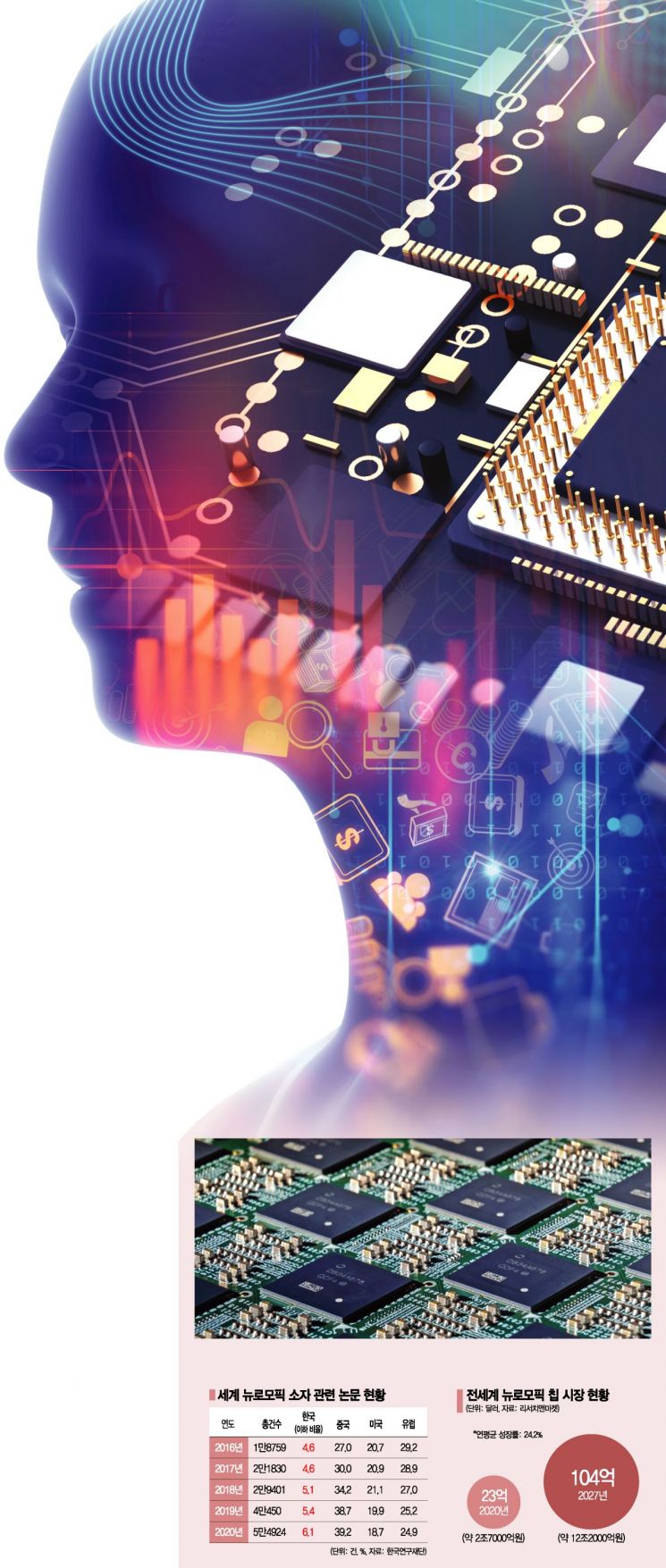
[Asia Economy Reporter Kim Bong-su] Domestic researchers have developed a core device for neuromorphic semiconductors, considered next-generation semiconductor technology.
KAIST announced on the 7th that a research team led by Professor Choi Seon-hyun of the Department of Electrical Engineering has developed a highly reliable next-generation resistive switching device (memristor) array that mimics the operation of neuron cells in our brain, which have excellent stability and high integration density. A memristor is a device that overcomes the limitation of transistor-based semiconductors used in conventional von Neumann computers, which perform either storage or processing functions, by changing the resistance state of the device according to input, enabling simultaneous storage and computation of information.
Professor Choi’s team developed a stable and highly reliable artificial neuron array using metal oxides with gradual oxygen concentration, moving away from the filament-based method that exhibits unstable characteristics in existing memristors. Existing memristor devices have low stability and are difficult to fabricate in array form for applications, but the device developed by Professor Choi’s team has excellent stability. It features self-rectifying characteristics and high yield, allowing integration into large-scale arrays. Therefore, it is expected to be actively used in implementing highly integrated and stable neuromorphic systems.
Human neurons process information by emitting or not emitting spikes depending on the magnitude and frequency of incoming signals. Unlike modern computers that consume a lot of energy to process big data, the human brain can process large amounts of data quickly with very little energy. For this reason, neuromorphic hardware technology, which mimics the efficient signal transmission system of nerves for computing, is being actively researched. Memristor devices are attracting attention as next-generation devices capable of implementing neuromorphic computing systems with high integration and high efficiency.
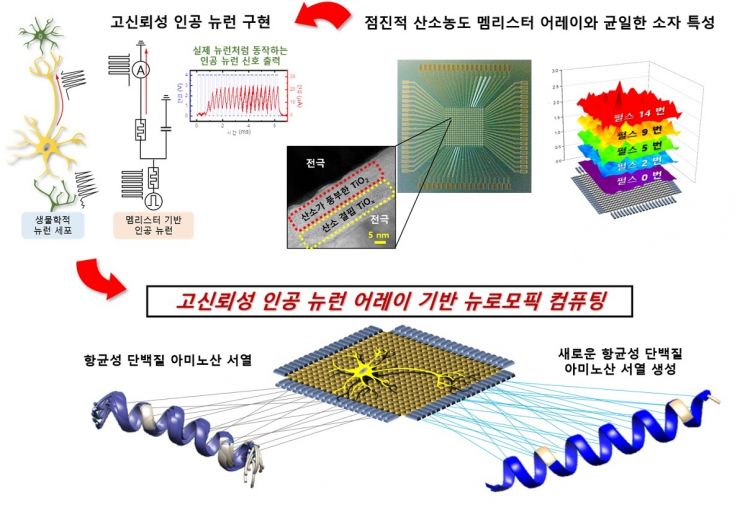
However, existing memristors face issues with the reliability and yield of individual devices, making it difficult to implement practical large-scale neural computing systems. Conventional memristors operate by randomly generating and extinguishing filaments inside the insulator like lightning, making control difficult and resulting in low reliability, which has been pointed out as a limitation in implementing stable neuromorphic systems.
Professor Choi Seon-hyun’s team secured device reliability by implementing resistive switching devices using gradual movement of oxygen ions instead of filament-based resistive switching. They also succeeded in fabricating an array of 400 high-reliability artificial neuron devices with 100% yield in a crossbar array form.
Using the fabricated high-reliability artificial neuron array-based neuromorphic system, the research team implemented a neuromorphic system that learns the amino acid sequences of antimicrobial peptides and generates new antimicrobial proteins based on this learning.
KAIST integrated MS/PhD course researcher Park Si-on said, "The highly reliable artificial neuron device developed this time is expected to contribute to the implementation of next-generation memristor-based neuromorphic computing systems based on its stable characteristics and high yield," adding, "Using the developed artificial neuron device, various applications such as artificial neural systems for robots sensing tactile stimuli and reservoir computing for processing time-series data will be possible, laying the foundation for future electronic engineering."
The research results were published in the June issue of the international journal Nature Communications.
© The Asia Business Daily(www.asiae.co.kr). All rights reserved.


















