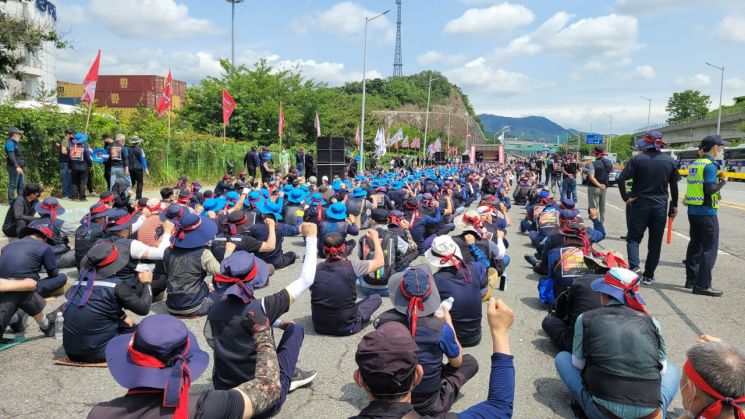
 The Cargo Solidarity Union is holding a general strike rally at Sinhang Samgeori in Gangseo-gu, Busan. [Image source=Busan Police Agency]
[Asia Economy Yeongnam Reporting Headquarters Reporter Hwang Du-yeol] On the morning of the 7th, when the Cargo Solidarity of the Korean Confederation of Trade Unions Public Transport Workers' Union went on a general strike, a send-off ceremony was held at Busan New Port.
From around 10:10 a.m. that day, about 700 Cargo Solidarity union members and about 550 cargo trucks gathered at Sinhang Samgeori in Gangseo-gu. The police deployed more than 1,100 personnel from 17 companies and 12 police motorcycles to respond to the strike rally in preparation for any emergencies.
The Cargo Solidarity announced a general strike on the 23rd, demanding the withdrawal of the abolition of the Safe Freight Rate System.
The Safe Freight Rate System was introduced to guarantee appropriate wages for cargo drivers and to prevent overwork, overloading, and speeding. The driving freight rate system, introduced with the amendment of the Freight Vehicle Transportation Business Act in 2018, is scheduled to be abolished by the end of this year.
In addition to the abolition of the Safe Freight Rate System, the Solidarity is also demanding ▲increased transportation fees ▲abolition of the consignment system and reform of the cargo transportation business structure ▲expansion of basic labor rights and protection of the rights of cargo workers.
As the Cargo Solidarity went on a general strike, an emergency was declared for the container storage rate at Busan Port, which handles the largest cargo volume in the country.
The storage rate refers to the ratio of stacked container cargo, and if the strike prolongs, the storage rate will increase, causing the port to be unable to operate properly.
The Busan Port Authority (BPA) announced on the 7th that the storage rate at Busan Port was 73.9%, which is not a high level compared to the usual average of about 70%.
Since the strike is still in its early stages, the storage rate can be maintained, but if it prolongs, the inbound and outbound volume at the container terminal will decrease, potentially paralyzing the port.
If the containers piled up at the terminal cannot be moved out, it will cause not only disruption in port operations but also a chain of damages such as domestic sales and import of raw materials for exports.
Busan City, Busan Maritime Affairs and Fisheries Office, and Busan Port Authority have formed an emergency response headquarters to prepare countermeasures against the Cargo Solidarity's transportation refusal and have set a policy to minimize port logistics damage caused by the strike.
© The Asia Business Daily(www.asiae.co.kr). All rights reserved.

















