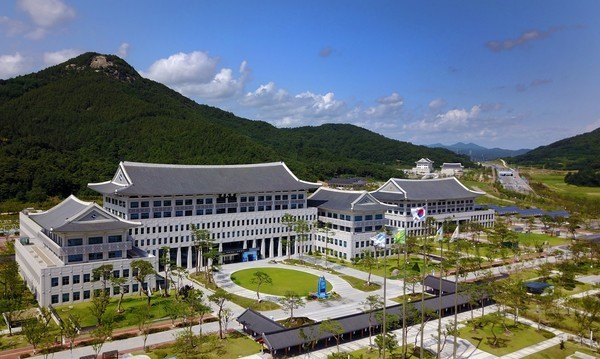
[Asia Economy Yeongnam Reporting Headquarters Reporter Kim Gwiyeol] On the 3rd, Dano Day, and the 7th, at the expanded executive meeting, Gyeongbuk Province held meetings where executives, including heads of departments and investment and foundation institutions, wore hanbok.
These two executive meetings were organized to share the direction that the 8th elected Gyeongbuk Province should take, to motivate and unify internally for the new Gyeongbuk provincial government, and to reaffirm new determination.
This reflects the province’s intention to successfully conclude the 7th elected term, which pursued change and innovation, and to promote the beauty of our traditional costume, hanbok, in the new era of decentralization ushered in by the new government, aiming for globalization through its everyday use.
Also, all attendees wore hanbok to express Gyeongbuk’s firm determination to lead the new Korean Wave by popularizing hanbok as a core content of K-culture along with Hangul, Hanok, and Hansik.
The newly introduced hanbok work uniform was selected through the ‘2022 Gyeongsangbuk-do Hanbok Work Uniform Design Contest’ held until mid-last month, aiming to introduce practical and sophisticated work uniforms embodying Gyeongbuk’s identity.
The selected hanbok work uniform was reborn as everyday wear with a modern sensibility and interpretation, and will be worn on important days such as Jeongwol Daeboreum (the first full moon of the lunar year), Dano Day, Hangul Day, Hanbok Day (October 21), and expanded executive meetings.
Through this, the excellence and value of hanbok will be elevated, and hanbok will naturally permeate everyday wear, developing its beauty into a cultural industry.
Gyeongbuk is the region where the Kansong edition and Sangju edition of the Hunminjeongeum Haerye (explanatory text of the Korean script) were discovered, and where three major traditional old cookbooks?Suwun Japbang, Eumsik Dimibang, and Onjubop?were written. It is also home to the Hanok villages of Hahoe and Yangdong, registered as UNESCO World Cultural Heritage sites.
Moreover, it possesses the foundation of traditional textile industries such as Sangju’s silk (95% of domestic production), Yeongju’s ramie fabric (85% of domestic production), and Andong’s hemp fabric (80% of domestic production), which are major materials for hanbok.
Based on this, as the origin region of K-culture (Hangul, Hansik, Hanok, Hanbok), the province is striving to establish itself as the mecca of the hanbok industry through the Korea Hanbok Promotion Center (Sangju Hamchang), promoting projects such as Hanbok Culture Week, support for regional Hanbok culture hubs, and revitalization of the traditional costume industry.
This year, two projects related to hanbok were selected in the Ministry of Culture, Sports and Tourism’s public contest in the first half of the year.
First, through this year’s regional hanbok culture creation center project, a Gyeongbuk-style hanbok culture creation center called Sangju Sanguiwon will be established, and hanbok culture education will be operated in about 50 elementary, middle, and high schools in the province.
Next, through this year’s fashion designer capacity-building support project (with 140 million KRW of national funding), the ‘New Hanbok Designer Discovery Project’ will be promoted to nurture traditional hanbok fashion designers.
The province plans to continue providing virtual hanbok experience services worldwide using metaverse technology in the era of the 4th Industrial Revolution through the ‘Everyday Hanbok Globalization Leading Project.’
It also envisions leading the growth engine of Korea’s hanbok cultural industry by building hanbok streets linked with Hanok villages such as Hahoe Village, sponsoring hanbok costumes in K-pop, K-drama, and K-movies to promote popularization and globalization of hanbok.
Lee Cheol-woo, Governor of Gyeongbuk Province, said, “I will enjoy wearing hanbok at various meetings and events so that the dignity and beauty of hanbok can impress the whole world,” and added, “Gyeongbuk will take the lead at the center so that hanbok can firmly establish itself as a core content of the new Korean Wave.”
© The Asia Business Daily(www.asiae.co.kr). All rights reserved.
![Clutching a Stolen Dior Bag, Saying "I Hate Being Poor but Real"... The Grotesque Con of a "Human Knockoff" [Slate]](https://cwcontent.asiae.co.kr/asiaresize/183/2026021902243444107_1771435474.jpg)
















