30% of Operating BCT Belongs to Cargo Solidarity Union... Blocking Main Gate Since This Morning
"If Logistics Stop, Ready-Mixed Concrete Production Will Halt and Construction Sites Must Stop"
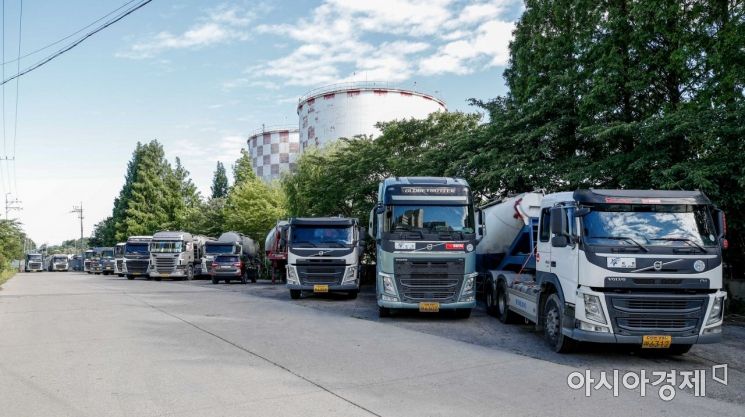 On the 7th, the Cargo Solidarity Headquarters of the Public Transport Union under the Korean Confederation of Trade Unions began an indefinite general strike from midnight, and trucks have stopped operating at the Seongsin Cement Susaek Plant in Mapo-gu, Seoul. Photo by Jinhyung Kang aymsdream@
[Asia Economy Reporter Kim Jong-hwa] As the Korean Confederation of Trade Unions' Cargo Solidarity launched a general strike on the 7th demanding the extension of the Safe Freight Rate System, the cement and ready-mixed concrete industries are on high alert.
In the case of the cement industry, there are concerns that the damage will exceed that of the Cargo Solidarity strike in November last year, when the average daily shipment volume plummeted by up to 80%, causing losses of about 11 billion KRW per day. This is because about 1,000 vehicles, approximately 30% of the 2,700 to 3,000 bulk cement trailers (BCTs) in operation, belong to the Cargo Solidarity union.
A cement industry official said, "Last year, it was entering the off-season, and we had pre-stocked inventory at distribution bases in preparation for the strike, so the damage was relatively less," adding, "This year, cement is shipped immediately after production, so there is no stockpile. Since they have already started blocking the main gates of cement plants this morning and are taking direct action, shipments will be completely halted. If the strike prolongs, the damage will be much greater than last year’s, which will seem trivial in comparison," expressing anxiety.
The cement industry normally sees a domestic daily cement demand of about 200,000 tons (during peak season), but during the Cargo Solidarity strike in November last year, the average daily shipment volume sharply dropped to 40,000 to 50,000 tons. In particular, ready-mixed concrete companies are known to have secured only about one to two days’ worth of cement supply, so if the strike continues for a long time, supply disruptions are inevitable.
Despite the cement supply shortage, the ready-mixed concrete industry, barely continuing production, now faces a crisis of supply suspension as BCTs stop operating. A ready-mixed concrete industry official said, "Cement supply is already unstable. With current reserves, production is limited to about one-third of normal levels," adding, "If logistics stop as well, we will no longer be able to produce ready-mixed concrete. Ultimately, construction sites will have no choice but to come to a halt."
When BCTs stop, there is virtually no way for the cement and ready-mixed concrete industries to respond. Cargo Solidarity-affiliated BCT drivers have no intention of handing over their vehicles to substitute drivers, and if they block the front of cement shipment plants using BCTs, there is no way to stop them. Last year, Cargo Solidarity-affiliated BCT drivers even threatened non-union drivers operating BCTs by throwing blunt objects.
A Korean Cement Association official appealed, "While it is impossible to prevent the suspension of operations of Cargo Solidarity-affiliated vehicles, we ask the government to minimize strike damage through strict law enforcement to prevent psychological pressure and physical conflicts against BCT drivers who are not members of the union."
© The Asia Business Daily(www.asiae.co.kr). All rights reserved.
![Clutching a Stolen Dior Bag, Saying "I Hate Being Poor but Real"... The Grotesque Con of a "Human Knockoff" [Slate]](https://cwcontent.asiae.co.kr/asiaresize/183/2026021902243444107_1771435474.jpg)
















