Rising International Commodity Prices and Inflation Pulling Together
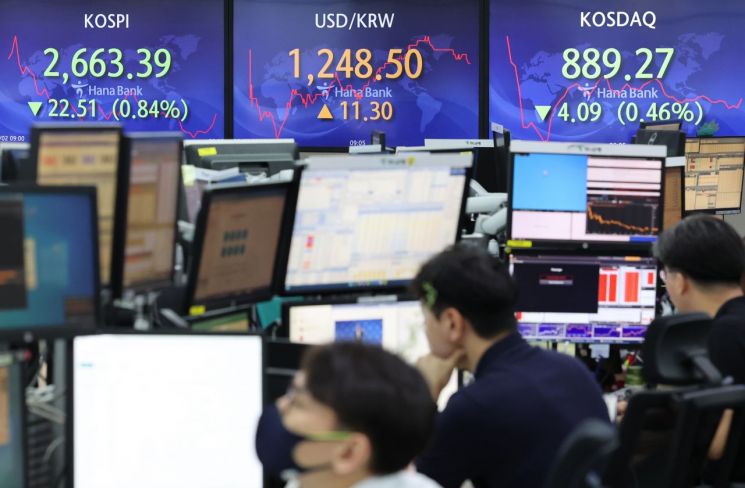
[Asia Economy Reporter Jin-ho Kim] Recent soaring exchange rates have been analyzed to have raised domestic consumer prices by 0.7 percentage points in the first quarter. Along with the rise in domestic raw material prices, the exchange rate has been identified as a new main culprit of inflation. There are calls for the government to directly intervene to ensure stable supply of international raw materials and stabilize the exchange rate.
According to the business community on the 5th, the Korea Economic Research Institute (KERI) recently made this claim in a report titled "The Impact of Exchange Rate Changes on Prices and Implications."
While the surge in international raw material prices continues due to supply chain disruptions and the prolonged Ukraine crisis, the won-dollar exchange rate is also showing a steep upward trend. In April this year, the won-dollar exchange rate averaged 1,232.3 won based on the transaction rate, marking a 10.1% increase compared to the same month last year, the highest rate of increase in 6 years and 2 months (10.8% in February 2016).
Due to the sharp rise in raw material prices and exchange rates, prices are also rising significantly. In April, consumer prices rose 4.8% compared to the same month last year, the highest level in 13 years and 6 months since October 2008 (4.82%) during the global financial crisis.
Producer prices also rose 9.2% in April. Producer prices have shown an increase rate of over 8% for seven consecutive months since October last year, a longer duration than during the global financial crisis (May to October 2008). The sharp rise in producer prices is attributed to the surge in raw material import prices. In April, raw material import prices based on the won rose 71.3% compared to the same month last year.
KERI analyzed that the sharp rise in import prices in won terms due to the increase in international raw material prices and depreciation of the won will continue to cause a chain effect leading to steep increases in producer and consumer prices for the time being.
KERI estimated the impact of the won-dollar exchange rate increase on consumer and producer prices using monthly data over 19 years from February 2003 to February 2022. The analysis showed that if the won-dollar exchange rate rises by 1 percentage point compared to the same month last year, consumer prices increase by 0.1 percentage points, and producer prices rise by 0.2 percentage points.
Based on the estimation results, KERI estimated the impact of the won-dollar exchange rate change in the first quarter of this year (an 8.2% increase compared to the same period last year) on the inflation rate during the same period. The analysis showed that consumer prices rose 3.8% in the first quarter of this year, with the exchange rate increase contributing 0.7%. This means that if the exchange rate had been stable, consumer prices in the first quarter could have been 3.1%. The producer price increase rate in the first quarter was 8.8%, with the exchange rate increase contributing 2.0%.
Choo Kwang-ho, Director of Economic Policy at KERI, said, "It has been empirically confirmed that when the won-dollar exchange rate rises, the cost of raw material imports for companies increases, leading to rises in producer and consumer prices. To stabilize prices, efforts should be made to overcome difficulties in the supply of international raw materials, but full efforts must also be made to stabilize the exchange rate, including turning the trade balance into a surplus."
© The Asia Business Daily(www.asiae.co.kr). All rights reserved.

![Clutching a Stolen Dior Bag, Saying "I Hate Being Poor but Real"... The Grotesque Con of a "Human Knockoff" [Slate]](https://cwcontent.asiae.co.kr/asiaresize/183/2026021902243444107_1771435474.jpg)















