Seoul City, New Applications for 'Seoul-type Childcare Centers' Certified by District Offices from 20 to 24 This Year to Lead Public Childcare
Reflecting Field Voices and Changed Childcare Environment, Evaluation Indicators Realigned, Key Indicators like Child Abuse Strengthened
[Asia Economy Reporter Lim Cheol-young] The Seoul Metropolitan Government announced on the 6th that it will expand the number of ‘Seoul-type Childcare Centers,’ which raise the public nature of private childcare centers to the level of national and public centers, to 100 this year, aiming to double the current number to 800 by 2025.
‘Seoul-type Childcare Centers’ is a system introduced by Mayor Oh Se-hoon in 2009 to strengthen public childcare. Each year, private and home childcare centers that meet certain evaluation criteria are selected, and the city supports personnel and operating expenses to encourage the hiring of quality teachers and enhance accounting transparency, ensuring high-quality childcare services. Currently, 446 centers across Seoul operate as ‘Seoul-type Childcare Centers.’
The Seoul Metropolitan Government will recruit 100 new ‘Seoul-type Childcare Centers’ from the 20th to the 24th of this month in 2022. Applications can be submitted to the childcare departments of the respective autonomous districts where the childcare centers are located. Detailed information regarding the evaluation plan for new certification of Seoul-type Childcare Centers can be found in the announcement on the Seoul Childcare Portal Service and the Seoul Childcare Support Center websites.
This recruitment is the first since the announcement of ‘Restarting Seoul-type Childcare Centers 2.0,’ a major overhaul that expands support and lowers entry barriers for Seoul-type Childcare Centers after 13 years since their introduction. The core of ‘Restarting Seoul-type Childcare Centers 2.0’ is maintaining existing support for personnel, operating, and environment improvement expenses while increasing personnel expense support for workers who need additional assistance.
In particular, the evaluation indicators for certification of ‘Seoul-type Childcare Centers’ have been rationally improved by reflecting difficulties in the childcare field and expert opinions, significantly lowering entry barriers for private and home childcare centers. To improve the evaluation indicators, the city held five advisory meetings with childcare experts with extensive field experience, including the Women and Family Foundation and the Childcare Center Association.
Reflecting the decrease in the number of children due to COVID-19 and low birth rates, the enrollment rate requirement was relaxed from 70% to 60%, and the standard number of children for home childcare centers was reduced from 11 to 10. Important evaluation indicators were further solidified by newly establishing indicators related to efforts to prevent child abuse and practical benefits such as meal fees and teaching materials expenses.
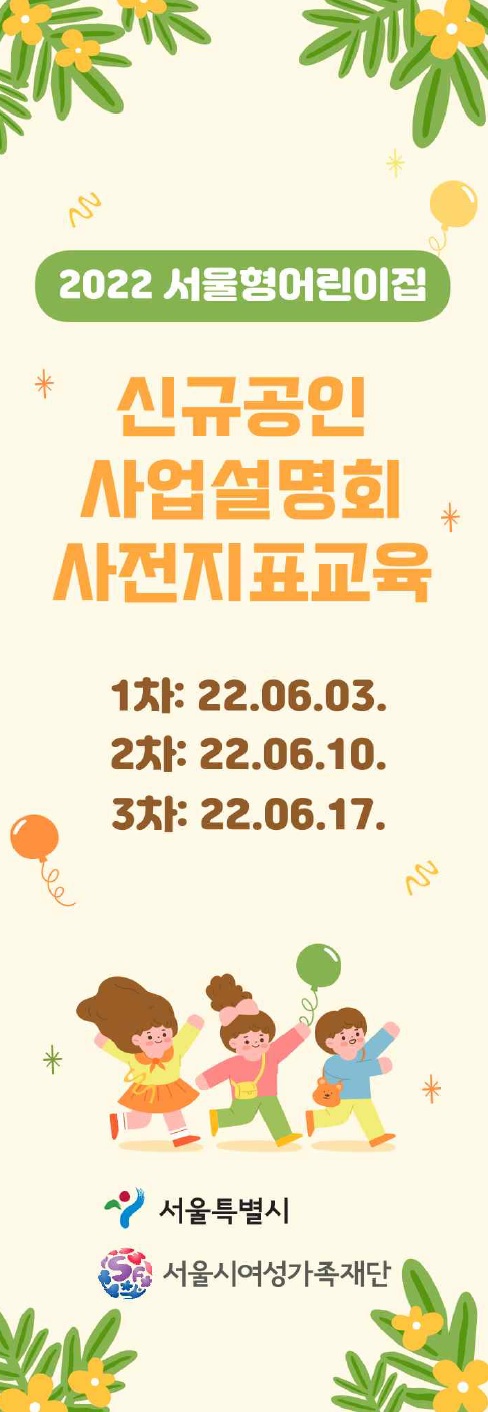
The Seoul Metropolitan Government will hold business briefing sessions to guide childcare centers wishing to apply for new certification about the significantly improved ‘Seoul-type Childcare Centers.’ To encourage diverse participation from interested childcare centers by region, the sessions will be held three times at three locations, including the Seoul Childcare Support Center.
At the new certification business briefing sessions, all information from A to Z necessary to be selected as a new Seoul-type Childcare Center will be comprehensively provided, from the greatly expanded support details to the newly improved evaluation indicators. Additionally, detailed information on the significantly improved evaluation indicators this year will be available.
After the briefing sessions, pre-education on the evaluation indicators and customized counseling support will be provided so that childcare centers wishing to newly enter can thoroughly prepare for the improved evaluation indicators. The Seoul Metropolitan Government plans to establish a ‘Seoul-type Support Center’ at the Seoul Women and Family Foundation to help the field understand the changed indicators, reflecting requests from the field that the Seoul-type evaluation indicators were too stringent while improving the indicators.
Since the application restriction period for childcare centers whose certification has ended or been canceled has been shortened from two years to one year, increasing re-entry opportunities, the city expects high interest from childcare centers in this new recruitment briefing session. Kim Seon-soon, Director of the Seoul Women and Family Policy Office, said, “As Seoul-type Childcare Centers are a project leading Seoul’s public childcare, we have expanded support and lowered entry barriers by actively reflecting the difficulties faced by the childcare field suffering from the double burden of low birth rates and COVID-19. We expect the quality of Seoul’s public childcare services to improve further through the expansion of 100 new Seoul-type Childcare Centers this year.”
© The Asia Business Daily(www.asiae.co.kr). All rights reserved.

![Clutching a Stolen Dior Bag, Saying "I Hate Being Poor but Real"... The Grotesque Con of a "Human Knockoff" [Slate]](https://cwcontent.asiae.co.kr/asiaresize/183/2026021902243444107_1771435474.jpg)
















