[Asia Economy Sejong=Reporter Dongwoo Lee] Amid the anticipated global energy supply shortage and record-breaking heatwaves caused by abnormal temperatures this summer, attention is focused on whether the electricity wholesale price cap system will be implemented.
According to the Korea Power Exchange on the 4th, the system marginal price (SMP), which is the wholesale electricity price paid by Korea Electric Power Corporation (KEPCO) to power producers, was 140.34 KRW per kWh in May, a 77.4% increase compared to the previous year (79.1 KRW). However, it fell by 30.6% compared to last month (202.11 KRW), which set an all-time high.
The industry expects that due to the decline in natural gas prices, the SMP will drop to the 130 KRW range this month.
The electricity wholesale price cap system announced by the Ministry of Trade, Industry and Energy is triggered when the "average SMP of the previous three months" is greater than or equal to the "top 10% of the monthly average SMP values over the past 10 years." The cap price is set at about 1.25 times the 10-year weighted average SMP and is applied for one month. As of the 24th of last month, the Korea Power Exchange estimated the top 10% of the monthly average SMP values over the past 10 years to be 155.8 KRW.
If the cap system is implemented immediately and the average SMP of the previous three months exceeds 155.8 KRW, the SMP cap system will be triggered, and electricity prices are expected to be settled at around 132 to 133 KRW.
However, power producers whose actual fuel costs exceed the capped price will be compensated. This means that if the cost of raw materials and other generation expenses to produce electricity are higher than the settlement cap price, fuel costs will be reimbursed. Other charges such as capacity fees and additional settlements will be paid without limitation to prevent excessive burdens on producers. The Ministry of Trade, Industry and Energy has stated that the cap system will not be implemented unless the triggering conditions are met.
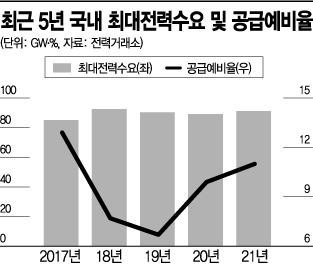
The government is also preparing a supply and demand plan to forecast electricity demand for this summer. It is reported that the maximum power demand and supply reserve ratio for this summer were reviewed through the recent second working-level meeting of the "Electricity Supply and Demand Expert Advisory Task Force (TF)."
According to the Korea Power Exchange's recent five-year electricity demand trends, last year's peak power demand was 91.1 GW, a 7.0% increase compared to 2017 (85.1 GW). Last year's lowest power supply reserve ratio was 9.45% (July 13), marking the lowest point in 1 year and 11 months. The peak power demand in July 2018, remembered as a record-breaking heatwave, was 92.5 GW, with the supply reserve ratio dropping to 7.7% at that time.
The industry also expresses concerns that if electricity demand rises, KEPCO's deficit could widen. They explain that even if the government adjusts KEPCO's electricity purchase price from power producers to 130?140 KRW per kWh, without implementing fundamental solutions such as normalizing electricity rates, it may only be a temporary measure.
© The Asia Business Daily(www.asiae.co.kr). All rights reserved.
![Clutching a Stolen Dior Bag, Saying "I Hate Being Poor but Real"... The Grotesque Con of a "Human Knockoff" [Slate]](https://cwcontent.asiae.co.kr/asiaresize/183/2026021902243444107_1771435474.jpg)

















