Noise Complaints Between Floors: 517 Cases in 2016 → 1,648 Cases in 2021... Tripled Over 5 Years
COVID-19 and Characteristics of Apartment Living Cited as Causes
Disputes Escalate to Crimes When Reports Fail to Resolve Issues
Attempts at Self-Resolution May Deepen Conflicts Due to 'Legal Risks'
Calls for Solutions Including Local Government Mediation Systems and Support for Construction Structure Improvement Costs
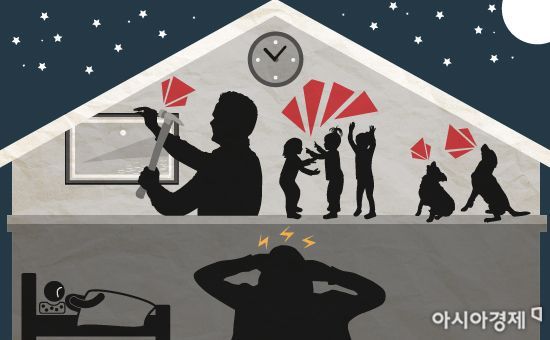 Conflicts over noise between floors have tripled in the past five years, highlighting the need for practical solutions.
[Asia Economy Reporter Kim Jung-wan] Amid the COVID-19 pandemic, with remote work and online education becoming routine, conflicts over noise between floors have surged to three times the level of the past five years. Such conflicts can escalate beyond disputes to criminal acts. Alternatives such as establishing practical conflict mediation systems within local governments and supporting costs for improving building structures are being proposed.
According to the report "Current Status and Improvement Tasks of Noise Between Floors in Apartment Complexes" released by the National Assembly Legislative Research Office on the 18th of last month, complaints about noise between floors submitted to apartment complex management dispute mediation committees increased more than threefold over the past five years, from 517 cases in 2016 to 1,648 cases in 2021. Additionally, phone consultations received by the Noise Between Floors Neighbor Center were △26,257 cases in 2019 △42,250 cases in 2020 △46,596 cases in 2021, representing about a 77% increase in 2021 compared to 2019, before COVID-19.
The increase in noise between floors is interpreted as a result of more time spent at home due to remote work and online education amid the COVID-19 pandemic. Furthermore, given South Korea's residential characteristics, where many live in apartments and villas (collective housing), and the number is increasing, it is considered difficult to eliminate noise between floors entirely. The research office stated, "As the population living in collective housing increases and remote work expands due to COVID-19, conflicts over noise between floors also seem to have increased. Since the residential style in South Korea mainly involves living in collective housing and not wearing shoes indoors, it is structurally possible to reduce but impossible to completely eliminate noise between floors in such housing."
 Due to the residential characteristics of our country, where there are many multi-family housing units such as apartments and villas, it is interpreted that completely eliminating noise between floors is difficult. The photo is unrelated to any specific expressions in the article.
Conflicts over noise between floors often remain unresolved through reports and escalate into disputes that sometimes lead to retaliatory crimes. According to the police, on the 29th of last month, in an apartment in the metropolitan area, Mr. A (male, in his 30s) stabbed a couple living downstairs with a weapon due to noise conflicts and fled to a nearby subway station but was found dead in an unidentified location in Daejeon on the 31st of the same month. It was investigated that they had been in conflict over noise issues before the incident and even engaged in a physical altercation. The victim couple is receiving treatment at a nearby hospital.
The conflict deepened and escalated to criminal acts such as murder. On the 17th of last month, the 1st Criminal Division of the Suncheon Branch of the Gwangju District Court (Chief Judge Heo Jeong-hoon) sentenced Mr. B (male, 35), who was tried on charges of murder and attempted murder related to noise between floors, to life imprisonment. Previously, on September 27 of last year, Mr. B wielded a weapon he had prepared in advance at an apartment in Yeosu City, Jeollanam-do, attacking a family of four living upstairs, killing a couple in their 40s and seriously injuring their parents in their 60s who tried to intervene.
Even attempts to resolve noise conflicts independently risk violating the Stalking Punishment Act, increasing the likelihood of conflicts festering. The Stalking Punishment Act stipulates that if a person repeatedly and continuously approaches another against their will without justifiable reason, causing anxiety or similar feelings, they may be punished with imprisonment of up to three years or a fine of up to 30 million won.
 Since noise victims have no practical alternatives other than seeking help from related organizations such as the Neighbor Relationship Center, a solution is urgently needed. The photo is unrelated to specific expressions in the article. [Image source=Yonhap News]
The police do not have the authority to punish noise issues occurring between individuals and can only refer cases to the Noise Between Floors Committee, so they cannot intervene further. Therefore, noise victims have no choice but to seek help from related organizations such as the Neighbor Center, with no other means to resolve the problem.
Before resorting to criminal justice solutions, measures such as establishing dispute mediation at the local government level and supporting costs for improving building structures are proposed as solutions. The research office explained, "In cases where disputes arise due to noise between floors in small-scale collective housing, local governments could consider mediating disputes through fact-finding and mediation." While stricter noise regulations can be applied to newly built apartments, since improvements to existing housing require costs, they suggested, "The government should support the costs of improving floor structures in existing collective housing."
© The Asia Business Daily(www.asiae.co.kr). All rights reserved.
![Clutching a Stolen Dior Bag, Saying "I Hate Being Poor but Real"... The Grotesque Con of a "Human Knockoff" [Slate]](https://cwcontent.asiae.co.kr/asiaresize/183/2026021902243444107_1771435474.jpg)












