[Asia Economy Sejong=Reporters Kim Hyewon and Son Seonhee] The domestic consumer price inflation rate rising to the 5% range for the first time in nearly 14 years since the 2008 global financial crisis is largely due to the full reflection of the severe global supply chain disruptions caused by Russia's invasion of Ukraine. The fuel price for diesel cars, the 'feet' of the common people, jumped 46%, while pork and cooking oil rose by 20% each. Additionally, with the lifting of social distancing measures and the pent-up demand effect from COVID-19, dining-out prices surged at the fastest rate since March 1998. Utility bills closely related to everyday life, such as electricity, gas, and water charges, were also raised one after another.
The 5.4% consumer price inflation rate for May, compiled by Statistics Korea on the 3rd, is the highest in 13 years and 9 months since August 2008 (5.6%). This figure entering the 5% range is the first time since September 2008 (5.1%), marking the return of a high inflation era comparable to the global financial crisis.
The 5% level inflation was driven by petroleum products and personal services such as dining out. Their respective contributions to the inflation rate were 2.86 percentage points and 1.57 percentage points, totaling 4.43 percentage points. Prices of fuel and various food items rose across the board, leading the overall price increase.
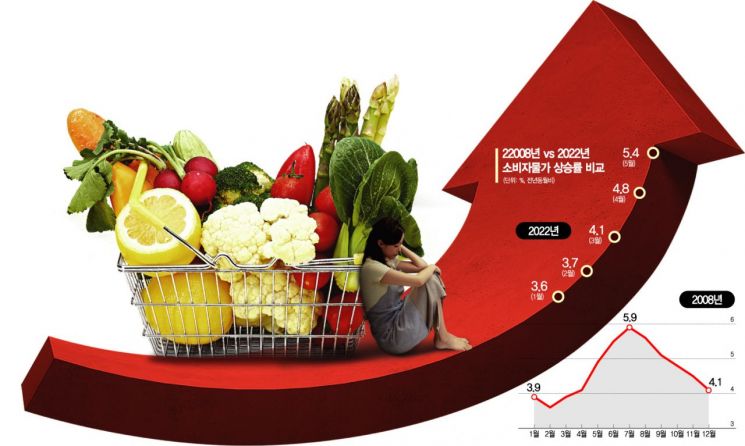
Agricultural, livestock, and fishery products rose 4.2%, led by livestock products (12.1%), with a larger increase than the previous month (1.9%). Due to rising feed and logistics costs, imported beef (27.9%), pork (20.7%), and chicken (16.1%) surged sharply. Among agricultural products, potatoes (32.1%) and napa cabbage (24.0%) increased significantly. In addition, electricity, gas, and water charges rose by 9.6%, the highest since the statistics began in January 2010. The living cost index, which is composed mainly of frequently purchased items and is closer to the perceived inflation rate, rose 6.7% last month, showing the largest increase since July 2008 (7.1%).
The first livelihood stabilization measures of the Yoon Seok-yeol administration, announced on the 30th of last month, focused on curbing grocery prices. Bang Gi-seon, the 1st Vice Minister of the Ministry of Economy and Finance, held the 3rd Economic Relations Vice Ministers' Meeting that day and said, "Now, what matters is speed and perception," adding, "We will proceed with follow-up procedures such as budget execution and related legal amendments as quickly as possible so that the effects of livelihood stabilization measures can appear immediately." Above all, the government judged that it is important for government support measures such as the application of tariff quotas and exemption of value-added tax to reduce the burden of rising costs to actually lead to lower consumer prices.
The prolonged high oil prices and agflation have gradually permeated domestic prices with a time lag, delivering a direct blow. The recent expected inflation rate (3.3%) hitting the highest level in 9 years and 6 months, and the rapidly spreading market sentiment that prices will rise further, are also problematic. Lee Seung-heon, Deputy Governor of the Bank of Korea, held a price situation review meeting that day and emphasized, "It is most important to stably manage the inflation expectations of economic agents so that the medium- to long-term price stability trend is not shaken."
The government seems to have accepted an annual consumer price inflation rate in the 4% range for this year as a given. It expects the inflation rate to peak in June-July and then move within the 4% range in the second half of the year. The Ministry of Economy and Finance is reportedly planning to significantly revise the forecast for this year's economic growth rate to the 2% range and the consumer price inflation rate to the 4% range in the new government’s economic policy direction to be announced this month. Some opinions suggest that, perceptually, the economy has already entered stagflation. South Korea is expected to record a 'twin deficit'?both fiscal balance and current account balance in deficit based on April indicators?for the first time in 25 years since the 1997 foreign exchange crisis.
© The Asia Business Daily(www.asiae.co.kr). All rights reserved.

















