Continuous Solo Loss Flow by Individuals Throughout This Year
Opportunity Must Be Found Amid Foreign Follower and Institutional Supply Gap
[Asia Economy Reporters Lee Seon-ae and Lee Myung-hwan] There were no surprises in the investment report card for May. Only individual investors suffered losses, while institutions and foreigners made profits. The trend of "individual investors' solo losses" has continued throughout this year. This is why the securities industry suggests that investment opportunities should be sought through a "follow-the-foreigners strategy" or an institutional "supply-demand gap strategy."
May Investment Report Card: 'Only Individual Investors Suffer Solo Losses'
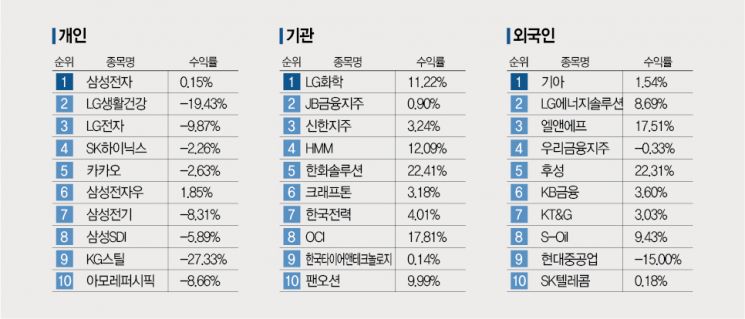
On the 3rd, Asia Economy analyzed the returns of the top 10 stocks by net purchases for each investor group last month, finding that the average return for individuals was -8.24%. This was the only negative return among investor groups. Among the top 10 stocks net purchased by individuals, eight stocks posted losses except for Samsung Electronics (0.15%) and Samsung Electronics Preferred (1.85%), which saw slight gains. KG Steel showed the largest decline, dropping 27.33%, followed by LG Household & Health Care, which fell 19.43%. Large-cap tech stocks and reopening-related stocks mainly bought by individuals, such as LG Electronics (-9.87%), Kakao (-2.63%), SK Hynix (-2.26%), and Amorepacific (-8.66%), experienced significant declines.
On the other hand, institutions achieved the best performance with an average return of 8.50%. All of the top 10 stocks net purchased by institutions yielded profits. LG Chem, the most net purchased stock by institutions, rose 11.22%, along with Hanwha Solutions (22.41%) and OCI (17.81%) over the month. Institutions mainly acquired financial holding companies (JB Financial Group, Shinhan Financial Group) and shipping companies (HMM, Pan Ocean).
Foreign investors also posted a solid average return of 5.10%. Among the top 10 stocks purchased by foreigners, eight generated profits. Secondary battery-related stocks such as Hwasung (22.31%), L&F (17.51%), and LG Energy Solution (8.69%) delivered high returns, but Hyundai Heavy Industries fell 15%, dragging down the average return. In addition to secondary battery stocks, institutions also bought financial holding companies like Woori Financial Group (-0.88%) and KB Financial Group (3.60%), similar to foreigners.
Investment Opportunities Found in Foreigners' and Institutions' Supply-Demand
The securities industry advises closely monitoring foreigners' supply-demand strategies. Yeom Dong-chan, a researcher at Korea Investment & Securities, emphasized, "It is effective to focus on stocks where foreign ownership has risen to the highest levels this year." This means that a strategy of following foreigners is more effective than targeting stocks with foreign supply-demand gaps. Daishin Securities also recommended paying attention to oversold stocks with increasing foreign ownership, and Cape Investment & Securities advised expanding the weight of sectors and stocks where foreigners are likely to return. Na Jung-hwan, a researcher at Cape Investment & Securities, said, "If risks affecting emerging markets centered on manufacturing are resolved, it is necessary to increase the weight of sectors (semiconductors) that could attract foreign investors."
Foreign investors have maintained a net buying streak for four consecutive trading days (May 26?31) in the domestic stock market, purchasing a total of 1.6488 trillion KRW. This marks the first time in three months since February 9?14 that foreigners have turned to net buying after a 'Sell Korea' trend. The stocks most purchased by foreigners during this period include SK Hynix, LG Energy Solution, Kia, Naver, KB Financial Group, Hana Financial Group, Krafton, Hyundai Motor, and Hyundai Mobis. This suggests a strict focus on fundamentals. The most promising sectors identified by securities firms for the second half of the year are semiconductors and automobiles. Additionally, financial stocks, which tend to perform well during interest rate hikes, are also being bought.
Shinhan Investment Corp. noted that as the domestic stock market undergoes a correction phase, the influence of foreign investors' supply-demand has increased, and their influence is expected to expand further. Choi Yoo-jun, a researcher at Shinhan Investment Corp., said, "Considering the influence of foreign supply-demand, investment ideas can be found in the net buying intensity (net purchase volume relative to market capitalization) since the switch to net buying on May 26," adding, "Sectors with high net buying intensity include hotels & leisure, energy, telecommunications, automobiles, and machinery."
Investment advice regarding institutional supply-demand strategies was also raised. Lee Kyung-soo, a researcher at Hana Financial Investment, said, "I insist on strategies that deliver results considering earnings and institutional vacancies." This means that selecting sectors and stocks where earnings are rising but institutional net buying intensity has recently weakened can yield profits. The researcher identified energy (refining), non-ferrous metals, semiconductors and equipment, telecommunications services, semiconductors, and steel as relevant sectors. Related stocks include Hwasung, DB HiTek, Semtech, Isu Petasys, Hansae Co., VC, Haesung DS, MindsLab, GeoSoft, Intops, KeyEast, and JC Chemical, which are top stocks in the concept of rapid earnings growth with institutional supply-demand vacancies.
© The Asia Business Daily(www.asiae.co.kr). All rights reserved.

![Clutching a Stolen Dior Bag, Saying "I Hate Being Poor but Real"... The Grotesque Con of a "Human Knockoff" [Slate]](https://cwcontent.asiae.co.kr/asiaresize/183/2026021902243444107_1771435474.jpg)















