[Seoul District News] Gwangjin-gu Installs New Concept Indoor Gardens with 5 Plant Species and IoT-Based Automated Plant Systems at Junggok 1-dong, Gunja-dong Community Centers, Gwangjin Economic Hub Center, and Gwangjin Residents Sports Center; Seongdong-gu Renovates 65 Local Small Businesses through 'Our Neighborhood Store Artterior Project'; 4th Guro Village Democracy Festival Held; Gwanak-gu Recruiting Participants for Youth Hope Academy Financial Program
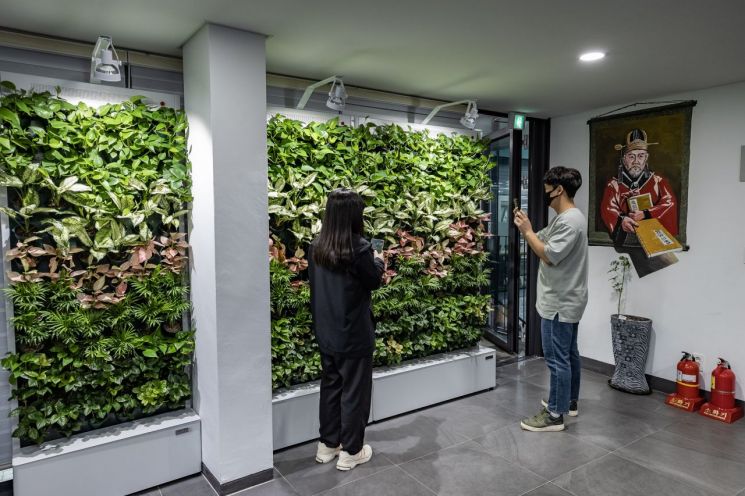
[Asia Economy Reporter Park Jong-il] Gwangjin-gu has completed the creation of a new concept indoor garden called ‘Smart Garden’ that incorporates IoT technology.
As part of the 2022 resident participation budget project for indoor garden creation, the district promoted the installation of ‘Smart Gardens’ and installed them in four locations: Junggok 1-dong Community Center, Gunja-dong Community Center, Gwangjin Economic Hub Center, and Gwangjin Residents’ Sports Center.
The ‘Smart Garden’ consists of plants that help reduce harmful air substances such as fine dust and formaldehyde, and a plant automation system that can control lighting, watering, wind, and air purification. Therefore, it provides a comfortable indoor environment through continuous air quality improvement.
Additionally, as a garden with green plants that can be enjoyed year-round is built on the walls of indoor spaces with high spatial constraints, it also offers ornamental effects. By providing healing spaces within the district office and public facilities through the Smart Garden, it is expected that residents’ satisfaction with visits will increase.
The Smart Garden is planted with a total of five types of plants suitable for indoor growth, including Scindapsus. The district plans to continue optimizing plant maintenance through plant automation technology and minimize Smart Garden maintenance costs.
Seongdong-gu announced that it has completed renovations for 65 local small business stores through the ‘Our Neighborhood Store Artterior Project.’
‘Our Neighborhood Store Artterior (Art+Interior)’ is a project that improves store design through collaboration between small business owners and local artists. It provides artists with opportunities to showcase creativity and workspace and jobs, while strengthening store competitiveness with interiors that highlight each store’s characteristics for small business owners.
The district carried out the project targeting a total of 65 stores: 32 in Yongdap Shopping Market, 20 near Wangsimni 2-dong Community Center, and 13 in the Sin Geumho Station alley shopping district. Last month, 25 local artists were recruited to carry out design projects, creating customized designs such as murals, exterior stickers, menus, logos, and signboards according to each store’s characteristics.
The stores newly renovated by the artists’ touch have transformed with unique designs.
‘Da○Bang’ in Songjeong-dong was given a lively feel with a red canopy and glass stickers to evoke the spicy and sweet atmosphere of a snack bar. A triangular shape was drawn above the letters to remind of an attic under the roof, making it easily noticeable from afar.
At the clothing repair shop ‘Dongmyeong○’ in Wangsimni 2-dong, instead of handwritten notices on paper, a classic and unified white cool font was engraved on the glass window. A related illustration was placed in the center of a round frame to immediately indicate it is a repair shop. The old canopy at the entrance was transformed into a vibrant blue. The front part of the canopy was designed with lines resembling overlock stitches, with the store name engraved in the middle for easy recognition.
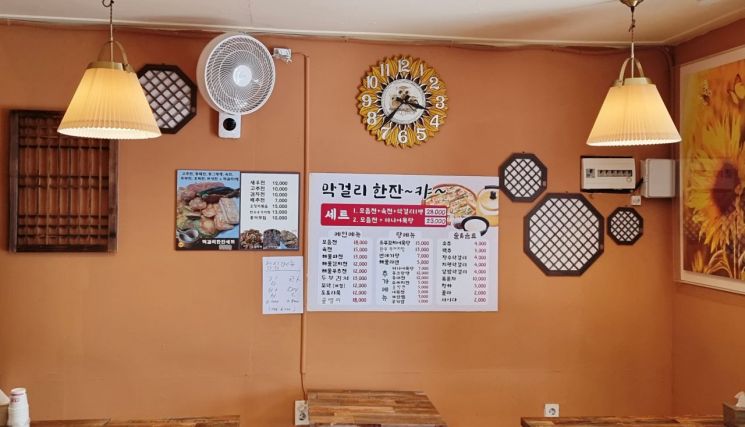
At the restaurant ‘Jeon○Hamkke,’ the wallpaper was transformed to match the store’s theme. To suit a place where traditional liquor like Makgeolli can be enjoyed, the walls were painted in ochre, and traditional patterned windows covered with hanji paper were installed, bringing out the store’s unique interior sense.
Additionally, the ‘Yu○Sushi’ specialty store replaced its menu board and signboard with blue ones, creating a fresh and vibrant food image. The sushi images, previously only photos, were supplemented with descriptions, making the store appear neat and clean from the entrance, attracting more attention from passersby. Other changes included logo creation, signboard fabric replacement, business card production, menu boards, signboards, and table designs, all receiving high praise from store owners.
A store owner in Wangsimni 2-dong who participated in the Artterior project said, “The store atmosphere has changed a lot through the Artterior project, and the number of new customers visiting with interest in the store has increased significantly.”
A Seongdong-gu official said, “We hope this Artterior project will be a great support for business owners preparing for daily life recovery. We will continue to lead regional economic revitalization through various projects that provide vitality and practical help to local small business owners.”
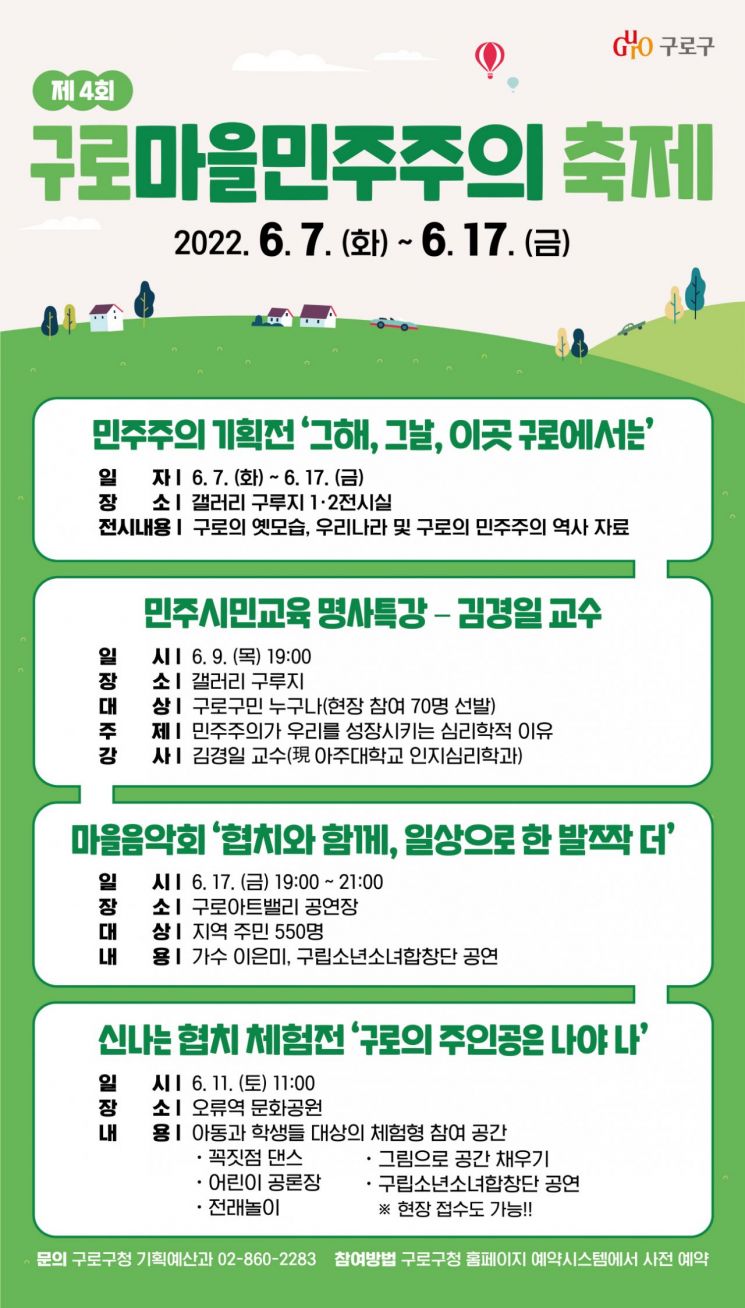
Guro-gu (Mayor Lee Sung) will hold the 4th Guro Village Democracy Festival from the 7th to the 17th.
On the 3rd, Guro-gu announced, “To commemorate the June 10 Democratic Uprising Day, we will conduct resident-participation programs to reflect on Guro-gu’s democratic history.”
Now in its 4th year, the festival is jointly hosted and organized by Guro-gu and the Guro Cultural Foundation, featuring experience exhibitions, concerts, exhibitions, and special lectures.
First, on the 11th at 11 a.m., the ‘I am the Hero of Guro’ experience exhibition will begin at Oryu Station Cultural Park. Traditional games such as ttakji-chigi (paper tile flipping) and biseok-chigi (stone flipping), clam fan making, and performances by the Guro Children’s Choir will be held. A group dance led by children and a children’s public forum discussing democracy will also take place.
On the 17th at 7 p.m., a ‘Village Concert’ will be held at the Guro Art Valley Arts Theater. Performances by singer Lee Eun-mi and the Guro Children’s Choir will be featured, along with a pre-recorded video titled ‘The Guro I Wish For.’ Applications are accepted through the district office website’s integrated reservation system until the 14th. Admission is limited to the first 500 applicants.
An exhibition and special lectures by notable figures will also be prepared at the Guro Residents’ Hall Gallery Guruji.
During the festival, the ‘That Year, That Day, Here in Guro’ exhibition will be held in Exhibition Rooms 1 and 2. Photos taken by local residents showing old scenes of Guro-gu, the history of democracy in Korea and Guro, and drawings by students will be displayed.
On the 9th at 7 p.m., Professor Kim Kyung-il of Ajou University’s Department of Cognitive Psychology will give a lecture titled ‘Diversity and Inclusion Are the Core of Competence.’ On-site participants were selected last month, and the lecture will be live-streamed on the YouTube channel ‘Cooperative Guro.’
A Guro-gu official said, “We hope this festival will be an opportunity to reflect on the meaning of democracy. As it is an event commemorating the democratic uprising, we ask for the interest and participation of many residents.”
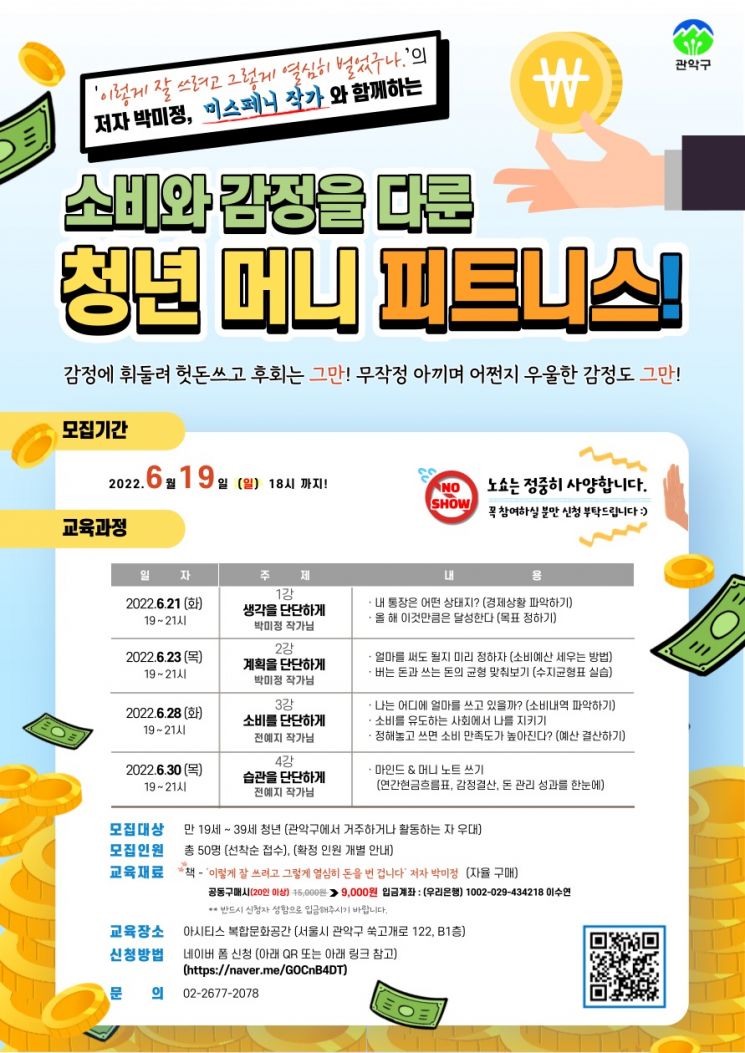
Gwanak-gu (Mayor Park Jun-hee) is recruiting participants for the Youth Hope Academy financial program under the theme ‘Youth Money Fitness Dealing with Consumption and Emotions.’
The Youth Hope Academy is a youth-specialized project unique to Gwanak-gu that invites expert instructors in various fields to provide customized education by topic, helping young people in the social entry stage to design their futures more independently.
This academy is a youth financial education program planned to analyze one’s economic situation and consumption tendencies, assist in developing valuable spending habits, and contribute to youth economic independence through proper money management methods.
The program includes practical and useful content for youth such as ▲understanding one’s economic situation and setting financial goals ▲creating a consumption budget and income-expenditure balance sheet ▲protecting oneself in a consumption-driven society and increasing consumption satisfaction through budgeting ▲writing a Mind & Money Note to track where and how much money was spent.
Author Park Mi-jung, who wrote ‘I Earned Money So I Can Spend It Well Like This,’ will be invited as an instructor to help youth overcome stress caused by appropriate consumption and economic activities and provide feedback through communication.
The education will be held face-to-face in compliance with quarantine rules at ‘Asitis Complex Cultural Space’ (122 Sukkogae-ro, B1 floor) on June 21, 23, 28, and 30 from 7 p.m. to 9 p.m. for a total of four sessions, following the easing of social distancing.
Applications will be accepted from June 3 to 19 for 50 youths aged 19 to 39 on a first-come, first-served basis via Naver Form (http://naver.me/GOCnB4DT) or QR code.
Mayor Park Jun-hee said, “I hope this will be an opportunity for young people struggling with poverty feelings and indiscriminate consumption restraint to maintain their current happiness and design a solid future. We will continue to develop and operate various programs to support youth independence.”
For detailed inquiries about the Youth Hope Academy education, please contact the Gwanak-gu Youth Policy Division.
© The Asia Business Daily(www.asiae.co.kr). All rights reserved.
![Clutching a Stolen Dior Bag, Saying "I Hate Being Poor but Real"... The Grotesque Con of a "Human Knockoff" [Slate]](https://cwcontent.asiae.co.kr/asiaresize/183/2026021902243444107_1771435474.jpg)


















