KOSPI Holds at Support Level 2650
Large Declines in Top Market Cap Stocks
NAVER Sees Foreign Buying, Closes Slightly Up
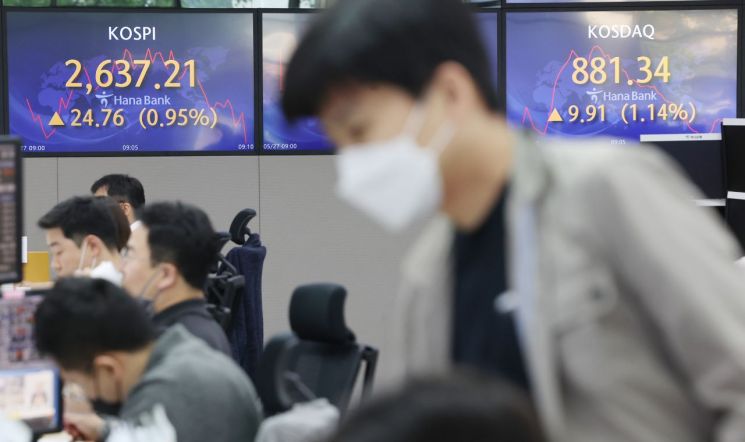
[Asia Economy Reporter Ji Yeon-jin] The domestic stock market closed lower on the 2nd with both the KOSPI and KOSDAQ indices falling. Although the KOSPI index rebounded for three consecutive trading days since the end of last month, reaching just below the 2700 level, concerns over an economic recession resurfaced, and the decline in the U.S. stock market fueled selling pressure from institutional investors.
The KOSPI index closed at 2658.99, down 26.91 points (1.00%) from the previous day. After hitting the 2610 level on the 26th of last month, it rebounded for three days, rising to 2685.90 on the 31st, before retreating back to the 2650 range.
Institutions led the decline by net selling about 748 billion KRW worth of stocks. Foreign investors also sold approximately 91.1 billion KRW. On the other hand, individual investors bought a net 792.7 billion KRW, preventing further decline. Some market participants predicted that if the KOSPI index falls below the 2650 level, it could slide further to the 2630 level. Lee Kyung-min, head of investment strategy at Daishin Securities, said, "Due to the sluggish U.S. stock market, the domestic market is showing an unstable trend. The KOSPI index appears to be experiencing a retracement after a relief rally at the 2650 support level, but if the 2650 level breaks, it could fall to 2630."
The weakness on this day was largely influenced by the previous day’s decline in the U.S. stock market amid high oil prices and renewed recession concerns. The U.S. Federal Reserve (Fed) mentioned weak demand in its Beige Book economic report, and the burden of rising interest rates due to quantitative tightening weighed on the market. Jamie Dimon, CEO of JP Morgan, the largest U.S. bank, confirmed market concerns by warning to "prepare for the hurricane (typhoon) hitting the economy."
Kim Seok-hwan, a researcher at Mirae Asset Securities, said, "The U.S. stock market’s recession issue and JP Morgan CEO’s remarks that the Fed’s tightening and the war-driven rise in oil prices will hit the economy like a hurricane have been a burden on the domestic stock market. Most of the top market cap stocks in the KOSPI declined, widening the gap compared to the KOSDAQ."
Among the top market cap stocks on the KOSPI that day, only NAVER (0.69%) saw foreign buying and rose slightly, while all others fell. LG Chem dropped 2.56%, Samsung Electronics fell 1.04%, slipping back to the 66,000 KRW range, and Hyundai Motor, Samsung SDI, and Kakao also recorded declines exceeding 1%.
By sector, non-metallic minerals rose 1.35%, while the early session gains in textiles and apparel (0.44%) narrowed slightly by the close. Food and beverages ended with a slight gain of 0.03%, finishing on a firm note.
At the same time, the KOSDAQ index closed at 891.14, down 2.22 points (0.25%). Foreigners and institutions sold 55.9 billion KRW and 51.7 billion KRW respectively, but individual investors bought a net 116.5 billion KRW, defending the 890 level.
However, among the top market cap stocks on the KOSDAQ, all except L&F (0.23%) recorded losses. Wemade’s self-issued cryptocurrency WEMIX fell 5.04% after a report suggested it could be classified as a security. Pearl Abyss and CJ ENM dropped 2.37% and 3.53%, respectively. Celltrion Healthcare and HLB also fell more than 1%.
Earlier, Kim Ha-jung, a researcher at Daol Investment & Securities, pointed out in a report that day, "Although WEMIX qualifies as a security, it did not comply with capital market regulations, and a complaint was filed with the Financial Services Commission. Whether tokens from P2E (play-to-earn) platforms like WEMIX are securities is a key issue, with the Musicow case cited as a similar precedent."
Meanwhile, in the KOSDAQ market that day, Notus recorded a 52-week high for the second consecutive day with an 800% free stock dividend ex-rights effect, and Woorim PTS surged to the price limit after speculation that it could be a target for Samsung Electronics’ mergers and acquisitions (M&A). Samsung SPAC No.4 also closed at the upper price limit following mentions of Samsung’s M&A activities.
© The Asia Business Daily(www.asiae.co.kr). All rights reserved.
![Clutching a Stolen Dior Bag, Saying "I Hate Being Poor but Real"... The Grotesque Con of a "Human Knockoff" [Slate]](https://cwcontent.asiae.co.kr/asiaresize/183/2026021902243444107_1771435474.jpg)
















