KakaoTalk Server Search and Seizure Deemed 'Time Requiring Urgency'... Guarantee of Participation Rights Essential During Data Extraction
Court: Lack of Participation Rights for Seized Party During Criminal Suspicion Search Constitutes Serious Illegality
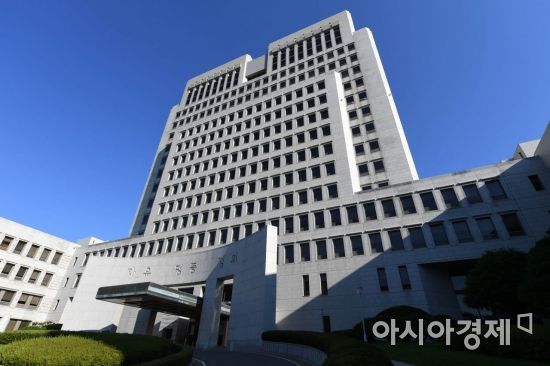
[Asia Economy Reporter Heo Kyung-jun] The Supreme Court has made its first ruling that it is illegal for investigative agencies such as the prosecution and police to secure data by conducting a search and seizure of electronic information stored on KakaoTalk's headquarters server without guaranteeing the 'right to participate' to the actual subject of the seizure, the suspect.
The Supreme Court's First Division (Presiding Justice Kim Seon-su) announced on the 2nd that it upheld the lower court's decision to dismiss the prosecutor's appeal in a quasi-appeal case filed by Yong Hye-in, a member of the Basic Income Party, who requested the cancellation of the search and seizure of her KakaoTalk messenger by investigative agencies.
In May 2014, Representative Yong organized a 'silent march to commemorate the Sewol ferry disaster.' The prosecution and police took issue with this and searched and seized the KakaoTalk conversations of Yong, who was a university student at the time. The prosecution and police received from Kakao's legal team the KakaoTalk messages, photos, and videos that Yong had exchanged between May 12 and 21, 2014. Subsequently, in November 2014, the prosecution indicted Yong without detention on charges of illegal assembly and demonstration, including occupying roads.
The problem arose when the prosecution and police secured Yong's KakaoTalk conversation contents without notifying her of the search and seizure and without involving her in the digital forensic process. Upon learning belatedly of the search and seizure, Yong filed a quasi-appeal, arguing that the investigative agencies did not notify her in advance and did not present the original warrant at the time of execution, which was illegal.
In the trial, the key issues were whether the suspect, as the actual subject of the seizure and holder of electronic information stored by the internet service provider, has the right to participate when investigative agencies execute a search and seizure warrant, and if so, whether the exception of 'when urgent action is required' stipulated in Article 122 of the Criminal Procedure Act applies, allowing the investigative agencies to omit prior notification to the suspect.
The lower court ruled that the search and seizure in this case did not fall under the exception of 'when urgent action is required' as stated in the proviso of Article 122 of the Criminal Procedure Act, which exempts the obligation of prior notification to the right-holder. It also found that the investigative agencies failed to notify the date and place of the warrant execution, thereby violating the right to participate of Yong and others.
The Supreme Court also found serious procedural violations, including the prosecution and police not presenting the original warrant during the search and seizure, printing and seizing all electronic information obtained from KakaoTalk without selecting only the parts related to the criminal charges, thus failing to guarantee the right to participate to the actual subject of the seizure, and not providing a list of the seized electronic information, which rendered the entire search and seizure procedure illegal.
However, the court stated that at the time of the search and seizure, the situation did correspond to the exception of 'when urgent action is required' under the proviso of Article 122 of the Criminal Procedure Act, and that failure to provide prior notification alone does not necessarily mean that the right to participate was violated.
Since the seizure of electronic information such as KakaoTalk servers usually involves freezing and taking servers containing information related to the criminal facts, in such cases, unless there are special circumstances, the urgency is recognized, and the suspect or right-holder does not need to participate. However, when extracting and exploring parts related to the criminal facts, the right to participate of the subject of the seizure must be guaranteed.
© The Asia Business Daily(www.asiae.co.kr). All rights reserved.
!["The Woman Who Threw Herself into the Water Clutching a Stolen Dior Bag"...A Grotesque Success Story That Shakes the Korean Psyche [Slate]](https://cwcontent.asiae.co.kr/asiaresize/183/2026021902243444107_1771435474.jpg)
















