WHO "Over 550 Infection Cases Reported in 30 Countries Worldwide"
"Pandemic Possibility Low but Insufficient Information on Monkeypox"
Earlier, Yoon Said "Should Have Controlled Entry from China"... What About Monkeypox?
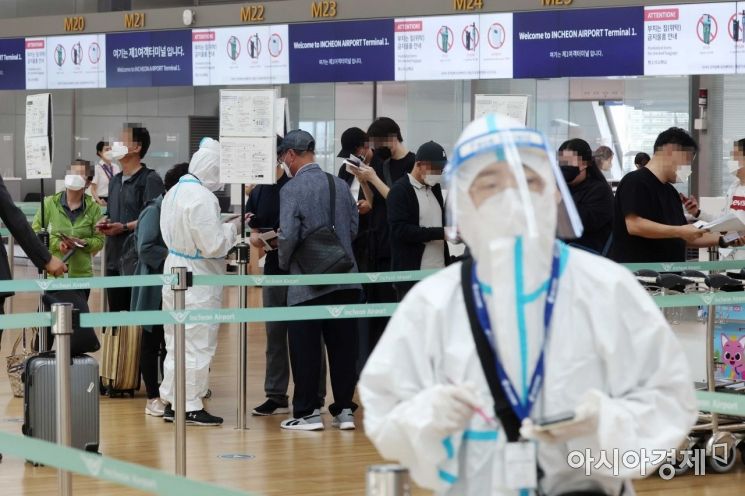 As the COVID-19 pandemic subsides and demand for overseas travel increases, the threat of imported COVID-19 variants and monkeypox is gradually rising. On the 26th, at the departure hall of Terminal 1 at Incheon International Airport, an airline staff member wearing protective clothing is guiding passengers heading to China. Photo by Moon Honam munonam@
[Asia Economy Reporter Yoon Seul-gi] The spread of monkeypox, an endemic disease in Africa, is becoming serious. After initial cases were reported in early May in the UK, the virus spread to Europe, the United States, and other regions, and within about a month, more than 550 infection cases were confirmed in 30 countries worldwide. As concerns grow that monkeypox could cause a large-scale outbreak like COVID-19, some voices are calling for quarantine measures such as entry restrictions.
On the 1st (local time), the World Health Organization (WHO) announced that more than 550 cases of monkeypox infection have been confirmed in over 30 countries worldwide. According to foreign media including AFP, WHO Director-General Tedros Adhanom Ghebreyesus said in a briefing that "the sudden appearance of monkeypox in many countries around the world means that this virus is spreading outside the usual endemic countries in West and Central Africa, where it had not been detected for some time."
Dr. Rosamund Lewis, WHO's technical lead on monkeypox, said, "At this point, we cannot confirm whether it is too late to contain the spread of monkeypox," adding, "WHO and all member states are working towards this goal."
Monkeypox is a zoonotic infectious disease endemic to Central and Western Africa, transmitted between humans and animals. It shows symptoms similar to smallpox, including fever, headache, muscle pain, as well as rashes, blisters, and pustules on the face and body. Monkeypox can be transmitted through direct contact with the blood or bodily fluids (saliva, urine, vomit, etc.) of an infected person via skin lesions or mucous membranes, or through sexual contact via semen.
Concerns about infection have increased due to the unusual surge of confirmed monkeypox cases in non-endemic regions. Since May 7, when a patient presumed to have contracted monkeypox virus after visiting Nigeria in Africa was reported in the UK, confirmed cases have appeared in Europe, North America, Australia, and the Middle East.
According to WHO statistics updated on the 29th of last month, a total of 257 confirmed and 117 to 127 suspected cases were identified in 23 countries. The UK reported the highest number with 106 patients, followed by Portugal (49), Spain (20), the Netherlands (12), Germany (5), and Italy (4), with cases reported across Europe. In North America, 10 cases were reported in the United States and 26 in Canada.
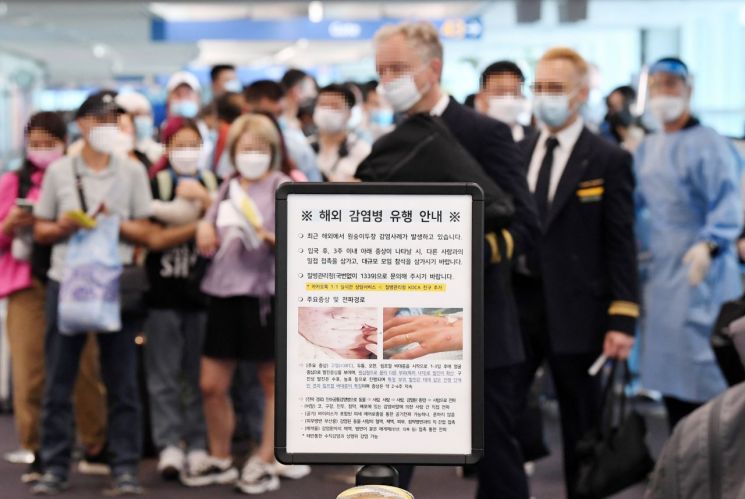 On the morning of the 27th of last month, overseas arrivals were waiting for quarantine at the arrival hall of Terminal 1, Incheon International Airport. In front of the passengers, there is a notice related to monkeypox. [Image source=Yonhap News]
◆ President Yoon: "We should have banned entry from China early in COVID-19"... What about monkeypox?
WHO states that the possibility of a pandemic is low but acknowledges that information is insufficient, so concerns remain. With the recent surge in overseas travel demand, the possibility of domestic importation is increasing, making it impossible to lower quarantine vigilance.
Consequently, voices demanding a ban on overseas entry to prevent monkeypox importation are emerging in online communities. During his presidential campaign, President Yoon Seok-yeol criticized the Moon Jae-in administration for not implementing a "ban on Chinese entry," drawing attention to entry controls.
Earlier, during the early spread of COVID-19, a petition urging a "ban on Chinese entry" was posted on the Blue House's public petition board. It recorded the third-highest number of signatures in history (761,833), reflecting high public interest, but the Moon Jae-in administration did not accept it. At the time, the administration judged that it could affect diplomatic relations with China and that the risk of infection through Chinese entrants was low since the Chinese government had already imposed lockdowns in Hubei Province, where COVID-19 had spread.
Since monkeypox is spreading in non-endemic regions outside the origin countries, it seems difficult to prevent the spread of infection solely through entry restrictions on specific countries. On the 24th, quarantine authorities strengthened monitoring by checking the fever of entrants and requiring health questionnaires to prevent domestic importation.
Moreover, as the spread of monkeypox shows signs of intensifying, emergency responses such as designating monkeypox as a second-class infectious disease have been initiated. On the 31st of last month, the Korea Disease Control and Prevention Agency held a crisis assessment meeting and decided to proceed with revising the notification to designate monkeypox as a second-class and quarantine infectious disease. This means monkeypox will be managed under the same system as COVID-19 and measles. The infectious disease crisis alert level for monkeypox was also issued at the "interest" stage. Currently, Korea's infectious disease crisis alert has four levels: "interest → caution → alert → severe," with the interest stage being issued when new infectious diseases emerge and spread overseas.
© The Asia Business Daily(www.asiae.co.kr). All rights reserved.


















