Bank of Korea Hosts International Conference
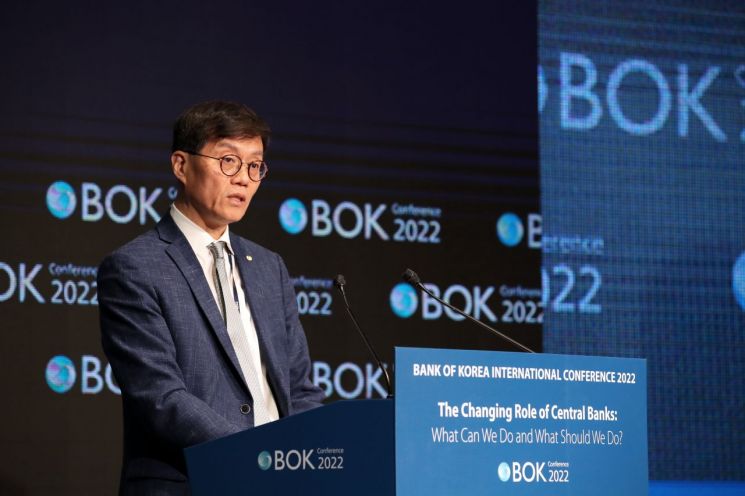
[Asia Economy Reporter Seo So-jeong] "When this inflation subsides, it cannot be ruled out that a low inflation and low growth environment will emerge in some emerging countries facing population aging issues, such as Korea, Thailand, and China."
Lee Chang-yong, Governor of the Bank of Korea, stated this during the opening remarks of the BOK International Conference held on the 2nd under the theme "The Changing Role of Central Banks: What Can and Should Be Done." He added, "We cannot yet confidently say whether the long-term secular stagnation trend will reappear once inflation subsides."
On the day, Governor Lee said, "If low inflation and low growth occur, I wonder whether countries like Korea and other emerging markets should, as Professor Paul Krugman advised advanced central banks, make an almost irresponsible firm commitment to continue accommodative monetary policy." He analyzed, "The use of unconventional policy tools like those in advanced countries could lead to expectations of currency depreciation, increasing the possibility of capital outflows, so emerging countries must act more cautiously and conservatively in monetary policy operations."
He noted, "If expansionary policies similar to those during the COVID-19 crisis are implemented again without the support of global liquidity, the implications for capital flows and inflation expectations will be quite different," and pointed out, "It is not easy to find a clear answer on what effective unconventional policy tools tailored for emerging countries in a low inflation and low growth phase would be, and this remains a challenge to be addressed going forward."
Furthermore, Governor Lee emphasized that the role of central banks has entered a major turning point since the COVID-19 crisis, and there is a need to expand their role beyond the fundamental task of 'price stability' to meet social expectations.
He stated, "Recent digital innovation and climate change response are unavoidable trends of the times, and the role of central banks for these will inevitably grow," adding, "Central banks around the world are either promoting the introduction of digital currencies (CBDCs) or intensifying research, and are also concretizing the development and implementation of policy tools for green growth."
He pointed out, "The social responsibility of central banks will continue to be demanded," and said, "While voices are emerging that central banks must fulfill social responsibilities as polarization caused by the pandemic is likely to worsen, it is questionable whether monetary policy alone can solve issues such as income polarization and asymmetric economic shocks across sectors."
He continued, "Central banks are like evolving organisms," and added, "We must not forget that interpretations of the responsibilities of central banks and the ways to achieve them have continuously evolved, and we should share thoughts and considerations to meet social expectations of central banks after the COVID crisis."
© The Asia Business Daily(www.asiae.co.kr). All rights reserved.

















