Reevaluation of the 2nd New Port Construction Master Plan
Securing Competitiveness Amid Supply Chain Disruptions
Accelerating the Establishment of a Fully Automated Gwangyang Port
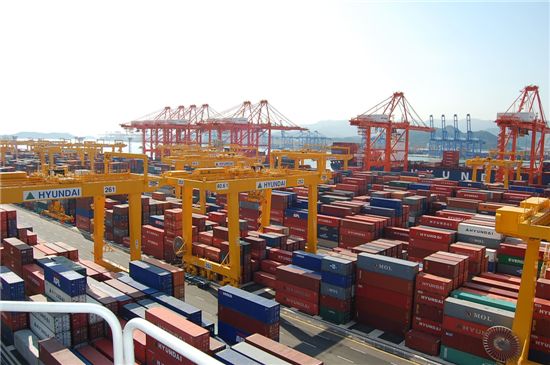 Container boxes are stacked at the Hyundai Merchant Marine New Port Terminal located on the south side of Busan New Port.
The Yoon Seok-yeol administration's national agenda in the maritime and fisheries sector includes the full-scale promotion of smart port construction to establish a world-class maritime transportation and logistics system. Alongside this, the government plans to accelerate the Busan Port Jinhae New Port project and the Gwangyang Port fully automated port construction project, aiming to 'restructure' the new port projects.
According to related ministries on the 31st, the Ministry of Oceans and Fisheries announced that it will begin revising the "2nd Basic Plan for New Port Construction (2019?2040)." From this day, the ministry will establish a new mid- to long-term development plan for 12 new ports through research services. First, it will comprehensively analyze the current status of the new ports, the progress of development projects, and issues specific to each new port to thoroughly review the validity of the existing plan.
In particular, the newly established basic construction plan will include specific measures to secure a leading position in the new shipping market, such as expanding ship and logistics hubs, enhancing competitiveness of the shipping logistics industry based on smart ports, and building a digital maritime traffic network?one of the 110 national agendas of the Yoon government. To this end, the criteria for designation and cancellation of new port planned areas will also be newly established. It is expected that institutional improvements will focus on facilitating efficient development, such as easing conditions for plan changes.
The reason the Ministry of Oceans and Fisheries is conducting a full review of the new port construction basic plan established in 2019 after only three years is due to the rapidly changing external environment, including port congestion and supply chain disruptions caused by the COVID-19 pandemic, which make it difficult to secure global competitiveness under the existing plan. Recently, demands for expanding public port development have steadily increased due to the global trend of larger vessels and growing demand for automated ports.
Since the enactment of the "New Port Construction Promotion Act" in 1996, the government has established the new port construction basic plan twice and has designated and developed 12 new ports with a total investment of 33 trillion won by the end of last year. However, it recognizes the need for more detailed strategic planning to secure future competitiveness.
Based on the results of feasibility reviews and regional opinion gathering, the Ministry of Oceans and Fisheries plans to prepare a basic plan amendment by the second half of next year and finalize the "2nd Basic Plan for New Port Construction Revision" in 2024. Kim Gyu-seop, Director of Port Development at the Ministry of Oceans and Fisheries, said, "New ports handle 85% of the country's total cargo volume, making them crucial hub ports for ensuring smooth logistics flow. Through the review of the new port construction basic plan, we will do our best to secure the competitiveness of our ports, the shipping logistics industry, and related fields."
© The Asia Business Daily(www.asiae.co.kr). All rights reserved.
















