"RAT Not Recommended... Can Be Performed When Prevalence Is High or PCR Is Limited"
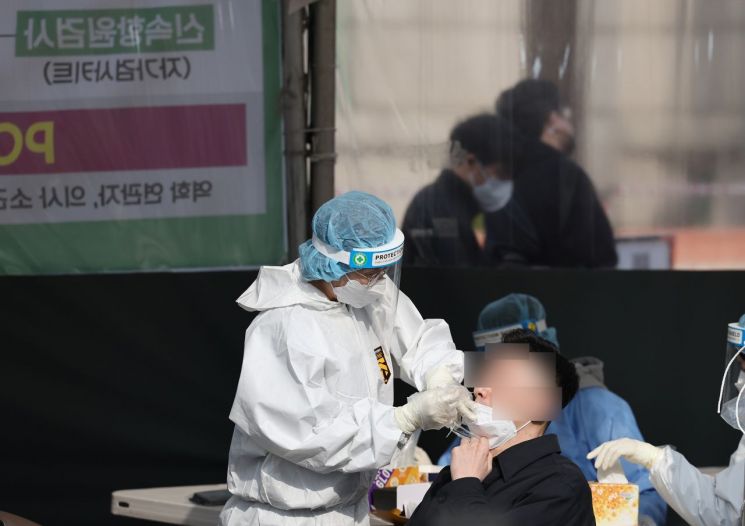 On the morning of March 25, a citizen visiting the temporary COVID-19 screening clinic at Seoul Station Plaza in Jung-gu, Seoul, is undergoing a rapid antigen test. [Image source=Yonhap News]
[Asia Economy Reporter Kim Jeong-wan] The sensitivity of rapid antigen tests (RAT) for asymptomatic COVID-19 pediatric and adolescent confirmed cases was found to drop to the 20% range.
On the 30th, the Korea Institute for Health and Social Affairs (KIHASA) stated, "For asymptomatic pediatric and adolescent cases, the positive diagnostic sensitivity was found to be 27?43%," adding, "Rapid antigen tests are generally not recommended for pediatric and adolescent individuals suspected of having COVID-19." However, they added, "Rapid antigen tests can be conducted if symptoms are present and PCR testing is not feasible."
KIHASA also stated, "Rapid antigen tests are generally not recommended for suspected COVID-19 cases (symptomatic or asymptomatic)," but "rapid antigen tests can be performed when COVID-19 prevalence is high and PCR testing is limited."
They further explained, "There is no significant difference in diagnostic accuracy depending on virus variants (Alpha, Delta, Delta+Omicron), but sensitivity tends to be lower in asymptomatic cases," adding, "Additional research is needed for recently emerging variants such as Omicron."
Meanwhile, regarding the use of oral COVID-19 therapeutics, KIHASA recommended considering molnupiravir administration for confirmed COVID-19 patients aged 18 or older with mild to moderate symptoms who have risk factors for severe disease but have difficulty using other COVID-19 treatments.
They also advised considering Paxlovid administration for mild to moderate COVID-19 patients aged 12 or older with risk factors for severe progression, provided their body weight is 40 kg or more.
Han Kwang-hyup, director of KIHASA, said, "Although the number of COVID-19 confirmed cases is gradually decreasing, new COVID-19 variants continue to emerge, making it important to prepare based on scientific evidence," adding, "We will continue to develop clinical practice guidelines based on the latest evidence in cooperation with the government and medical community."
The discussion involved eight Korean medical societies participating in the COVID-19 clinical practice guidelines, including the Korean Society of Infectious Diseases, Korean Academy of Tuberculosis and Respiratory Diseases, Korean Society of Pediatric Infectious Diseases, Korean Society of Radiology, Korean Society of Emergency Medicine, Korean Society of Critical Care Medicine, Korean Society for Laboratory Medicine, and Korean Society for Clinical Microbiology.
© The Asia Business Daily(www.asiae.co.kr). All rights reserved.
![Clutching a Stolen Dior Bag, Saying "I Hate Being Poor but Real"... The Grotesque Con of a "Human Knockoff" [Slate]](https://cwcontent.asiae.co.kr/asiaresize/183/2026021902243444107_1771435474.jpg)
















