Concerns over China's 'Resource Weaponization'
172 out of 228 Key Imported Items Are Chinese
Experts "Government Must Actively Diversify Import Sources"
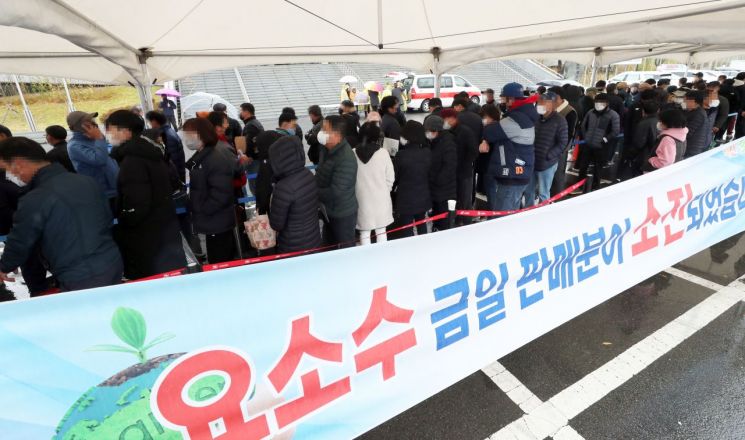
The so-called ‘urea solution shortage crisis’ that occurred last year is a representative case that highlighted the importance of securing global supply chains. Due to trade conflicts between Australia and China, exports of urea were restricted, causing the price of urea solution?which had a 97% dependence on China?to surge more than tenfold. As a result, South Korea was hit hard. Nationwide, truck lines formed at gas stations trying to obtain urea solution. The government hastily mobilized military transport planes to secure alternative supply routes to prevent a logistics system paralysis caused by the urea solution shortage. This was a harsh lesson on the cost of relying on a single country for essential industrial items.
Concerns about a ‘second urea solution crisis’ due to South Korea’s excessive import dependence on China are closely linked to the worsening global supply chain crisis caused by the Russia-Ukraine conflict and the prolonged lockdown measures in Shanghai, China. Among key goods imported into South Korea from the U.S., China, and Japan, 75% are of Chinese origin. Particularly, items with vulnerable supply chain stability account for an overwhelming 95.4%. Given the ongoing global supply chain disruptions, there are calls to resolve the ‘overconcentration’ on China.
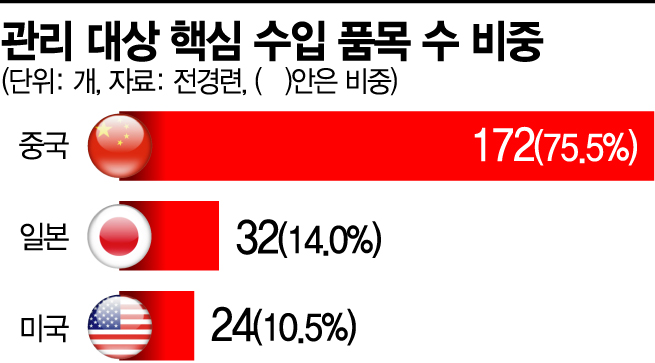
According to a report released on the 30th by the Federation of Korean Industries, 228 items with an import dependence rate of over 90% and absolute inferiority in import competitiveness, which fall within the top 30% in terms of import value, were defined as ‘key import items requiring management.’ The analysis showed that among these 228 items, 172 (75.5%) were Chinese-made. Japanese-made items accounted for 32 (14.0%), and U.S.-made items were 24 (10.5%).
The dependence on China for tungsten oxide, used in semiconductors and high-strength steel, is nearly 95%, and magnesium ingots essential for automobile production are entirely imported from China. If China imposes export restrictions again due to trade disputes with other countries, as it did during the ‘urea solution crisis,’ domestic industries are inevitably at risk of severe damage.
In particular, with the recent launch of the Indo-Pacific Economic Framework (IPEF) led by the U.S., concerns have arisen that China could weaponize resources at any time. If economic and diplomatic cooperation with China is not closely maintained through this opportunity, a ‘second urea solution crisis’ could strike the South Korean economy once again. A business community official said, "Because dependence on China is so high, the global supply chain crisis is expected to continue. There is concern that China, displeased with IPEF participation, might weaponize resources."
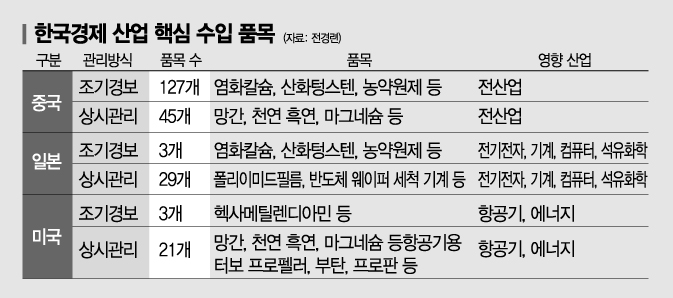
Experts recommend that the government make policy efforts to resolve this China overconcentration. Professor Choi Nam-seok of Jeonbuk National University identified 133 import items vulnerable to global supply chain shocks, including tungsten oxide, manganese, and magnesium, in his report. Among these, 127 items are Chinese-made, representing virtually the entire group. Japanese and U.S.-made items number only three each.
Professor Choi pointed out, "An early warning management system for key import items should be established, and government response plans should be continuously adjusted in a tailored manner based on field demand." He added, "If supply management for key import items is not properly handled, supply crises like the urea solution shortage can occur at any time. A continuous monitoring system should be built, and measures such as import diversification should be implemented."
Yoo Hwan-ik, head of the industrial division at the Federation of Korean Industries, also stated, "As the global supply chain crisis worsens, measures to resolve the overconcentration on China for key import items should be prepared through import source diversification and active participation in global supply chain alliances."
Meanwhile, with the inauguration of the new government, the need for economic cooperation with Japan is also emerging. Since trade between the two countries declined by about 10% due to Japan’s export restrictions on materials, parts, and equipment (so-called ‘Sobu-jang’ items) to South Korea, there are calls to strengthen economic cooperation between the two countries to reinforce the global supply chain.
© The Asia Business Daily(www.asiae.co.kr). All rights reserved.
![Clutching a Stolen Dior Bag, Saying "I Hate Being Poor but Real"... The Grotesque Con of a "Human Knockoff" [Slate]](https://cwcontent.asiae.co.kr/asiaresize/183/2026021902243444107_1771435474.jpg)


















