Investor-Centric Disclosures, Not Company-Centric
Management → Detailed Disclosure of Environmental and Social Impacts
Authorities in Each Country Can Adjust Accordingly
Companies Demand "Slower Adoption Pace for SMEs"
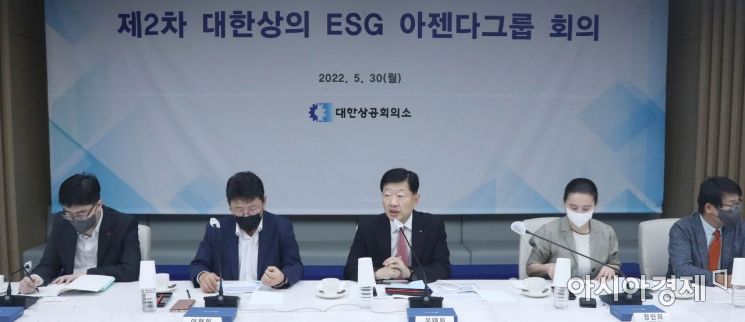 Woo Tae-hee, Executive Vice Chairman of the Korea Chamber of Commerce and Industry (center), is delivering a greeting at the 2nd KCCI ESG (Environment, Social, Governance) Agenda Group meeting held on the 30th at the KCCI Hall in Seoul.
[Asia Economy Reporter Moon Chaeseok] The industry sector has argued that the domestic introduction of the International Sustainability Standards Board (ISSB) 'sustainability disclosure' by the end of the year should be implemented sequentially according to company size and include a grace period. This response came after the IFRS Foundation in the UK, known for the so-called 'ESG (Environmental, Social, and Governance) disclosure' system, established a related organization at the end of last year and recently released a draft. The sustainability disclosure draft recently announced is expected to be finalized by the end of the year.
The Korea Chamber of Commerce and Industry (KCCI) announced on the morning of the 30th that it held the '2nd ESG Agenda Group Meeting' at the Jung-gu Chamber Hall in Seoul to discuss these matters with companies. The meeting was attended by Woo Tae-hee, Executive Vice President of KCCI; Lee Hyung-hee, Chairman of SK SV (Social Value) Committee; Kim Kwang-il, Director of Fair Market Division at the Financial Services Commission; Kim Ui-hyung, President of the Korea Accounting Standards Board; Kim Dong-soo, Director of Kim & Chang ESG Management Research Institute; Jeon Gyu-an, Vice Chairman of the KSSB Preparatory Committee; and executives from Samsung Electronics, Hyundai Motor, LG, Lotte (Lotte Holdings), POSCO, Hanwha, Doosan, CJ, GS Caltex, KT, KB Financial Group, and Shinhan Financial Group (Shinhan Holdings), among others from the industrial and financial sectors.

According to a survey conducted by KCCI among the top 20 domestic conglomerates and 17 major banks, 73% responded that "a sufficient grace period should be provided and the application should be gradual to avoid increasing the burden on companies" regarding the timing of applying ISSB disclosure standards. There is especially strong demand for a grace period for mid-sized and small enterprises. Many mid-sized and small companies currently lack sufficient IR (Investor Relations) organizations, leading to basic disclosure errors submitted to the Korea Exchange, and are already burdened by various ESG disclosures, which must be taken into account.
Yoon Cheol-min, Head of ESG Management Office at KCCI, said, "Since ESG disclosure is being standardized globally, many opinions emphasized the need for careful preparation according to company size," adding, "For example, the consensus is to apply the standards step-by-step based on a total asset threshold of 2 trillion KRW." The '2 trillion KRW total assets' threshold is the mandatory disclosure criterion for corporate governance (the 'G' in ESG) for KOSPI (Korea Composite Stock Price Index) companies. Since ISSB disclosures allow autonomous application according to each country's circumstances, if authorities accept corporate opinions, sequential application by size and grace periods can be established.
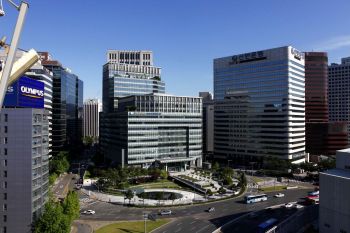 Exterior view of the Sangui Hall in Jung-gu, Seoul, where the meeting was held. (Photo by Korea Chamber of Commerce and Industry)
The presenters emphasized the need to accelerate the establishment of a Korean dedicated organization called 'KSSB' (Korea Sustainability Standards Board) and build a cooperative system with the IFRS Foundation.
Vice Chairman Jeon Gyu-an said, "We need to establish a dedicated organization domestically to strengthen cooperation channels with the IFRS Foundation and actively present opinions reflecting the unique characteristics of the domestic business environment during the ISSB standards development process," adding, "KSSB should be established within the Korea Accounting Standards Board, and the Capital Market Act should be amended to include the legal basis and related provisions." He also stated, "Companies need to actively provide opinions during the ISSB sustainability disclosure standards development process."
Since sustainability disclosures have legal binding force in the United States and the European Union (EU), advice was given that companies should promptly establish ESG data management systems for each business site.
Director Kim Dong-soo said, "In March, the U.S. Securities and Exchange Commission (SEC) climate change disclosure standards and ISSB standards were released consecutively, and at the end of last month, the EU's Corporate Sustainability Reporting Directive (CSRD) standards were also announced, presenting legal requirements related to ESG information disclosure and accounting standards simultaneously in the U.S. and Europe," adding, "Future ESG disclosure issues will include which standards to use, the scope of information disclosure, who and how to guarantee the quality verification standards of information disclosure, and what institutional measures to prepare." He continued, "Regardless of the outcome, establishing an ESG data management system for each business site has become an important task for companies."
As the disclosure subject and content are expected to shift from being 'company'-centered to 'investor'-centered, companies must make thorough preparations to reduce management uncertainty and costs. Yoon said, "Once ISSB's sustainability disclosure standards are disseminated, companies will disclose not the impact they have on the environment and society but the impact the environment and society have on the companies," explaining, "The obligation to disclose will shift from being company-centered to investor-centered."
According to KCCI, the IFRS Foundation established the ISSB at the end of last year, formulated the related disclosure standards, and announced a draft on March 31. It is expected to collect opinions until July 14 and announce the final version by the end of the year.
© The Asia Business Daily(www.asiae.co.kr). All rights reserved.

![Clutching a Stolen Dior Bag, Saying "I Hate Being Poor but Real"... The Grotesque Con of a "Human Knockoff" [Slate]](https://cwcontent.asiae.co.kr/asiaresize/183/2026021902243444107_1771435474.jpg)

















