Strengthening Education to Support Adaptation of Migrant Background Youth
Enhancing Awareness Improvement Projects for Educational Institutions
[Asia Economy Reporter Han Jinju] The Ministry of Gender Equality and Family announced on the 29th that it will strengthen support for education and welfare services to help migrant-background youth adapt to Korean society.
According to the Ministry's 2022 Youth Statistics, multicultural students accounted for 3% of all students last year, totaling 160,058, which is about three times higher than in 2013 (55,780). Including children of multicultural families who entered mid-way and North Korean defector youth, the migrant-background youth population is estimated to be about 270,000.
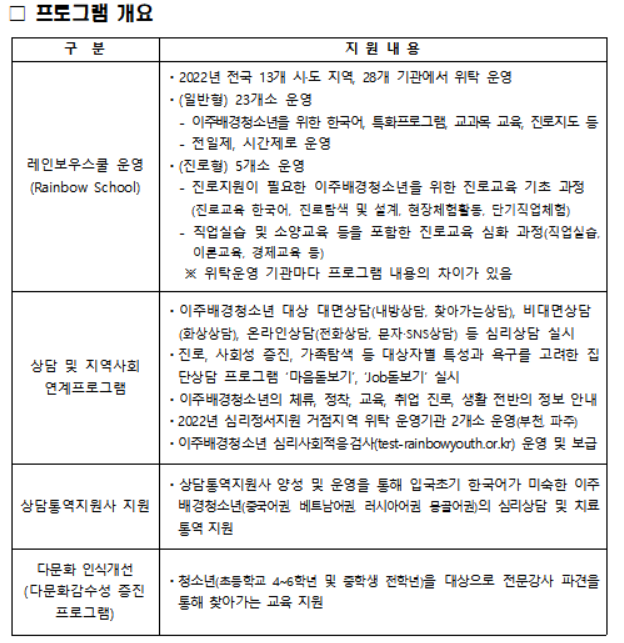
The Ministry supports services for migrant-background youth aged 9 to 24 who face difficulties with language barriers, social adaptation, and academics. It provides information on Korean language education, transfer admissions, career and academic guidance, as well as foreigner registration, stay, and nationality acquisition. At 13 Rainbow Schools nationwide, Korean language education, specialized programs, and career guidance are offered. From this year, Korean language education has been reorganized into level-based courses such as basic and advanced, and programs have been revamped to align with participants' goals, including college preparation and career specialization.
Counseling is also provided tailored to the age and migration type characteristics of migrant-background youth. Counselors are directly dispatched to areas with low accessibility. Psychological counseling and therapy are supported by experts who can interpret and counsel in Chinese, Vietnamese, Russian, and other languages.
The Ministry plans to strengthen awareness-raising projects to help understand migrant-background youth. Professional multicultural understanding instructors are dispatched to elementary and secondary school classes and educational institutions nationwide to conduct the "Multicultural Sensitivity Enhancement Program." Training to strengthen multicultural understanding is provided to youth leaders, related institution workers, and university students majoring in youth studies and social welfare to improve their ability to prevent and respond to discrimination that may occur in the field.
Kim Kwon-young, Director of Youth Policy at the Ministry of Gender Equality and Family, said, "We will systematically support migrant-background youth to guarantee their diversity and educational opportunities so that they can settle stably in our society and grow up healthily."
© The Asia Business Daily(www.asiae.co.kr). All rights reserved.

















