Lee "Nightmares Resurface Since People Power Government"
Presidential Office "No Plans to Proceed"... Concern Over Election Impact
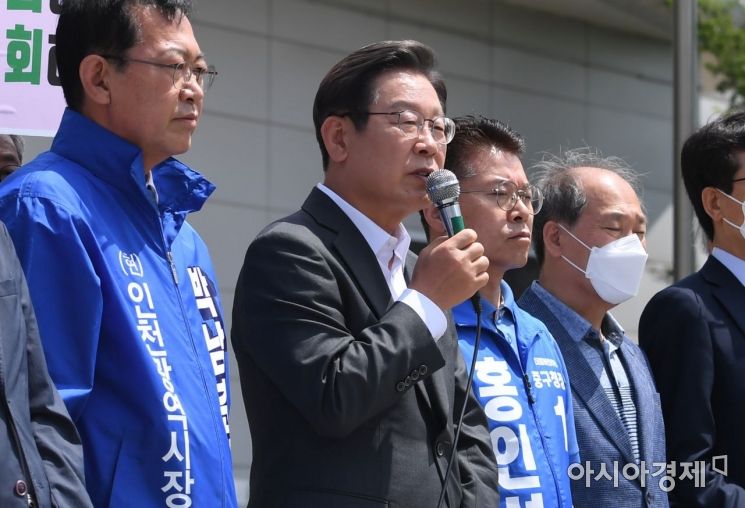 Lee Jae-myung, the Democratic Party of Korea candidate for the Incheon Gyeyang-eul by-election, attended and spoke at the "Press Conference Against the Privatization of Airport Railroad Electricity and Water" held on the 26th at Gyeyang Station Square in Incheon. Photo by the National Assembly Press Photographers Group
[Asia Economy Reporter Park Jun-yi] The Democratic Party of Korea has raised the 'anti-privatization' card ahead of the June 1 local elections. They claim that the Yoon Seok-yeol administration is attempting to revive the 'Incheon Airport privatization plan' that was pushed during the Lee Myung-bak government. In response, the Presidential Office dismissed the claim, stating that 'privatization has never been considered.'
On the morning of the 26th, Lee Jae-myung, the Democratic Party's general election committee chairman and candidate for the National Assembly in Incheon Gyeyang-eul, held a 'Press Conference Against Privatization of Airports, Railways, Electricity, and Waterworks' at Incheon Gyeyang Station Plaza. He announced, "We plan to make the bill banning privatization our top priority legislation."
He appealed, "With the People Power Party government in power, the nightmare of privatization is being revived. The Democratic Party of Korea will definitely protect Incheon Airport. We ask the citizens to join forces with us."
Recently, the Democratic Party has used 'anti-privatization' as an offensive card against the government and ruling party. This began at the National Assembly Steering Committee's plenary meeting on the 17th. On that day, Kim Dae-gi, Chief Secretary to the President, responded to questions about public enterprise privatization by saying, "The government will manage Incheon International Airport, but about 30-40% of shares should be sold to the private sector." Based on this, the Democratic Party raised concerns that the government is pushing for privatization of key national industries.
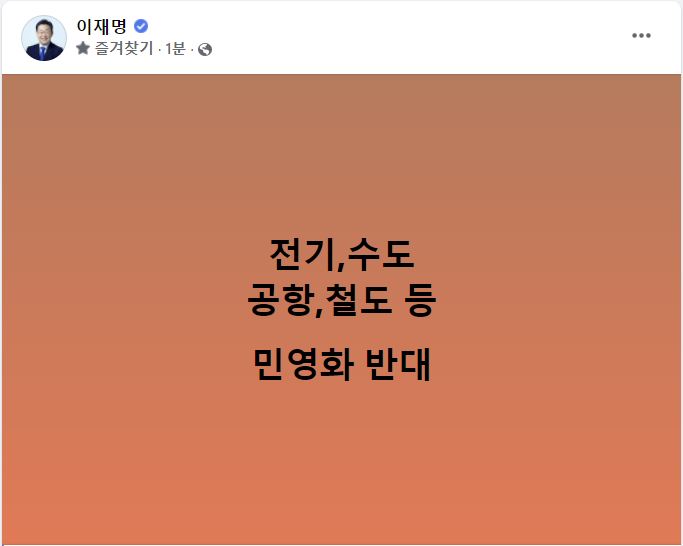
Subsequently, Chairman Lee and Song Young-gil, the Democratic Party's Seoul mayoral candidate, proposed a popular resistance movement and continued their offensive. On the 18th, Chairman Lee posted a brief message on Facebook saying, "Opposition to privatization of electricity, water, airports, and railways," and Candidate Song also stated, "I propose a popular resistance movement. I oppose the privatization of electricity, water, airports, and railways."
This is interpreted as an 'anti-ruling party strategy' aimed at changing approval ratings about two weeks before the local elections. In the past, during the Lee Myung-bak administration, plans to privatize 305 public enterprises, including Incheon Airport, were pursued but were completely withdrawn due to strong public opposition. It is claimed that Chief Secretary Kim's remarks are linked to the 2009 'Incheon Airport Corporation Modernization Plan' announced by the Lee Myung-bak government, which pushed for selling 49% of Incheon Airport shares.
However, the People Power Party's Central Election Committee's Fair Election Headquarters responded on the 22nd through a press release, stating, "Strict legal action is inevitable against acts that confuse voters by promoting fake privatization," and "We will root out the spread of fake news and false information."
The Presidential Office also dismissed the claims on the 27th, saying, "The government has never considered privatizing public enterprises, nor does it currently plan to do so." A Presidential Office official said at the Yongsan Presidential Office that day, "I recall the question was whether the personal beliefs expressed in a past book are still valid. The comments were personal opinions mentioned in the book, not statements about the new government's policy direction."
© The Asia Business Daily(www.asiae.co.kr). All rights reserved.


















