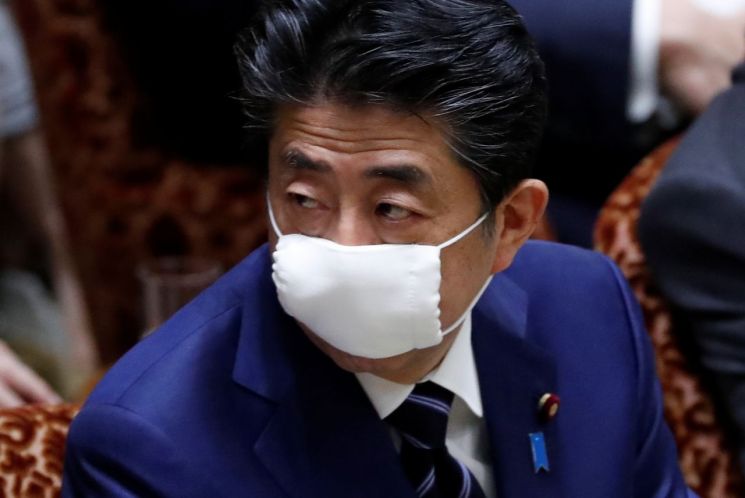
[Asia Economy Reporter Kim Daehyun] Former Japanese Prime Minister Shinzo Abe said that the launch of the Yoon Suk-yeol administration has created an opportunity to improve Korea-Japan relations.
In an interview with the British magazine The Economist published on the 26th (local time), former Prime Minister Abe was asked whether the new government in Korea has created an opportunity to improve bilateral relations, to which he replied, "I believe there is an opportunity."
He added, "From a security perspective, it seems that President Yoon Suk-yeol understands the importance of cooperation not only among the three countries of Korea, the U.S., and Japan but also between Korea and Japan," and said, "I recently met with a Korean policy delegation, and my thoughts are based on what I heard at that meeting."
He stated, "Regarding the comfort women agreement and forced labor issues, it is important that Korea respond thoroughly based on the agreements and treaties concluded between the two countries."
When asked if Korea should take the first step, he answered, "The comfort women agreement was made under the condition that it was final and irreversible during former President Park Geun-hye's administration, but then former President Moon Jae-in overturned it," and added, "I hope Korea restores the agreement."
Regarding the proposal of the 'nuclear sharing' policy, former Prime Minister Abe said, "I did not say it must be adopted exactly," but "I said that discussing reality should not be taboo." He also said, "I hope Japan and the U.S. discuss the timing and methods of nuclear retaliation, including the use of tactical nuclear weapons," and added, "A system should be created in which Japan can participate in the decision-making process."
He argued, "If North Korea thinks the U.S. will not retaliate, the risk of attacking Japan will increase," and emphasized, "To prevent that, Japan and the U.S. must thoroughly discuss and make it clear that the U.S. will retaliate on behalf of Japan."
While supporting a tough stance against Russia, he analyzed, "If Ukrainian President Volodymyr Zelensky had promised not to join the North Atlantic Treaty Organization (NATO) or guaranteed a high degree of autonomy to eastern Donbas, the war could have been avoided." "Of course, it is not an easy matter," he added, "The U.S. leader might have been able to do it, but President Zelensky would have refused."
Regarding the time and political capital spent on 27 meetings with Russian President Vladimir Putin, he said he did not regret it and added, "It was a situation where the northern threat had to be reduced and the southwest defended."
According to The Economist, Japan's ruling Liberal Democratic Party is still influenced by former Prime Minister Abe in its foreign and security policies. His strategy remains Japan's fundamental strategy.
© The Asia Business Daily(www.asiae.co.kr). All rights reserved.

















