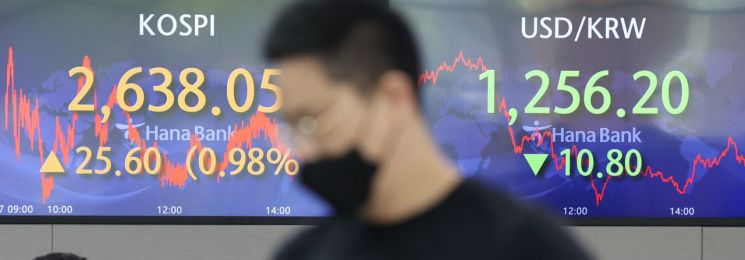
[Asia Economy Reporter Lee Seon-ae] This week (May 30 to June 3), the KOSPI is expected to attempt a rebound amid easing inflation concerns. However, since caution still remains, it remains to be seen whether the rebound rally will continue.
According to the Korea Exchange on the 29th, last week (May 23 to 27) the KOSPI closed at 2,639.29, up 1.3 points (0.05%) from the previous week. It has been stuck in a box range of 2,500 to 2,600 for a month.
This week, the market is expected to be influenced by major economic indicators from the U.S. and Korea released at the end and beginning of the month. NH Investment & Securities forecasted that the KOSPI will move between 2,550 and 2,670 points. Strong economic indicators such as U.S. employment and Korean exports could be positive factors, but ongoing inflation concerns are expected to weigh on stock prices.
Kim Young-hwan, a researcher at NH Investment & Securities, said, "Korea’s May export growth rate on June 1 is expected to increase by 12.9% compared to the previous month, and if the export growth rate meets consensus levels, it will support a solid earnings outlook for the KOSPI," adding, "The stock market is currently paying more attention to inflation and economic slowdown concerns underlying the positive economic indicators. Therefore, it is important to confirm that inflationary pressures are easing more than other economic indicators."
Daishin Securities also sees a low possibility of the KOSPI falling below 2,600 and expects the market to gradually respond to positive factors. Lee Kyung-min, a researcher at Daishin Securities, emphasized, "The trade deficit, which had pressured the Korean won to weaken, is expected to shrink, and a rebound in China’s economy is anticipated. These outcomes could increase upward pressure on the yuan and won, positively affecting foreign investor demand." He added, "For the time being, 2,600 will serve as a short-term and important support level for the KOSPI, and the possibility of a significant drop below this level is low. The market will gradually become more sensitive to positive news than negative."
Hyundai Motor Securities also expects positive changes in foreign investor demand. Kim Jung-won, a researcher at Hyundai Motor Securities, noted, "Recently, Christine Lagarde, President of the European Central Bank (ECB), indicated that net asset purchases will end in early Q3 and interest rates will rise in July, potentially ending negative interest rates by the end of Q3." He added, "With the German and Latvian central bank governors mentioning the possibility of a big rate hike, the dollar’s strength appears limited. If additional upward pressure on the dollar eases, the burden on foreign investor demand in the domestic stock market could also be alleviated."
The automotive sector is the most notable industry. Kim Young-hwan of NH Investment & Securities advised, "Looking toward the second half of the year, it is necessary to focus on sectors with positive momentum beyond the economy, such as automotive and electronic components, where shipment increases are expected due to easing vehicle semiconductor shortages, and the gaming sector with anticipated new momentum." Researcher Kim Jung-won also explained, "Although the dollar’s rise has paused, it is expected to remain at a high level for some time, which could improve margins for domestic export companies. Attention is needed for export sectors such as semiconductors, IT home appliances, and automobiles."
© The Asia Business Daily(www.asiae.co.kr). All rights reserved.
![Clutching a Stolen Dior Bag, Saying "I Hate Being Poor but Real"... The Grotesque Con of a "Human Knockoff" [Slate]](https://cwcontent.asiae.co.kr/asiaresize/183/2026021902243444107_1771435474.jpg)
















