Reliable Environmental and Ethical Evaluation Indicators
"Must Be Entrusted to Both Public and Private Institutions"
Essential for ESG Management Decision-Making and Forecasting
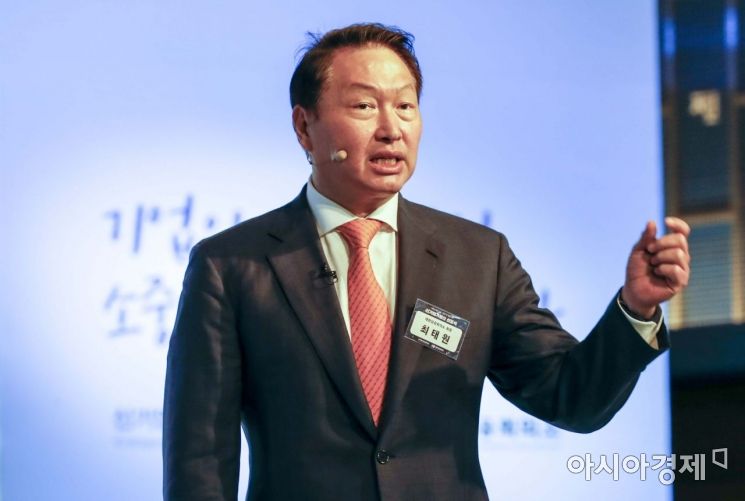 Chairman Choi Tae-won of the Korea Chamber of Commerce and Industry is giving a presentation on the Entrepreneurial Spirit Council (ERT) at the Entrepreneurial Spirit Declaration Ceremony held at the Chamber of Commerce Building in Jung-gu, Seoul on the morning of the 24th. Photo by Kim Hyun-min kimhyun81@
[Asia Economy Reporter Moon Chaeseok] Attention is focused on Choi Tae-won, the head of the Korea Chamber of Commerce and Industry (KCCI), a major economic organization, as he emphasizes that establishing a proper system to evaluate companies' 'social management' is an urgent task. Although companies have declared a 'new (Shin) entrepreneurial spirit' that pursues 'social value' such as job creation, ESG (environment, social, and governance) management, and the expansion of advanced management culture beyond financial performance, he pointed out that the lack of an evaluation system will only increase confusion.
Choi made these remarks at the 'New Entrepreneurial Spirit' declaration ceremony held on the 24th at the KCCI building in Jung-gu, Seoul. This was a point he has consistently emphasized since the end of last month. At the 'Energy Transition and Carbon Neutrality Policy Seminar' hosted by KCCI on the 28th of last month, Choi stated, "Various private institutions, companies, and government agencies will be able to create (carbon neutrality) evaluation systems, and (most importantly) someone has to measure it," adding, "There must be an evaluation model so that policy authorities and companies can make key decisions, and from there, various systems such as prediction models and stock price forecasting systems will gradually be established."
Choi is a figure who has consistently emphasized the social management philosophy called 'Finance Story' to all employees through SK Group's management manual, SKMS (SK Management System). Since taking the helm of KCCI, he has led new management discourse by proposing the 'net-zero growth theory,' which argues that carbon neutrality (net zero) will drive economic growth once the break-even point is surpassed, and by leading the recent 'New Entrepreneurial Spirit' declaration ceremony. In essence, he acts as an evangelist of 'social management,' presenting the philosophy cultivated at SK Group to the Korean business community.
Why did Choi strongly insist on the need for a social management evaluation system? From a corporate perspective, companies are inclined to participate in realizing the new entrepreneurial spirit only if it benefits management. Capitalism requires a virtuous cycle where various credit indicators, reputation that helps attract investment, index rises, favorable media coverage, consumer response, and brand value enhancement translate into 'money.' Transitioning to 'stakeholder capitalism,' which contributes to the benefits of stakeholders rather than merely improving financial profitability and stock price management, requires corporate cooperation. In today's era of triple high inflation, exchange rates, and interest rates, management uncertainty is so high that it is difficult to induce corporate response with a simple 'spirit declaration' alone.
Accordingly, Choi diagnosed that a credible evaluation system must be established first to spread the new entrepreneurial spirit throughout the business community. Currently, evaluation entities and criteria are listed in a department store-like manner. In the financial investment sector, there are the Korea Exchange ESG disclosure guidance, the Financial Services Commission's mandatory corporate ESG disclosure, and the Korea Exchange's emission trading price indicators. Due to the lack of unified standards, corporate response is not high. In the public sector, the evaluation score for social value implementation in public institution management evaluation by the Ministry of Economy and Finance, which became a topic after last year's LH (Korea Land and Housing Corporation) employee land speculation scandal, serves as a reference. It is difficult to find unified standards like the MSCI (Morgan Stanley Capital International) ESG index used by major overseas investment banks (IBs).
There are concerns that without a credible evaluation system like the MSCI index, the new entrepreneurial spirit might be reduced to merely a corporate ethics awareness campaign. The message to 'do social management well' could be distorted into '(management) just needs to avoid causing social controversies.'
In particular, Korea's ESG management is widely believed to have started as an effort to improve 'G (corporate governance)' in response to social outrage over the power abuse scandals involving the management of Korean Air, Namyang Dairy Products, and webhard companies WEDISK and FileNori. It is said that companies, conscious of 'chaebol reform' and 'corporate punishment,' began ESG management reluctantly to avoid consumer lawsuits and criminal legal actions by authorities. This is far from the global standard of ESG management, which is based on a consensus, centered around the United Nations (UN) and others, that incorporating environment, social, and governance factors into corporate management is beneficial. Considering this background, establishing a credible ESG evaluation system is an essential requirement for properly implementing the 'New Entrepreneurial Spirit' declared on this day in the corporate field.
Choi's ultimate goal is to induce a 'virtuous cycle' where social management leads to improved financial performance. This is why he led the New Entrepreneurial Spirit declaration ceremony in his capacity as head of KCCI, not as a representative of SK Group. As the head of an economic organization, encouraging companies to participate in the social management-centered New Entrepreneurial Spirit declaration ceremony is the most certain way to reduce counterarguments that 'New Entrepreneurial Spirit' is merely SK Group's philosophy. Although SK is recognized as the company with a notable social value evaluation system in the Korean business community, 'SK' was not mentioned at the declaration ceremony.
© The Asia Business Daily(www.asiae.co.kr). All rights reserved.
!["The Woman Who Threw Herself into the Water Clutching a Stolen Dior Bag"...A Grotesque Success Story That Shakes the Korean Psyche [Slate]](https://cwcontent.asiae.co.kr/asiaresize/183/2026021902243444107_1771435474.jpg)
















