Average Card Sales Increased by 60% After Social Distancing Lifted
Sales Soared in Itaewon (180%), Euljiro (103%), University Areas (Around 90%)
Self-Employed Say, "Cooking Oil Price Rose from 30,000 to 60,000 Won"... Store Operations Still Challenging Due to Soaring Raw Material Costs
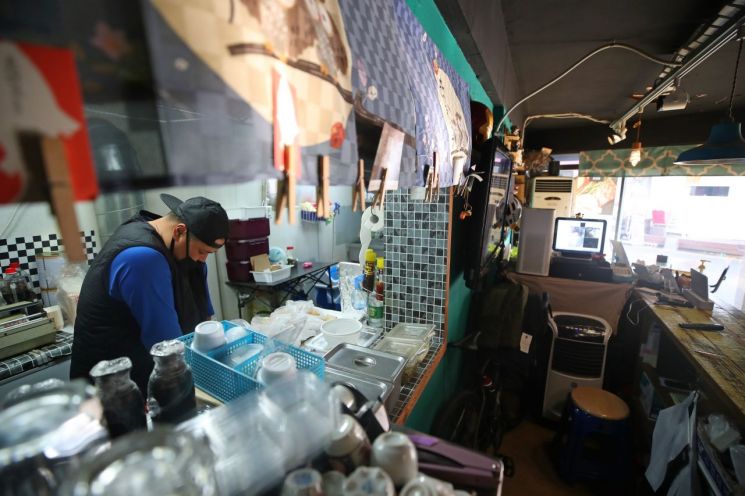 The owner of a tavern in Eunpyeong-gu, Seoul, is preparing for the evening business.
 [Image source=Yonhap News]
[Asia Economy Intern Reporter Kim Gun-chan] "Honestly, there’s not much left," "I don’t think we can smile just yet."
Although the number of consumers visiting restaurants and cafes has increased since the social distancing measures were lifted, self-employed business owners and small merchants complain that running their stores remains difficult due to soaring raw material prices such as cooking oil.
According to the 'Analysis of the Impact of the Lifting of Social Distancing Measures by Major Areas in Seoul' report released by KB Kookmin Card on the 16th, credit and debit card sales of self-employed business owners in Seoul increased after the social distancing measures were lifted. Compared to the period when business was restricted after 9 p.m. (December 18, 2021 ? February 18, 2022), card sales after 6 p.m. rose by an average of 60%.
The number of card transactions also increased compared to the period when business was restricted after 9 p.m. After the lifting of social distancing, the number of transactions after 6 p.m. increased by 44%. The reason the sales growth rate is higher than the transaction count is interpreted as meaning that people’s average spending has increased.
In particular, sales surged in Seoul’s Yongsan-gu Itaewon and Jung-gu Euljiro, which are considered 'hot places' among young people. Itaewon-dong recorded a 180% increase compared to the period when business was restricted after 9 p.m., ranking first among 232 administrative neighborhoods in Seoul. Euljiro-dong, known as 'Hipjiro' for its retro vibe, also saw sales increase by 103%. According to an analysis by Shinhan Card Big Data Research Institute, card payments in the area behind the Hamilton Hotel in Itaewon, where clubs and pubs are concentrated, surged by 296%.
It is analyzed that the 20s and 30s age group, who had refrained from outdoor activities due to COVID-19, led the sales recovery. The proportion of sales transactions by age group in Itaewon-dong, which had the highest sales growth rate, was 61% for people in their 20s and 27% for those in their 30s, totaling 88%.
Sales in university district commercial areas, filled with students returning to face-to-face classes after two years, are also on the rise. Sales increased by 100% in Jung-gu Pildong near Dongguk University, 93% in Seongbuk-gu Anam-dong where Korea University is located, 85% in Seongdong-gu Sageun-dong near Hanyang University, and 90% in Dongjak-gu Heukseok-dong where Chung-Ang University is situated.
A KB Card official said, "Analyzing changes in consumer behavior in Seoul by period after the lifting of social distancing, we confirmed that consumption is recovering mainly in major commercial areas."
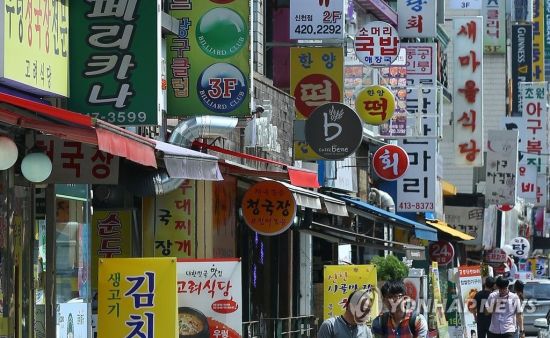 A bustling street in Songpa-gu, Seoul [Yonhap News archive photo]
◆ Rising Raw Material Prices such as Flour and Cooking Oil... Supplementary Budget Bill for Loss Compensation to Small Merchants and Self-Employed Passes National Assembly
Although consumers are increasing, self-employed business owners express that they cannot simply smile. This is because rising prices of raw materials such as cooking oil and flour make it difficult to operate restaurants and other businesses.
Kim Bok-soon (64), who has run a chicken restaurant in Euljiro for over 20 years, said, "Cooking oil that used to cost 35,000 won now costs about 65,000 won," adding, "Although sales are rising, prices have increased so much that the profit margin is not that large."
Jung (63), who has operated a pub in Euljiro for over 15 years, said, "Salmon used to cost 90,000 won per fish, but now it’s over 200,000 won," and added, "Mayonnaise and dried pollack prices keep rising too." He continued, "Prices go up overnight," and "No matter how much sales increase by a few percent, there’s not much left."
According to the Korea Agro-Fisheries & Food Trade Corporation’s Food Industry Statistical Information, the price of wheat, the raw material for flour, was $458.38 per ton as of the 16th. This is about a 76% increase compared to the same period last year ($260.88 per ton) and a 64.5% increase compared to earlier this year. Additionally, some large supermarkets have imposed purchase limits on cooking oil, causing a shortage of cooking oil.
For example, Lotte Mart announced on the 31st that it will accept pre-orders for large-capacity cooking oil (18L) from June 1 to 15. Amid the worsening domestic cooking oil supply shortage due to the Ukraine-Russia war, they are introducing a reservation system to sell large-capacity cooking oil at 69,900 won.
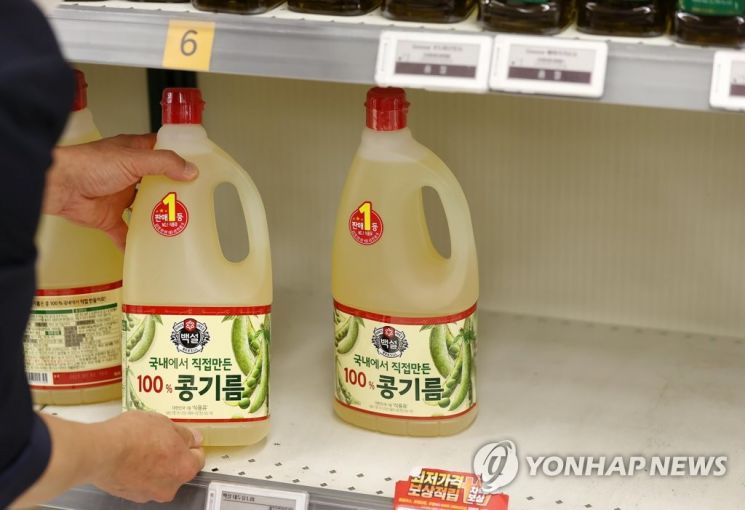 On the 16th, an empty spot is visible on the cooking oil shelf at a large supermarket in Seoul. Concerns over domestic cooking oil supply disruptions have increased since Indonesia restricted palm oil exports at the end of last month.
 [Image source=Yonhap News]
As the worries of self-employed business owners deepen, the government recently announced measures to reduce tariffs and value-added tax on imported goods such as cooking oil, flour, and coffee, focusing on price stabilization. Accordingly, tariffs on cooking oil, wheat, flour, and processed egg products will be exempted until the end of the year, and a 0% tariff quota will be applied to imported pork.
Meanwhile, with the supplementary budget bill for loss compensation for small merchants and self-employed passing the National Assembly, self-employed business owners are expected to breathe a little easier. According to the National Assembly on the 30th, the 39 trillion won supplementary budget bill for loss compensation for self-employed and small merchants was passed at the plenary session held the previous afternoon. As a result, 3.71 million self-employed individuals can receive loss compensation ranging from 6 million won to a maximum of 10 million won per person.
Self-employed organizations expressed their welcome on the day. The 'Korea Federation of Small Business Owners Affected by COVID-19 (Koja-chong),' composed of nine self-employed organizations including the Korea Foodservice Industry Association, stated in a press release, "Although it feels late compared to the urgent reality of small merchants and self-employed, we welcome the expression of sympathy."
They evaluated, "Despite enduring business suspensions and operating hour restrictions due to government administrative orders, small merchants and self-employed who silently complied and suffered severe pain have not been forgotten. The political sphere extinguishing the urgent fire while the state keeps its promises until the end is the great significance of this supplementary budget for people’s livelihood."
© The Asia Business Daily(www.asiae.co.kr). All rights reserved.
![Clutching a Stolen Dior Bag, Saying "I Hate Being Poor but Real"... The Grotesque Con of a "Human Knockoff" [Slate]](https://cwcontent.asiae.co.kr/asiaresize/183/2026021902243444107_1771435474.jpg)

















