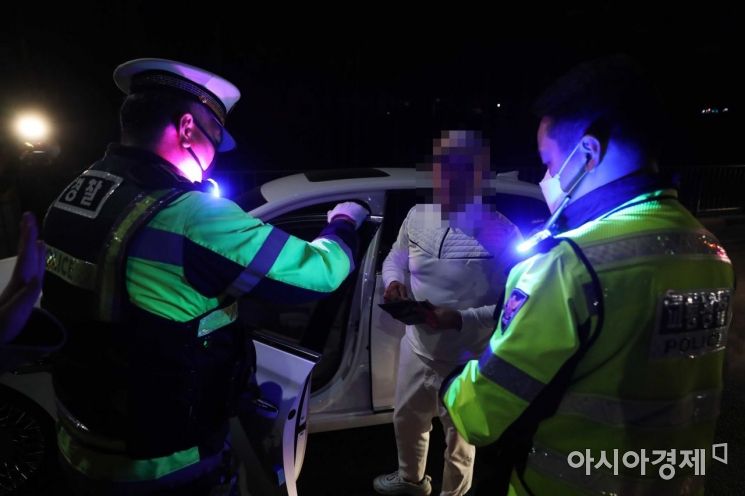
 Last March, police were conducting a drunk driving crackdown at the entrance ramp to the Busan direction of Seocho IC in Seoul. Photo by Mun Ho-nam munonam@
[Asia Economy Reporter Kim Daehyun] The Constitutional Court has ruled unconstitutional the so-called 'Yoon Chang-ho Act' provision that imposes aggravated punishment on drivers who repeatedly commit drunk driving or refuse breathalyzer tests.
On the afternoon of the 26th, the Constitutional Court judged that Article 148-2, Paragraph 1 of the Road Traffic Act violates the Constitution. Regarding past violation records, it pointed out that imposing aggravated punishment uniformly on relatively minor repeated offenses of drunk driving prohibition or refusal of breathalyzer tests without any restrictions cannot recognize proportionality between responsibility and punishment.
Article 148-2, Paragraph 1 of the Road Traffic Act stipulates that those who mix drunk driving and refusal of breathalyzer tests two or more times, or refuse breathalyzer tests two or more times, shall be punished by imprisonment for 2 to 5 years or a fine of 10 million to 20 million won.
In response, the Constitutional Court pointed out, "There is no temporal limitation between the past violation acts that constitute the aggravating condition and the repeated drunk driving prohibition violation or refusal of breathalyzer test acts subject to punishment."
Furthermore, "While strong punishment for repeated violations of drunk driving prohibition or refusal of breathalyzer tests may align with the general public's sense of justice, it can ultimately lead to immunity and insensitivity to severe punishments, resulting in situations where it does not substantially contribute to crime prevention and maintenance of legal order." Strengthening punishment as a measure to prevent repeated violations should be a last resort.
The Constitutional Court added, "Since it imposes aggravated punishment uniformly even on relatively minor types of acts, it sets excessive statutory penalties that significantly deviate from the degree necessary for the original function of punishment," and "the provision under review violates the principle of proportionality between responsibility and punishment."
However, Justices Lee Seon-ae and Moon Hyeong-bae dissented from this decision. The two justices explained, "About 40% of drunk driving traffic accidents in our country are classified as accidents caused by repeat offenders with prior records related to drunk driving enforcement," and "This provision was legislated based on criminal policy considerations to prevent related crimes, and repeated drunk driving or refusal of breathalyzer tests is highly blameworthy."
Previously, on November 25 last year, the Constitutional Court also ruled that the part of Article 148-2, Paragraph 1 of the Road Traffic Act concerning 'persons who have violated Article 44, Paragraph 1 (prohibition of drunk driving) two or more times' was unconstitutional. It was deemed unfair to impose aggravated punishment without considering the period or degree between the two offenses.
© The Asia Business Daily(www.asiae.co.kr). All rights reserved.
![Clutching a Stolen Dior Bag, Saying "I Hate Being Poor but Real"... The Grotesque Con of a "Human Knockoff" [Slate]](https://cwcontent.asiae.co.kr/asiaresize/183/2026021902243444107_1771435474.jpg)
















