Positive Outlook on Presidential Office Relocation and Deregulation
Only Gangnam, Seocho, Yongsan, and First-Generation New Towns Show Strength
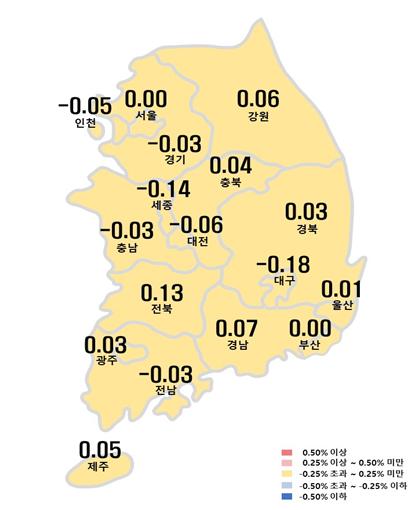
Amid the coexistence of positive factors such as expectations for the presidential office relocation to Yongsan and deregulation, and concerns about market contraction due to interest rate hikes, Seoul apartment prices remained flat for the third consecutive week. While areas with favorable conditions like Gangnam, Seocho, and Yongsan districts, which benefit from reconstruction and the presidential office relocation, as well as first-generation new towns, showed strength, other regions mostly exhibited stability or weakness.
According to the weekly apartment price trend survey for the fourth week of May by the Korea Real Estate Board on the 26th, Seoul apartment prices remained unchanged, marking three consecutive weeks of stability. The nationwide apartment sales price change rate was -0.01%, declining for the third consecutive week.
In Seoul, Yongsan-gu, where the presidential office is located, recorded the highest increase in Seoul with a 0.05% rise for two consecutive weeks following last week.
Seocho-gu, which is not designated as a land transaction permission zone, rose 0.04% compared to last week as record-high transactions occurred in ultra-high-priced apartments over 3 billion KRW in Seocho-dong and other areas. Seocho-gu has shown the highest cumulative increase in Seoul this year, with apartment prices rising 0.51% on a weekly basis.
Gangnam-gu rose 0.02% this week, ranking third in Seoul after Yongsan and Seocho districts. It showed strength centered on high-priced homes unrelated to loans and reconstruction complexes.
Areas such as Nowon (-0.04% → -0.02%), Seodaemun (-0.03% → -0.01%), and Mapo-gu (-0.02% → -0.01%), which had expanded declines last week, saw a reduction in the rate of decline. Meanwhile, Gangseo (-0.01%) and Gwanak-gu (-0.02%), which turned to decline last week due to weak buying demand, recorded the same rate of increase as the previous week.
On the other hand, four districts including Songpa-gu, Gwangjin, Guro, and Jungnang-gu continued to show weakness, shifting from stability last week to decline this week.
The Real Estate Board analyzed, "While high-priced areas with good location conditions and development prospects continued to rise, overall, Seoul's apartment market showed weakness this week due to concerns about further interest rate hikes, stabilization of jeonse prices, and weakened buying sentiment."
Apartment prices in Gyeonggi (-0.03%) and Incheon (-0.05%) also continued to weaken.
First-generation new town areas such as Bundang-gu in Seongnam (0.03%) and Goyang-si (0.06%) maintained strength due to reconstruction expectations. However, Gwacheon-si, which has seen an increase in new apartment move-ins, saw apartment prices fall 0.09% compared to last week, and Siheung-si and Hwaseong-si dropped 0.18% and 0.15%, respectively, with the rate of decline increasing from last week (-0.14%, -0.08%).
The jeonse market, which is in the off-season, generally showed stability.
Seoul apartment jeonse prices turned to a decline of -0.01% this week after three consecutive weeks of stability until last week, and Incheon (-0.10%) saw a larger decline compared to last week.
Gyeonggi recorded stability this week after a decline last week. Demand for apartments close to workplaces continued in Icheon-si (0.25%) and Pyeongtaek-si (0.10%), resulting in jeonse prices rising along with sales prices.
© The Asia Business Daily(www.asiae.co.kr). All rights reserved.

![Clutching a Stolen Dior Bag, Saying "I Hate Being Poor but Real"... The Grotesque Con of a "Human Knockoff" [Slate]](https://cwcontent.asiae.co.kr/asiaresize/183/2026021902243444107_1771435474.jpg)















