Court: Current 'Elderly Employment Act' Provision Prohibiting Age Discrimination Is a Mandatory Rule
Wage Peak System Workers Likely to File Wage Lawsuits... 'Wage Statute of Limitations 3 Years'
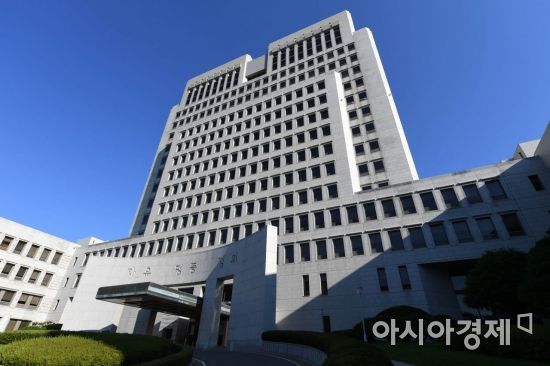
[Asia Economy Reporter Heo Kyung-jun] The Supreme Court has issued its first ruling that the "wage peak system," which reduces wages solely based on age without reasonable justification, violates current law and is therefore invalid. This ruling shakes the foundation of the wage peak system, which has been in effect for six years since its implementation in 2016, and inevitably causes confusion in the industry. Currently, 354,000 workplaces have introduced the wage peak system while operating a retirement age system.
The Supreme Court's First Division (Presiding Justice No Tae-ak) on the 26th upheld the lower court's ruling that the wage peak system constitutes age discrimination in the final appeal filed by retiree A against Research Institute B regarding a wage lawsuit.
The court stated, "The current law provisions prohibiting discrimination based on age are mandatory regulations," and added, "Whether discrimination based on age without reasonable justification is invalid must be judged comprehensively."
A joined Research Institute B in 1991 and retired honorably in 2014. The institute, through an agreement with the labor union, introduced a performance-based wage system (wage peak system) in January 2009 targeting employees aged 55 and older, and A became subject to it from 2011. Consequently, A received a basic salary reduced by two rank levels and 49 competency grades due to the wage peak system and filed a lawsuit claiming the wage difference until retirement. The claim was that the wage peak system is invalid as it constitutes age discrimination prohibited by the Act on Employment of Older Persons.
The trial focused on whether the age discrimination prohibition clause in the Act on Employment of Older Persons is a mandatory regulation and whether the wage peak system violates this clause, rendering it invalid. Article 4-4 of the Act stipulates that employers must not discriminate against workers based on age without reasonable justification when paying wages, etc.
The first trial court ruled that the Act on Employment of Older Persons is a mandatory regulation prohibiting discriminatory acts outside of exceptions. It found that the institute’s wage peak system reduced wages for employees aged 55 and older and that even with measures such as honorary retirement or workload reduction, the disadvantages to workers could not be compensated.
The first trial court stated, "It cannot be assumed that workers aged 55 and older lack performance, and there is no reasonable justification to discriminate only against workers aged 55 and older," ordering payment of approximately 146 million won to A. The second trial also ruled that the wage peak system violates the mandatory provisions of the Act on Employment of Older Persons and is invalid but reduced the compensation to about 137 million won.
With the Supreme Court upholding the lower courts’ rulings, the likelihood of workers at workplaces that have introduced the wage peak system filing wage lawsuits is increasing. However, since the statute of limitations for wage claims is three years, even if workers file lawsuits, they can only be compensated for wage reductions within the past three years (2019, 2020, 2021) from the current point.
Individual workplaces are expected to begin full-scale labor-management discussions regarding the introduction and methods of the wage peak system. Furthermore, as labor groups such as the Korean Confederation of Trade Unions and the Federation of Korean Trade Unions have consistently demanded extending the retirement age to 65 and abolishing the wage peak system, this Supreme Court ruling is expected to further escalate conflicts between labor and management.
© The Asia Business Daily(www.asiae.co.kr). All rights reserved.
!["The Woman Who Threw Herself into the Water Clutching a Stolen Dior Bag"...A Grotesque Success Story That Shakes the Korean Psyche [Slate]](https://cwcontent.asiae.co.kr/asiaresize/183/2026021902243444107_1771435474.jpg)
















