3-Month Average Trading Value Tops with 'Wonyu Inverse'
Wonyu ETF Returns Gradually Decline, Recorded Negative Yesterday
Experts Say "High Oil Prices Will Persist for a While"
Aramco CEO Warns of "Oil Shortage" in Foreign Media Interview
[Asia Economy Reporter Hwang Yoon-joo] Amid warnings of a large-scale crude oil supply shortage from Amin Nasser, CEO of Saudi Arabia's state-owned oil company Aramco, individual investors are betting on a decline in international oil prices.
According to the Korea Exchange on the 26th, the crude oil ETF with the highest average trading volume over the past three months was 'KODEX WTI Crude Oil Futures Inverse (H)'. The second place was also 'TIGER Crude Oil Futures Inverse (H)'. The top two ETFs by trading volume on the previous day were also inverse crude oil products.
'Inverse' refers to products that track price or index declines, so when crude oil prices fall, the returns increase. KODEX WTI Crude Oil Futures Inverse (H) maintained the number one spot in average trading volume over 6 months, 3 months, and 1 day.
The reason individual investors are turning to crude oil inverse ETFs is interpreted as due to the lowered expected returns of oil price rising ETFs. The period returns of KODEX WTI Futures (H) were 89.70% (1 year), 48.35% (6 months), 18.40% (3 months), 7.58% (1 month), and -1.86% (1 day). TIGER Crude Oil Futures Enhanced (H) also recorded 89.16% (1 year), 48.11% (6 months), 18.94% (3 months), 7.12% (1 month), and -1.61% (1 day).
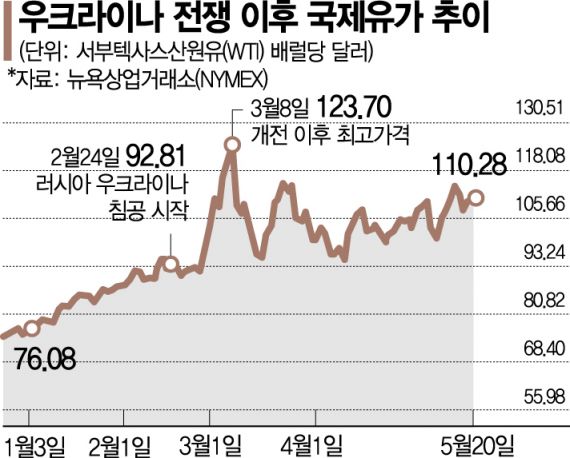
Experts believe that even if the sharp rise in international oil prices calms down, high prices will be maintained. This is because the price determination structure of the crude oil market has changed since the Russia-Ukraine war. Kim Ye-in, a researcher at Korea Investment & Securities, said, "If supply and demand were the main factors influencing commodity price determination, diplomatic, security, and political issues have started to emerge due to the Russia war," adding, "Even if commodity production increases, price declines are not expected to be significant."
Jeon Gyu-yeon, a researcher at Hana Financial Investment, also said, "Considering Russia's influence on the crude oil market, which accounted for about 11% of global oil supply, despite production by OPEC+ and the U.S. and the release of strategic reserves, supply shortages are likely to continue," and forecasted, "The high oil price phase will last longer, with the WTI price band remaining around $90 to $130 per barrel."
Meanwhile, CEO Nasser said in an interview with foreign media on the 23rd (local time), "The global additional crude oil production capacity is less than 2%," and warned, "If the aviation industry, which consumed 2.5 million barrels more crude oil before COVID-19 than now, recovers, there will be significant problems in crude oil supply and demand."
© The Asia Business Daily(www.asiae.co.kr). All rights reserved.


















