"Efforts Needed to Improve Unemployment Rate... Some Indicators Worse Than 2020"
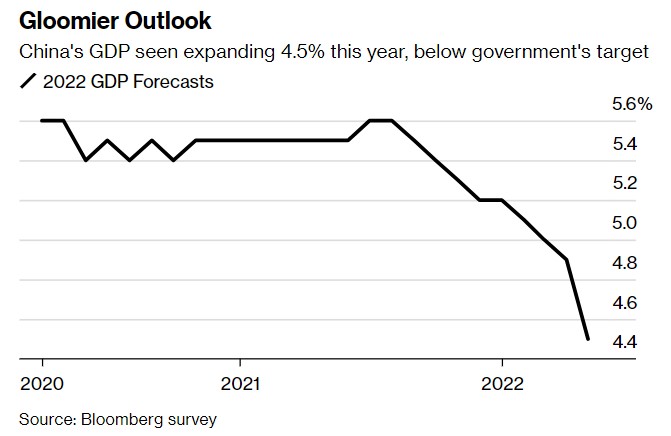
Foreign Media Interpret as Implying 5.5% Growth Unachievable
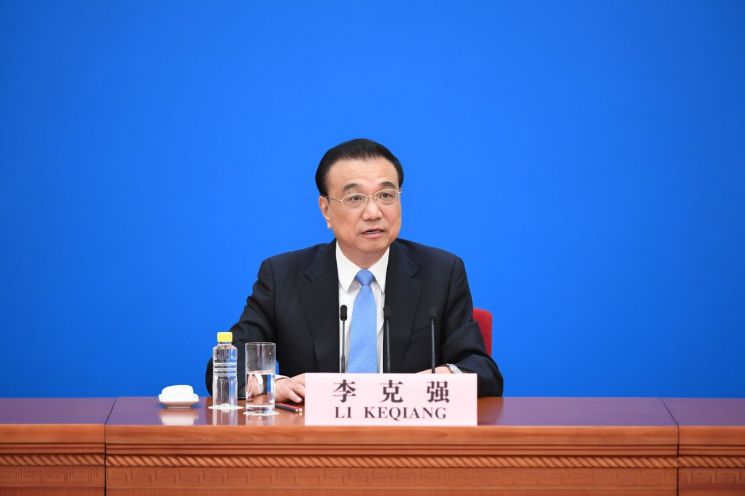
[Asia Economy Reporter Kim Hyunjung] Li Keqiang, Premier of the State Council of China, stated that he will strive to achieve "reasonable growth" of the Chinese economy in the second quarter (April to June) this year and to lower the unemployment rate. Foreign media interpreted this as implying that the government's annual growth target of "5.5%" has become practically unattainable. Some forecasts even suggest that China may record negative growth in the second quarter.
According to China's state-run Xinhua News Agency, on the 25th (local time), Premier Li made these remarks during an emergency online meeting with local government officials to discuss economic stabilization measures. He said, "China's economic indicators have dropped significantly, and in some aspects, they are worse than in 2020." China's annual growth rate in 2020 was 2.2%.
The state-run Global Times reported that more than 100,000 people nationwide attended the meeting, making it the largest since the February 23, 2020 meeting (170,000 attendees) held after the outbreak of COVID-19. It also added that detailed measures for economic support will be announced at the end of this month based on the meeting's outcomes.
◆ Plummeting Indicators... SMEs and Local Governments Hit Harder = According to the National Bureau of Statistics, last month China's retail sales decreased by 11% year-on-year, and industrial production fell by 3%. This marks the first decline since the pandemic began in early 2020. Premier Li noted that in the first half of May, key indicators such as power generation, freight transport, and new bank loans all declined.
Premier Li emphasized, "Now is the time to determine this year's economic trend," and urged, "Efforts must be made to bring the economy back to a normal track." He also added that a detailed implementation plan for a policy package aimed at stable growth will be presented by the end of this month. He stressed, "We must reduce the economic impact caused by virus control and simultaneously accomplish epidemic control and economic development tasks."
According to the transcript of the meeting reported by the Financial Times (FT), Premier Li urged senior officials including Vice Premier Liu He, Vice Premier Han Zheng, and Yi Gang, Governor of the People's Bank of China, to assist in resuming corporate production. He said, "The progress is unsatisfactory," and added, "In some provinces, only 30% of companies have resumed operations; this ratio must be raised to 80% in a short period."
It was also reported that corporate liquidations surged by more than 23% year-on-year in April when Shanghai was fully locked down. This is interpreted as the result of private small and medium-sized enterprises (SMEs), which account for more than half of government revenue, economic output, and employment, being the hardest hit by the zero-COVID policy. Regarding this, Premier Li emphasized, "We must ensure both the smooth functioning of supply chains and COVID-19 prevention," and said, "Many SMEs and local governments have told me that 'the worst day has come.'"
Premier Li also urged, "When a large economy like China deviates from a reasonable range, it takes enormous costs and time to return," and requested, "Please strive for positive growth in our economy in the second quarter."
◆ "Improvement Difficult While Zero-COVID Sword Remains" = Major foreign media viewed Premier Li's remarks as an acknowledgment that achieving 5.5% growth in China has become practically impossible.
Bloomberg cited an investment memo from Goldman Sachs economists, suggesting that Premier Li's emphasis on "second-quarter growth" may be an implicit admission that the 5.5% growth target is under challenge. Economists noted, "After very weak economic activity growth in April, sluggish recovery in May, and a continuous rise in unemployment, Chinese policymakers are seeking to accelerate economic support." The FT also interpreted that "making such remarks in front of tens of thousands of officials emphasized the difficulty of achieving 5.5% growth while fighting the Omicron outbreak."
Bill Bishop, a China political expert, mentioned in his Sinocism newsletter that "policymakers are extremely worried about the economic situation," referring to signals sent by the Chinese cabinet, the State Council, the central bank, and banking regulators. He explained, "However, as long as the zero-COVID dynamic sword is wielded over the Chinese economy, it will be difficult to see these measures actually work."
© The Asia Business Daily(www.asiae.co.kr). All rights reserved.


















