Supply in the Seoul Metropolitan Area Increases but Buyer Sentiment Plummets
Seoul Apartment Transactions at Half Last Year's Level
[Asia Economy Reporter Kim Min-young] With the Bank of Korea raising the base interest rate again, the housing market is expected to freeze further. Recently, the supply in the Seoul metropolitan area, including Seoul, Incheon, and Gyeonggi, has increased by nearly 10% due to the one-year postponement of the capital gains tax surcharge on multi-homeowners. However, buyer sentiment is expected to weaken as variables such as increased financial burden from interest rate hikes and changes in the new government's real estate policies come into play. The phenomenon of simultaneous increase in supply and transaction freeze is expected to continue for the time being, leading to stagnant housing prices.
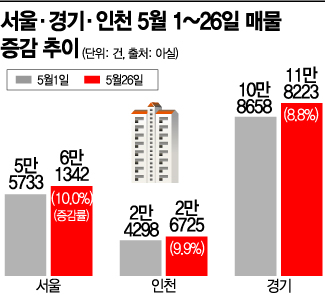
According to real estate big data company Asil on the 26th, the number of apartment listings in Seoul was recorded at 61,342 as of that day. Compared to 55,733 listings on the 1st of this month, the supply increased by 10.0%, ranking second in terms of supply growth among all districts and counties. The number of apartment listings in Seoul exceeding 60,000 is the first time in 1 year and 9 months since August 2020. In Incheon, where housing prices soared last year due to panic buying by the 20s and 30s generation, the supply increase during this period reached 9.9%, making it the region with the second largest supply increase after Seoul. Gyeonggi recorded an 8.8% increase in supply during the same period, ranking fifth among regions with significant supply growth. The prominent increase in supply this month is attributed to the new government's implementation of multi-homeowners' capital gains tax relief measures on the 10th, which released a large number of tax-saving listings into the market.
However, the buying demand has not kept pace. According to the Seoul Real Estate Information Plaza, the number of apartment transactions in Seoul as of that day was 1,714 in April, less than half of last year's 3,655. Even considering the remaining reporting period, the transaction volume of 704 this month is low. Although transactions increased for two consecutive months in February and March compared to the transaction cliff peak in January, they remain far below the same period last year. This is believed to be due to weakened buyer sentiment caused by changes in the new government's real estate policies and increased financial burden from interest rate hikes.
The market expects the increase in supply and transaction stagnation to continue for the time being. Although there are concerns that housing prices may rise further due to soaring material costs, the excessive interest burden from interest rate hikes makes it difficult for buyers to jump into chasing purchases. Additionally, Minister of Land, Infrastructure and Transport Won Hee-ryong announced that improvement plans and supplementary measures regarding the price ceiling system for pre-sale and the three lease laws will be released next month, adding a variable of policy changes.
Ham Young-jin, head of the Zigbang Big Data Lab, said, "With the possibility of additional interest rate hikes in the US and domestic base rate hikes open due to rising raw material prices and service inflation, housing purchase demand considering loan interest burden is expected to take a breather for the time being," adding, "It is highly likely that the flow of housing sales volume and prices will continue in a slightly weak trend compared to the average year."
© The Asia Business Daily(www.asiae.co.kr). All rights reserved.
![Clutching a Stolen Dior Bag, Saying "I Hate Being Poor but Real"... The Grotesque Con of a "Human Knockoff" [Slate]](https://cwcontent.asiae.co.kr/asiaresize/183/2026021902243444107_1771435474.jpg)











