Steady Increase in Overdependence Risk Group Among 4th Graders Over 3 Years
Impact of Social Distancing Raising Internet and Smartphone Accessibility
88,123 Youths with Multiple Overdependence, Up 4,243 from Previous Year
235,687 Youths in One or More Risk Groups, Up 6,796 from Previous Year
[Asia Economy Reporter Han Jinju] The number of elementary school students at risk of internet and smartphone overdependence has significantly increased over the past three years. The number of adolescents overdependent on at least one of the internet or smartphones also rose by about 3% compared to last year.
On the 26th, the Ministry of Gender Equality and Family announced the results of the "2022 Youth Internet and Smartphone Usage Habit Diagnostic Survey," conducted on 1.27 million adolescents nationwide at school transition stages (4th grade elementary, 1st grade middle, and 1st grade high school). The number of youths diagnosed as at-risk for overdependence on at least one of the internet or smartphones was 235,687 (18.55%), an increase of 2.96 percentage points (6,796 individuals) from the previous year.
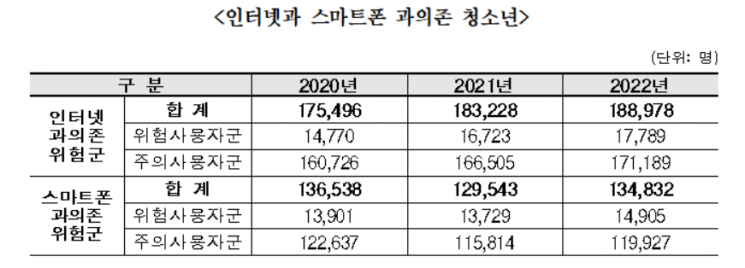
The internet overdependence risk group numbered 188,978 (14.88%), up 3.14 percentage points from the previous year, while the smartphone overdependence risk group was 134,832 (10.78%), increasing by 4.08 percentage points. Both the risk user group showing withdrawal symptoms in daily life and the caution user group experiencing difficulties with self-regulation increased. Adolescents overdependent on both internet and smartphones (overlapping risk group) numbered 88,123, an increase of 4,243 (5.05%) compared to the previous year.
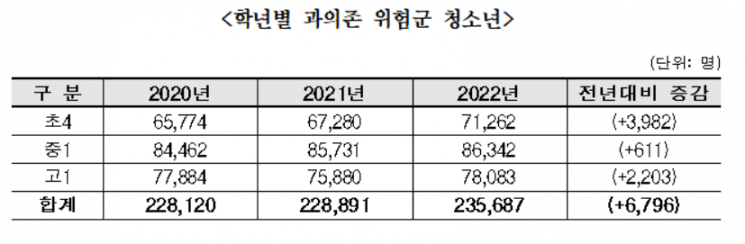
The age group experiencing internet and smartphone overdependence is gradually getting younger. In particular, 4th grade elementary students have seen the largest increase in the number of at-risk individuals over the past three years. The numbers rose from 65,774 in 2020, to 67,280 last year, and 71,262 this year. This represents a 5.91% increase from last year and an 8.34% increase compared to two years ago. This is attributed to reduced outdoor and face-to-face activities due to COVID-19 and increased accessibility to smartphones and the internet through remote classes, leading to longer media usage times. Across all grades, the number of internet and smartphone overdependence risk groups increased, with middle school students (86,342), high school students (78,083), and elementary students (71,262) in descending order.
When broken down by gender, the increase in internet and smartphone overdependence risk groups was more pronounced among male adolescents. The risk group among male youths increased across all grades, whereas female youths showed only a slight increase, with a decrease observed in 1st grade middle school girls. However, among high school students, the number of female adolescents in the risk group was higher.
The Ministry of Gender Equality and Family provides tailored services such as counseling, hospital treatment, and residential healing programs according to the degree of individual youth overdependence. The "caution user group" participates in group counseling at schools, while the "risk user group" receives individual counseling. If comorbid conditions such as depression or Attention Deficit Hyperactivity Disorder (ADHD) are identified through additional testing, hospital treatment is supported. City and provincial youth counseling welfare centers offer residential healing services such as overdependence healing camps and family healing camps during weekends or vacations. Last year, the Korea Youth Counseling and Welfare Institute developed the media usage control training program "Instop," which will be widely promoted in coordination with counseling welfare centers nationwide.
Kim Kwon-young, Youth Policy Officer at the Ministry of Gender Equality and Family, stated, "As the trend of younger adolescents becoming overdependent on smartphones continues, we will do our best to protect youths from the negative effects of media by providing specialized counseling and healing services tailored to their characteristics from the early stages of overdependence, helping them develop balanced lifestyle habits."
© The Asia Business Daily(www.asiae.co.kr). All rights reserved.


















