IPEF Launch Draws Attention
High Growth Potential
Expectations for Trade Diversification
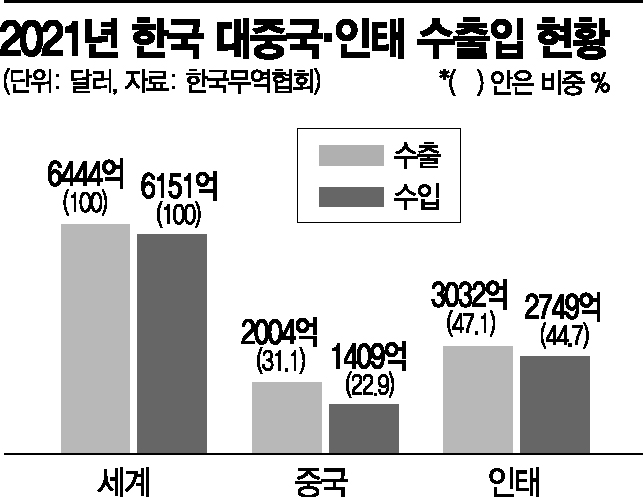
With the official launch of the Indo-Pacific Economic Framework (IPEF), a US-led regional multilateral economic cooperation body, attention is focused on whether the Indo-Pacific region can replace China in our economy, trade, and investment.
According to the Korea International Trade Association on the 25th, Korea's export share to the Indo-Pacific region was 47.1% last year, up 5.3 percentage points from 41.8% in 2015. This is the highest level in 20 years since 2003, when exports to the Indo-Pacific region were active. On the other hand, the export share to China, the top single country in trade volume, has stagnated from 31.8% in 2015 to 31.1% last year.
The import share also showed the Indo-Pacific region (44.7%) nearly doubling China (22.9%) last year. While the import share of the Indo-Pacific region increased by 3.6 percentage points from 41.1% in 2015 to last year, the import share from China rose only 1.9 percentage points during the same period.
The growth trend of the Indo-Pacific region is also evident in the global foreign direct investment status. The share of the Indo-Pacific region in global direct investment increased by 15 percentage points from 31% in 2010 to 46% in 2020, clearly indicating a shift in the global manufacturing base. In contrast, investment in China stagnated in the mid-teens over the past decade since 2010, except for a rapid production restart in 2020 due to the impact of COVID-19.
Experts predict that emerging Indo-Pacific countries such as India and the Association of Southeast Asian Nations (ASEAN) will show remarkable growth as major consumer markets and production bases based on their high potential. The International Monetary Fund (IMF) forecasted that India (8.2%) and ASEAN (5.3%) will surpass China's economic growth rate (4.4%) this year and maintain this trend until at least 2027, five years from now. In particular, with India's population surpassing 1.4 billion this year and expected to exceed China's from 2024, it is analyzed that India will emerge as a central axis of the global consumer market in the future.
Participation in IPEF is also expected to be a boon for Korean companies. It is interpreted that opportunities for overseas expansion may increase, along with supply chain stabilization and diversification, and competitiveness enhancement. Professor Jeong In-kyo of Inha University's Department of International Trade said, "If IPEF strengthens and activates regional cooperation, especially in supply chains, the share of China is expected to decrease and substitution to other regions will proceed. However, this does not mean intentionally distancing from China."
© The Asia Business Daily(www.asiae.co.kr). All rights reserved.
![Clutching a Stolen Dior Bag, Saying "I Hate Being Poor but Real"... The Grotesque Con of a "Human Knockoff" [Slate]](https://cwcontent.asiae.co.kr/asiaresize/183/2026021902243444107_1771435474.jpg)
















