Ministry of Gender Equality and Family Releases 2022 Youth Statistics
4 out of 10 Recognize Stress, Higher Among Female Students
Youth Deaths Decrease by 2.3% Compared to Previous Year
Youth Population 15.8%, Down 0.4%p from Last Year
School-Age Population 14.5% → 9.8% by 2060
87.7% of Elementary to High School Students Say "We Must Participate in Society"
[Asia Economy Reporter Han Jinju] Three out of ten middle and high school students reported experiencing feelings of depression in the past year. 'Extreme choices' have been the leading cause of death among adolescents for over a decade.
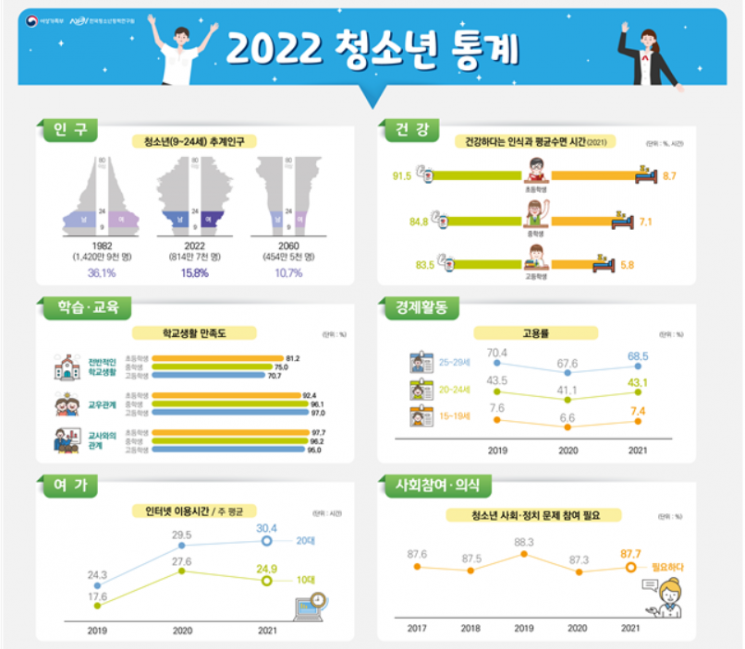
According to the '2022 Youth Statistics' released on the 25th by the Ministry of Gender Equality and Family and the Korea Youth Policy Institute, 38.8% of middle and high school students reported feeling stressed regularly, and 26.8% experienced feelings of depression within the past year.
The stress recognition rate was higher among high school students (41.2%) than middle school students (36.4%), and higher among female students (45.6%) than male students (32.3%). Among middle and high school students, 4.5% had smoked within the past 30 days, and 10.7% had experience with drinking alcohol.
The number of adolescent deaths was 1,909 in 2020, a 2.3% decrease compared to the previous year. The leading cause of death has consistently been self-harm (suicide) since 2011. The rate of extreme choices was 11.1 per 100,000 people, followed by safety accidents (3.7) and cancer (2.4).
The adolescent population (ages 9?24) was 8,147,000 in 2022, accounting for 15.8% of the total population, and is projected to decrease to 4,540,000 (10.7%) by 2060. The school-age population (ages 6?21) is expected to decline from 7,482,000 (14.5%) in 2022 to 4,167,000 (9.8%) in 2060.
Multicultural students have steadily increased, reaching 160,058 last year, an 8.6% increase from the previous year. Among multicultural students, 69.6% are elementary students, 21.2% are middle school students, and 8.9% are high school students.
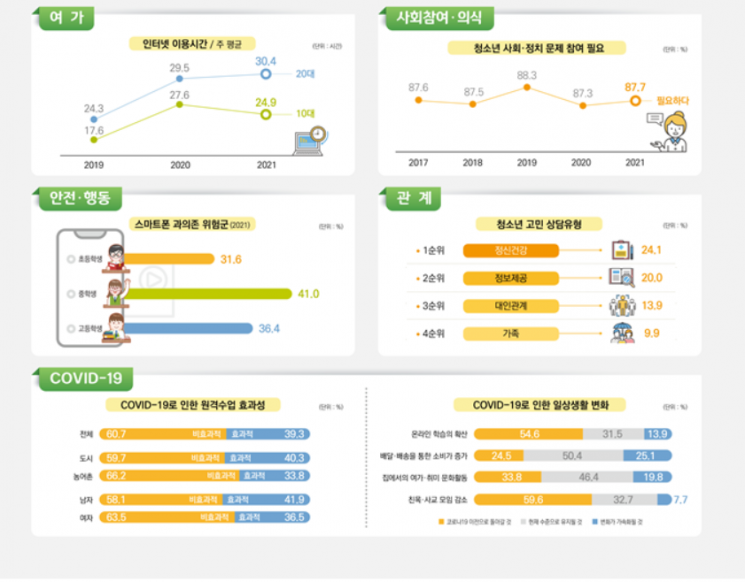
Eight out of ten elementary, middle, and high school students (75.8%) said they enjoy going to school. The participation rate in private education was 75.5%, a 9.0 percentage point increase from the previous year. The average weekly hours spent on private education was 6.7 hours, 1.4 hours more than the previous year. Regarding remote classes, 6 out of 10 students (60.7%) responded that they were not effective.
Although online learning expanded due to COVID-19, more than half of adolescents (54.6%) believe that learning methods will return to pre-COVID-19 ways. Over half (59.6%) think that social and friendship gatherings will also revert to pre-pandemic levels. Two out of ten adolescents (18.7%) said their relationships with close friends have weakened since COVID-19. Two-thirds of adolescents (66.8%) reported being satisfied with their overall interpersonal relationships.
Four out of ten teenagers (37%) are at risk of smartphone overdependence, an increase of 1.2 percentage points from the previous year. Middle school students (41.0%) are the most vulnerable to smartphone overdependence, followed by high school students (36.4%) and elementary students (31.6%). The main content used includes movies, TV, and videos (98.5%), games (96.7%), and messengers (96.5%).
Elementary, middle, and high school students sleep an average of 7.2 hours per day. Elementary students sleep 8.7 hours, middle school students 7.1 hours, and high school students 5.8 hours. Six out of ten students exercise regularly at least once a week.
Nine out of ten adolescents (87.7%) believe they should participate in society, and the vast majority (96.8%) think that men and women should have equal rights in all aspects.
Awareness of gender equality has been steadily increasing, rising from 59.4% in 2015 to 75.0% in 2021. Female students (97.9%) showed stronger gender equality awareness than male students (95.7%). Among elementary (grades 4?6), middle, and high school students, 69.7% disagreed with the view that adolescents lack decision-making ability.
© The Asia Business Daily(www.asiae.co.kr). All rights reserved.
![Clutching a Stolen Dior Bag, Saying "I Hate Being Poor but Real"... The Grotesque Con of a "Human Knockoff" [Slate]](https://cwcontent.asiae.co.kr/asiaresize/183/2026021902243444107_1771435474.jpg)

















