Samsung Announces Mammoth-Scale Investment and Job Creation Plan
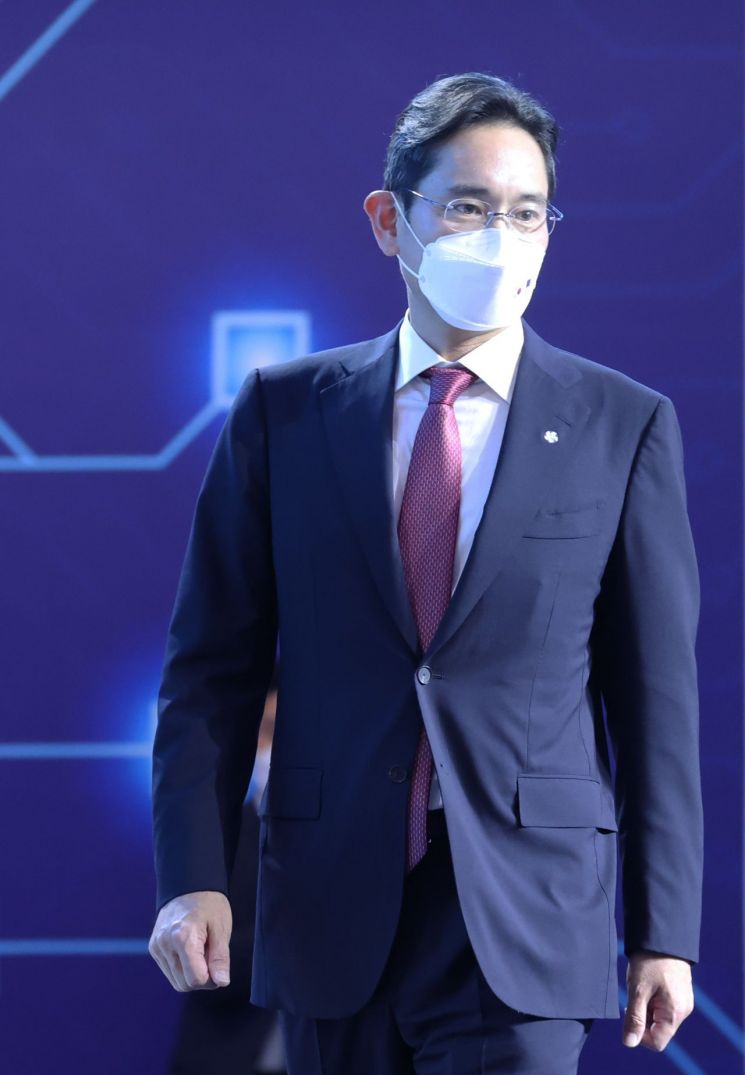
[Asia Economy Reporters Sunmi Park and Jinho Kim] Samsung Electronics Vice Chairman Lee Jae-yong is providing strong support for President Yoon Suk-yeol’s industrial strategy, which emphasizes securing a super-gap in future strategic industries such as semiconductors, through unprecedented large-scale investment and job creation plans.
450 Trillion KRW Investment and 80,000 New Hires Over the Next 5 Years
On the 24th, Samsung announced a large-scale investment plan titled ‘Samsung’s Future Preparation for Dynamic Innovation Growth,’ which includes 450 trillion KRW investment and 80,000 new hires over the next five years. The investment amount of 450 trillion KRW represents an increase of 120 trillion KRW (over 30%) compared to the past five years. 80% of the total investment will be made domestically, with domestic investment planned to increase by 110 trillion KRW (over 40%) compared to the previous five years.
The investments will focus on future growth sectors such as semiconductors, bio, and new growth IT. Samsung identifies ▲fabless system semiconductors ▲foundry ▲bio sectors as future growth industries expected to rapidly expand in market size in the post-COVID era. Additionally, new growth IT is viewed as a field where enterprises and industrial ecosystems can interact to create enormous added value.
Samsung also plans to hire 80,000 new employees over the next five years. This hiring will be expanded mainly in core businesses such as semiconductors, bio, and new growth IT. Beyond new hires, employment inducement from investments is expected to create 1.01 million jobs, and CSR and win-win cooperation initiatives will generate an additional 60,000 jobs.
Samsung, which announced a ‘40,000 hires over 3 years’ plan in 2018, exceeded its target at that time and also announced a similar 40,000 hires plan over three years last year. The current plan to hire 80,000 new employees nearly doubles the previous scale, reflecting a strong commitment to fully support the Yoon Suk-yeol administration’s efforts to create youth jobs.
Goal of Becoming a Semiconductor Superpower... Samsung Takes the Lead
Samsung Electronics stated that it will take a leading role in achieving the goal of becoming a so-called ‘semiconductor superpower’ through proactive investment, differentiated technology, and creating new markets. This is interpreted as a commitment to actively support the semiconductor industry, a core of the 4th Industrial Revolution, so that it can continue to serve as the ‘growth engine’ of the Korean economy.
First, Samsung plans to continue investing in the memory sector, which it has led for the past 30 years, over the next five years to strengthen its ‘super-gap’ status. To this end, it will enhance research and development (R&D) on new materials and new structures that can overcome the limits of process miniaturization and will proactively apply advanced technologies such as early adoption of extreme ultraviolet (EUV) lithography, which is advantageous for semiconductor miniaturization.
In October last year, Samsung announced mass production of 14nm DRAM using EUV processes. Samsung’s 14nm DRAM has a shorter line width than Micron’s 10nm-class 4th generation DRAM, confirming ‘advanced technology’ compared to Micron. Samsung also expanded the number of layers using EUV equipment to five in 14nm DRAM production, making it the first company to use multi-layer EUV processes. A Samsung Electronics official explained, “Despite fierce competition, we plan to maintain our No. 1 position by increasing market share in the DRAM market based on advanced technology.”
Samsung Electronics also announced plans to secure competitiveness centered on fabless system semiconductors and sensors essential for realizing the 4th Industrial Revolution, such as ▲high-performance/low-power APs ▲5G/6G communication modems ▲high-definition image sensors. To this end, it will support the establishment of a new growth fabless system semiconductor ecosystem domestically.
Among Samsung’s major fabless system semiconductor businesses, mobile SoCs and image sensors have a large market gap compared to leading companies. However, through investment and R&D, Samsung is narrowing the ‘technology gap’ and increasing growth potential. Samsung’s image sensor sales share is expected to rank second at 24.9% this year. Additionally, Samsung is expanding its ‘No. 1’ and ‘first’ positions in fabless system semiconductor businesses, such as being the first in the industry to develop 5G modems (communication chips).
The foundry business plans to develop and apply differentiated next-generation production technologies to mass-produce products below 3nm early. By securing next-generation package technology, Samsung aims to develop converged solutions combining logic chips and memory, laying the foundation to leap into the industry’s leading group.
Realizing the ‘Second Semiconductor Miracle’ Through Aggressive Investment in Bio and Next-Generation Communications
Samsung revealed its goal to achieve a ‘second semiconductor miracle’ through aggressive investment in the bio sector. It plans to strengthen investments in the bio industry, which is led by a few advanced countries and large pharmaceutical companies.
In the CDMO sector, Samsung plans to aggressively invest by constructing the 5th and 6th plants following the currently under-construction 4th plant, and aims to solidify its position as the ‘overwhelming global No. 1’ beyond just being the ‘No. 1 in CDMO production volume’ by advancing production technology and capabilities. The bio-similar focused pipeline will also be expanded and advanced.
Separately from semiconductors and bio, Samsung plans to focus on strengthening competitiveness through ‘super-gap innovation’ in new growth IT fields such as artificial intelligence and next-generation communications, which will determine future industrial competitiveness. AI and communications are core technologies of the 4th Industrial Revolution and are expected to contribute to innovation and advancement across industry, society, and the economy.
In the AI field, Samsung is conducting advanced technology research through seven global AI centers worldwide, while recruiting talent and fostering experts. Through the Samsung Future Technology Development Project, it plans to expand support for innovative AI research by domestic young researchers and contribute to broadening the domestic AI base through software education for youth.
Samsung will also strengthen leadership in next-generation communications based on its experience and capabilities leading 3G, 4G, and 5G communications. In particular, it plans to pursue a ‘super-gap’ in communications by securing core 6G technologies and global standardization. 6G, which is 50 times faster than 5G, is called a foundational technology for digital transformation and super-gap innovation because it can realize services such as ultra-realistic extended reality, high-precision mobile holograms, and digital twins in everyday life.
© The Asia Business Daily(www.asiae.co.kr). All rights reserved.

















