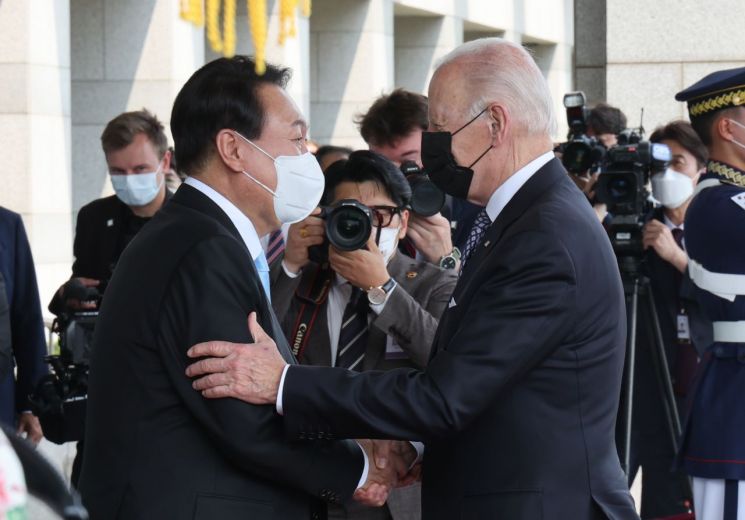
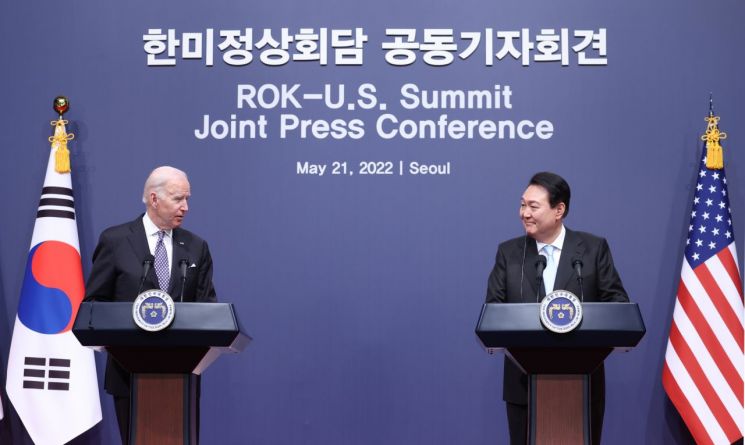
[Asia Economy Reporter Kim Jin-ho] More than seven out of ten citizens gave a positive evaluation of the South Korea-U.S. summit held on the 21st between President Yoon Seok-yeol and U.S. President Joe Biden. Additionally, the majority of the public expressed high expectations for strengthening Korea-U.S. economic security cooperation through South Korea's participation in the Indo-Pacific Economic Framework (IPEF).
The Federation of Korean Industries (FKI) announced on the 24th that it conducted a survey on the "Meaning and Outcomes of the South Korea-U.S. Summit" with 1,019 adults nationwide through Mono Research, yielding these results.
First, 74.8% of the public positively evaluated the fact that this summit was the shortest time in which a South Korea-U.S. summit was held since the government took office in Korea. Regarding the overall results of the summit, including the expansion of the Korea-U.S. alliance role and agreements to strengthen economic security and core technology cooperation, 74.2% of respondents expressed satisfaction.
Regarding the impact of the strengthened Korea-U.S. alliance based on the summit, 41.3% of respondents answered that "South Korea's global status will be further elevated." Responses indicating that the strengthened alliance would help economic stability aspects such as advanced technology cooperation and supply chain stabilization accounted for 18.3%.
Looking ahead, to expand cooperation in various economic fields such as supply chains and core and emerging technologies through a "technology alliance," respondents cited "expansion of joint research and investment in new technology fields (37.9%)" and "increased incentives for private investment from both South Korea and the U.S. (17.7%)" as necessary.
Furthermore, regarding the impact of South Korea's participation in the Indo-Pacific Economic Framework (IPEF) on the Korean economy, 53.7% answered "strengthening supply chain cooperation with major regional countries," indicating high public expectations for supply chain stabilization. The response that IPEF participation is expected to help reduce South Korea's economic dependence on China was 14.6%.
On the other hand, 14.3% of respondents anticipated negative effects due to China's countermeasures as Korea-U.S. economic security cooperation strengthens. In response, an FKI official stated, "Since expectations for this IPEF participation are high, it should be used as an opportunity for our economic development while also managing relations with neighboring countries."
Kim Bong-man, head of the FKI International Headquarters, evaluated the survey results by saying, "The public actively welcomes the fundamental strengthening of the Korea-U.S. alliance and seems to be focusing on economic benefits through supply chain cooperation with allies amid recent global supply chain disruptions."
© The Asia Business Daily(www.asiae.co.kr). All rights reserved.


















