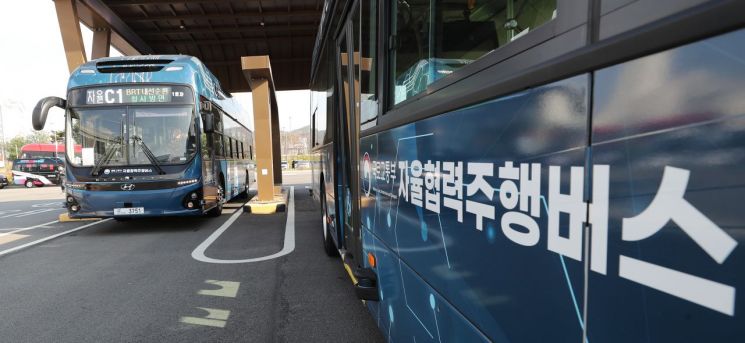
 The autonomous driving bus showcased around Sejong City by the Ministry of Land, Infrastructure and Transport and the Korea Transport Institute (Photo by Yonhap News)
[Asia Economy Reporter Ryu Tae-min] Starting as early as October, 'autonomous driving mobility services' will be gradually introduced in Daegu and Jeju.
The Ministry of Land, Infrastructure and Transport announced on the 24th that it has selected consortia led by Autonomous A2Z and IT Telecom as the final operators through a public contest for autonomous driving mobility service projects.
This public contest project provides a subsidy of 8 billion KRW over two years (4 billion KRW each for the first and second years) for private autonomous vehicle-based mobility projects, aiming to offer autonomous driving services that the public can directly experience, while also providing testing opportunities for startups and small and medium-sized enterprises.
Previously, the Seoul National University Industry-Academic Cooperation Foundation, which received the first phase of project support (2020?2021, 7 billion KRW), provided autonomous driving services to more than 1,900 citizens through a demand-responsive autonomous night shuttle service in Siheung, producing seven autonomous vehicles and operating services in transportation-vulnerable areas.
A total of seven consortia participated in the second public contest, and the operators were selected based on evaluations of various indicators including the innovativeness of the business model, feasibility of the technologies applied to the service, and the effect of enhancing public acceptance of autonomous vehicle services.
First, the Autonomous A2Z consortium (Kakao Mobility, KT, Hyundai AutoEver, Newility, Korea Automotive Technology Institute) will establish a vehicle platform and related communication infrastructure capable of integrating passenger (demand-responsive) and logistics (delivery service) services, based on Daegu Technopolis and the National Industrial Complex.
The IT Telecom consortium (RideFlux, Gwangmyeong D&C, KAIST, Jeju Research Institute) will provide a circular autonomous driving tourist shuttle service connecting major tourist spots near Jeju Airport, a carrier delivery service between the airport and Jungmun hotels, and public transportation shuttle bus services.
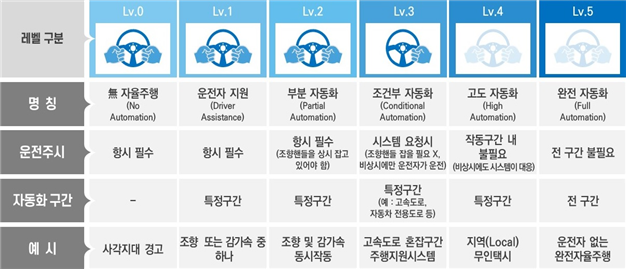
The selected operators will manufacture autonomous vehicles using the subsidies and build autonomous driving infrastructure in the service areas to operate the projects. During the project period, approximately 11 Level 3 autonomous vehicles (such as Ioniq and Solati) will be produced and operated. While autonomous driving services will be provided as a standard, the vehicles will be operated with professionally trained safety personnel on board to respond to unexpected situations.
The autonomous vehicles produced during the project will be reclaimed by the state at the end of the project and utilized for continuous mobility service provision by lending them to industry, academia, and research institutions for various test drives and data collection purposes.
The Ministry of Land, Infrastructure and Transport and the consortia plan to sign detailed project agreements within this month and begin manufacturing autonomous vehicles and building infrastructure starting next month. The project will be promoted to officially launch autonomous driving mobility services in the second half of this year.
Park Ji-hong, Director of the Automobile Policy Division at the Ministry of Land, Infrastructure and Transport, stated, “Through this project, the public will be able to experience a more stable autonomous vehicle mobility service, making it clear that the era of commercial autonomous vehicles is rapidly approaching.”
© The Asia Business Daily(www.asiae.co.kr). All rights reserved.


















