Seoul Metropolitan Council Announces Analysis of Sales in Four Major City Districts Over the Past 6 Years: Alley, Developed Commercial Areas, and Tourist Zones Sales Decline; Traditional Market Sales Increase by 19.4%... Steady Support Policies Revitalize Traditional Markets Amid COVID Crisis... Chair Kim In-ho Urges Urgent Compensation for Self-Employed and Small Businesses and Customized Revitalization Measures by Commercial Area

[Asia Economy Reporter Jong-il Park] The Seoul Metropolitan Council (Chairman Kim In-ho · photo) recently published a big data analysis report titled "Estimation of Small Business Damage and Policy Implications through Analysis of Seoul Commercial District Sales Data" on May 23, based on an analysis of card sales data over the past six years.
The analysis data is estimated mainly from Shinhan Card affiliated stores, based on card sales approval amounts, utilizing card usage rates and cash usage rates. It is estimated by applying credit card usage rates and cash payment rates by card companies compiled by the Bank of Korea, as well as floating population data.
This analysis report focused on quarterly sales and store count data for 1,493 detailed commercial districts and 63 detailed business sectors from 2016 to 2021.
Alley Commercial Districts, Tourist Special Zones, and Developed Commercial Districts Saw Sharp Declines in Total Sales from 2018... Traditional Markets Increased by 19.4%
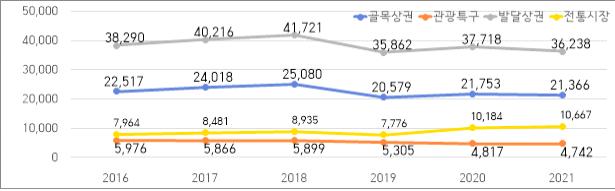
According to the report, total sales by commercial district decreased across all districts between 2018 and 2019, but after the COVID-19 crisis, the fortunes of alley and developed commercial districts, tourist special zones, and traditional markets diverged.
For alley commercial districts, tourist special zones, and developed commercial districts, total sales sharply declined in 2019 after peaking in 2018 and continued to decrease during the COVID period. In contrast, traditional markets experienced a sales decline in 2019 similar to other districts but showed a clear increase starting in 2020. Last year (2021), total sales increased by 19.4% compared to 2018.
The average sales per store by commercial district showed a similar trend to total sales by district.
Average sales per store by commercial district also significantly decreased across all districts between 2018 and 2019. However, for alley and developed commercial districts, sales in 2020 slightly increased compared to 2019 but did not recover to 2018 levels in 2021. Conversely, traditional markets saw a significant increase in average sales per store starting in 2020 during the COVID period.
The report analyzes that various traditional market promotion policies implemented so far have greatly helped revitalize traditional markets despite the difficult economic situation caused by the spread of COVID-19. It suggests tailored measures suited to the characteristics of alley commercial districts, tourist special zones, and developed commercial districts.
Total Sales of Food Service and Service Industries Greatly Decreased Since 2018... Retail Sales Increased by 24.6% from 2019 to 2020
Examining sales trends of the three major industries?food service, service, and retail?there was a serious decline in sales after peaking in 2018. The food service industry was the most severely affected by COVID-19. In contrast, the retail industry, which is a non-face-to-face sector, saw a significant increase in sales in 2020, deepening the polarization of sales by industry.
Since the severe sales impact on food service and service industries was evident from 2018 before COVID-19, it indicates a need to address structural problems such as the small scale of the small business market.
Average Sales per Store Increased Across All Commercial Districts, but More Than Half of Individual Districts Experienced Sales Decline
The average sales per store across all commercial districts slightly increased from 64.249 million KRW in 2019 to 68.238 million KRW in 2021. However, among the 1,493 individual commercial districts, 765 districts (51.2%) experienced a decrease in average sales per store from 2019 to 2021, exceeding half.
Among the 765 districts with decreased average sales per store, 205 districts saw sales drop below 3 million KRW per store, and 74 districts experienced a significant decrease exceeding 3 million KRW. Conversely, 167 districts saw an increase of more than 3 million KRW per store, indicating that the overall increase in average sales per store was influenced by a small number of districts with large sales growth. In conclusion, the sales damage to small-scale commercial districts has been underestimated.
Overall Average Sales in the Service Industry Decreased by Only 2.7%, Influenced by a Few Sub-sectors with Large Sales Such as Clinics... Detailed Sub-sectors Suffered Significant Sales Damage Since 2018
This average mask effect was also evident in the sales decline of detailed sub-sectors within the service industry. Contrary to the trend of average sales per store in the service industry, detailed sub-sectors experienced continuous severe sales declines from 2018 through the COVID period.
During COVID-19, the overall average sales in the service industry decreased by 2.7%, which may appear as relatively minor damage. However, this is because the total sales scale includes general clinics (total sales of 3.3 trillion KRW), dental clinics, etc., which exceed the sales scale of small self-employed businesses like karaoke rooms and boarding houses by more than tenfold, masking the sales decline of small self-employed sectors. Most detailed sub-sectors in the service industry suffered severe sales damage from the recession starting in 2018 through the COVID period.
Among service industries, automobile beauty services that refurbish used cars to look new showed strong sales performance, and general clinics and dental clinics showed robust sales growth regardless of commercial district.
The report proposes both short-term and mid-to-long-term solutions. In the short term, it calls for support for small business owners and self-employed individuals along with tailored revitalization measures by commercial district. In the mid-to-long term, it suggests measures to improve and convert the saturated small business and self-employed structure into high-quality urban advanced industry jobs, focusing on revitalizing private companies, especially in advanced manufacturing and supporting IT service industries.
Chairman Kim In-ho (Democratic Party · Dongdaemun 3) stated, "In the midst of the COVID crisis, the difficulties faced by self-employed and small business owners have become more severe, and detailed compensation measures are urgently needed. Along with this, based on this big data budget and finance analysis report, the Seoul Metropolitan Council will do its best to prepare improvement measures from administrative, financial, and legislative perspectives, including industry revitalization measures considering the characteristics of commercial districts."
The report can be accessed from May 24 on the Seoul Metropolitan Council website (Data Room / Budget & Finance / Budget & Finance Data / No. 200 (Big Data Budget and Finance Analysis No. 2)).
© The Asia Business Daily(www.asiae.co.kr). All rights reserved.


















