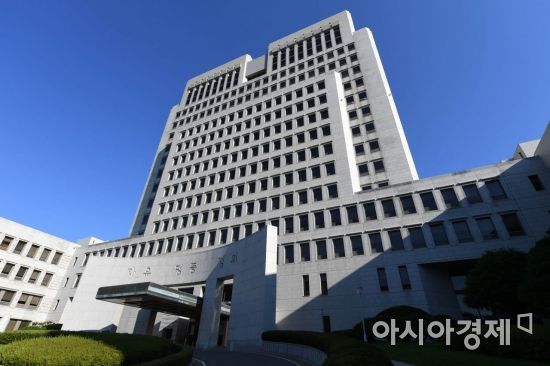
[Asia Economy Reporter Kim Daehyun] Korean Air has won the final victory in a lawsuit filed against the Fair Trade Commission regarding fines for 'preferential treatment of related parties.'
According to the legal community on the 23rd, the Supreme Court Division 2 (Presiding Justice Jo Jaeyeon) recently confirmed the lower court ruling in favor of Korean Air in the appeal trial of the cancellation lawsuit filed by Korean Air, Cybersky, and Uniconverse against the Fair Trade Commission's imposition of fines.
Previously, in November 2016, the Fair Trade Commission imposed a total fine of 1.43 billion KRW on these companies, including Korean Air, for providing unfair benefits to the controlling family through internal transactions within affiliates. Korean Air as a corporation and Cho Won-tae, chairman of Hanjin Group, were also reported to the prosecution.
This was the first case where the Fair Trade Commission imposed fines based on Article 23-2 of the Fair Trade Act, which prohibits providing unfair benefits to special related parties.
Cybersky is a Korean Air affiliate engaged in in-flight duty-free product sales. The children of the late Cho Yang-ho, former chairman of Hanjin Group, hold 100% of its shares.
Uniconverse is a company responsible for call center operations and network facility construction, and from 2007 for over ten years, Cho and his children held 70 to 100% of its shares.
The Fair Trade Commission judged that Korean Air mobilized employees to handle most of the in-flight duty-free internet advertising work or funneled advertising revenue to Cybersky, and guaranteed profits to Uniconverse by excessively paying system usage fees and maintenance costs.
The lawsuit against the Fair Trade Commission's disposition proceeded through a two-tier system (Seoul High Court and Supreme Court).
The Seoul High Court ruled in favor of Korean Air, stating that it was difficult to conclude unfair trade without a comparison target. It said that based on the submitted evidence alone, it could not be determined that the benefits attributed to Cybersky and Uniconverse were unfair.
The Supreme Court also agreed with this judgment. Regarding Article 23-2 of the Fair Trade Act, which was the basis for the disposition, it clarified the interpretation and application standards by stating, "Regardless of whether the act constitutes providing unfair benefits, a normative evaluation of whether the benefits attributed to special related parties through that act are 'unfair' must also be conducted."
The Supreme Court elaborated on 'unfairness,' stating, "It should be judged based on whether there is a concern that economic power concentration centered on special related parties of large business groups is maintained or intensified through irregular wealth transfers."
As specific judgment criteria, it also presented ▲the relationship between the act's subject, object, and special related parties ▲the purpose and intent of the act ▲the circumstances and economic situation of the act ▲the scale of the transaction ▲the scale of benefits attributed to special related parties ▲and the duration of the benefit-providing act.
© The Asia Business Daily(www.asiae.co.kr). All rights reserved.

![Clutching a Stolen Dior Bag, Saying "I Hate Being Poor but Real"... The Grotesque Con of a "Human Knockoff" [Slate]](https://cwcontent.asiae.co.kr/asiaresize/183/2026021902243444107_1771435474.jpg)















